
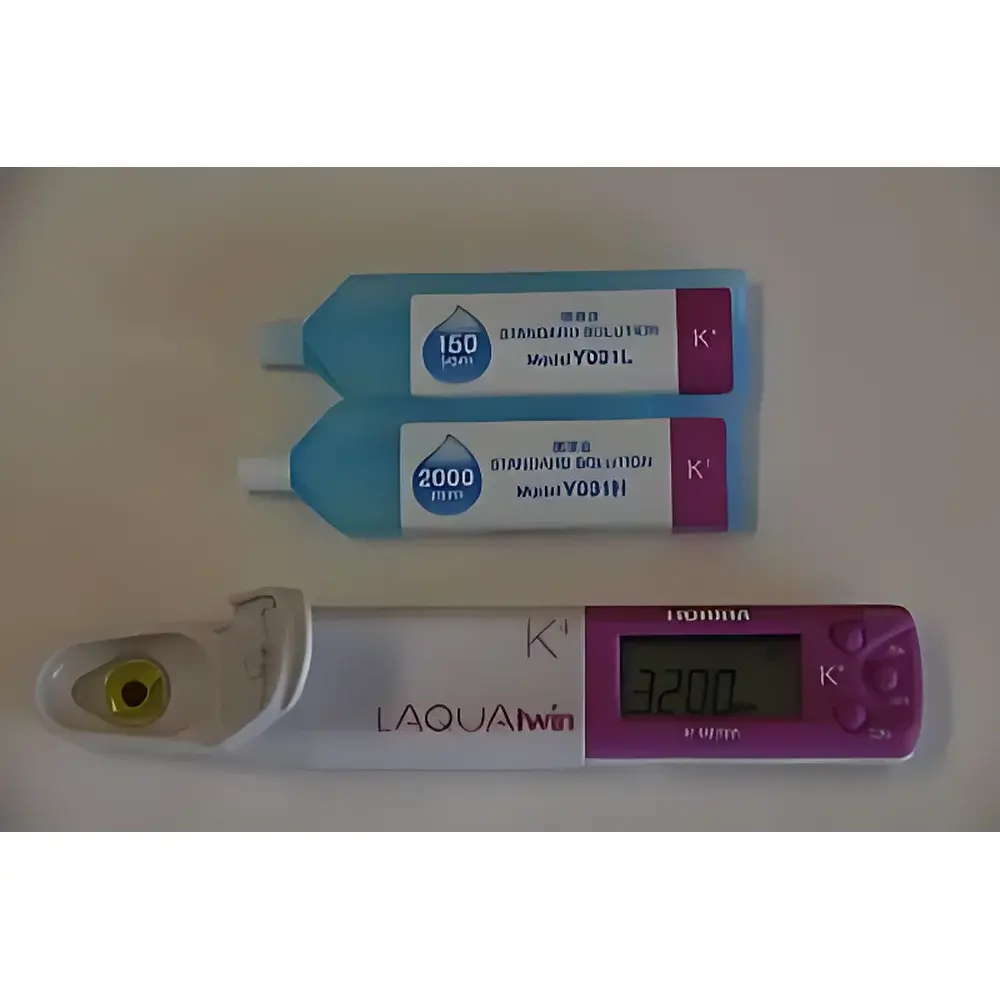
HORIBA B-731 Potassium Ion Meter
| Brand | HORIBA |
|---|---|
| Origin | Japan |
| Model | B-731 |
| Measurement Principle | Ion-Selective Electrode (ISE) Method |
| Measuring Range | 39–3900 ppm (mg/L) or 1.0 × 10⁻³ – 1.0 × 10⁻¹ mol/L K⁺ |
| Minimum Sample Volume | 0.05 mL × 2 or ≥0.3 mL |
| Calibration | Two-point calibration |
| Accuracy | ±10% of reading |
| Temperature Compensation | Automatic (NTC thermistor) |
| IP Rating | IP67 |
| Operating Environment | 5–40 °C, RH <85% (non-condensing) |
| Power Supply | Two CR2032 batteries |
| Dimensions (L×W×H) | 164 × 29 × 20 mm (excl. protrusions) |
| Weight | Approx. 50 g (instrument only) |
Overview
The HORIBA B-731 Potassium Ion Meter is a compact, handheld ion-selective electrode (ISE)-based analyzer engineered for rapid, on-site quantification of potassium ions (K⁺) in aqueous samples. Designed for field-deployable water quality assessment, it employs a solid-state, membrane-type potassium-selective electrode coupled with an integrated reference electrode and precision temperature sensor. The instrument operates on the Nernst equation principle, converting the electrochemical potential difference between the sample and internal reference into a stable, digitally processed concentration value. Its miniaturized architecture—measuring just 164 mm in length and weighing under 50 g—enables single-hand operation in constrained environments such as wastewater treatment outfalls, agricultural runoff sites, aquaculture tanks, and environmental monitoring stations. Unlike benchtop ISE systems requiring extensive sample preparation and buffering, the B-731 delivers direct-read results from minimal volumes (as low as 0.05 mL per measurement), significantly reducing reagent consumption and cross-contamination risk.
Key Features
- Ion-selective electrode (ISE) detection optimized specifically for K⁺ with high selectivity over Na⁺, Ca²⁺, and Mg²⁺ under typical environmental pH ranges (pH 4–10)
- Two-point calibration protocol using standardized KCl solutions (e.g., 100 ppm and 1000 ppm), supporting traceable accuracy per ISO 17025-aligned field procedures
- Automatic temperature compensation (ATC) via built-in NTC thermistor (25 °C reference), correcting for thermal drift across the full operating range (5–40 °C)
- IP67-rated enclosure ensures dust-tight integrity and submersion resistance up to 1 m for 30 minutes—validated per IEC 60529—making it suitable for rain-exposed or humid field deployments
- Auto-hold function freezes stable readings after signal stabilization (±0.5% variation over 3 s), eliminating operator timing bias during manual recording
- Low-power design powered by two replaceable CR2032 coin-cell batteries, delivering >2000 measurements per set under typical usage conditions
Sample Compatibility & Compliance
The B-731 is validated for use with natural waters (surface water, groundwater, seawater dilutions), treated effluents, nutrient solutions, and soil leachates. It exhibits robust performance in samples with total dissolved solids (TDS) up to 10,000 ppm and conductivity ≤10 mS/cm. While not intended for highly viscous or suspended-solids-laden matrices (>50 mg/L SS), optional filtration (0.45 µm membrane) prior to analysis maintains measurement fidelity. The device complies with general requirements for portable field instruments under ISO 5667-3 (water sampling—preservation and handling) and supports data integrity practices consistent with EPA Method 300.0 (determination of anions by ion chromatography) when used for screening-level K⁺ verification. Its calibration traceability aligns with manufacturer-certified standards traceable to NIST SRM 3192 (potassium chloride).
Software & Data Management
As a standalone field meter, the B-731 does not feature Bluetooth, USB, or cloud connectivity. All measurements are displayed in real time on a high-contrast LCD and retained in volatile memory until power-off. Users are expected to manually log results—including date, time, location, calibration status, and sample ID—in accordance with site-specific QA/QC protocols. For laboratories operating under GLP or GMP frameworks, the instrument’s simplicity supports audit-ready documentation when paired with controlled calibration logs and maintenance records. Though lacking FDA 21 CFR Part 11-compliant electronic signatures, its deterministic analog-to-digital conversion path and fixed firmware ensure reproducible output without software-mediated variability.
Applications
- Environmental field surveys: Monitoring potassium leaching from agricultural fields, forest soils, or landfill leachate plumes
- Aquaculture management: Tracking K⁺ fluctuations in recirculating aquaculture systems (RAS) where imbalance affects osmoregulation in finfish and crustaceans
- Drinking water compliance checks: Rapid verification of potassium levels post-treatment, particularly following softening or reverse osmosis processes
- Educational field labs: Undergraduate hydrochemistry exercises requiring portable, intuitive ISE instrumentation with minimal training overhead
- Industrial process water screening: Spot-checking boiler feedwater or cooling tower make-up for K⁺ accumulation indicative of corrosion inhibitor degradation
FAQ
What sample volume is required for reliable measurement?
A minimum of 0.05 mL per electrode immersion is specified; however, optimal reproducibility is achieved using ≥0.3 mL in a clean, low-volume container to ensure full electrode tip coverage and minimize air-gap interference.
Can the B-731 measure potassium in seawater?
Direct measurement in undiluted seawater (≈380 ppm K⁺) falls within the 39–3900 ppm range, but high ionic strength may cause minor activity coefficient deviation; dilution to ≤1000 ppm K⁺ is recommended for improved accuracy.
How often should calibration be performed?
Calibration is required before each measurement session and repeated if ambient temperature shifts >5 °C or after exposure to extreme pH (11) or high-protein organic matrices.
Is electrode replacement supported in the field?
Yes—the potassium ISE module is user-replaceable using HORIBA’s genuine B-731-ISE-K cartridge (P/N: 610-731-001), with no tools required and full recalibration guidance included in the operator manual.
Does the device meet any regulatory testing standards?
While not certified to a specific regulatory method, its measurement principle and performance specifications conform to the technical basis of ASTM D6919-22 (Standard Test Method for Determination of Dissolved Alkali and Alkaline Earth Cations by Ion Chromatography), serving as a validated field screening tool.







