
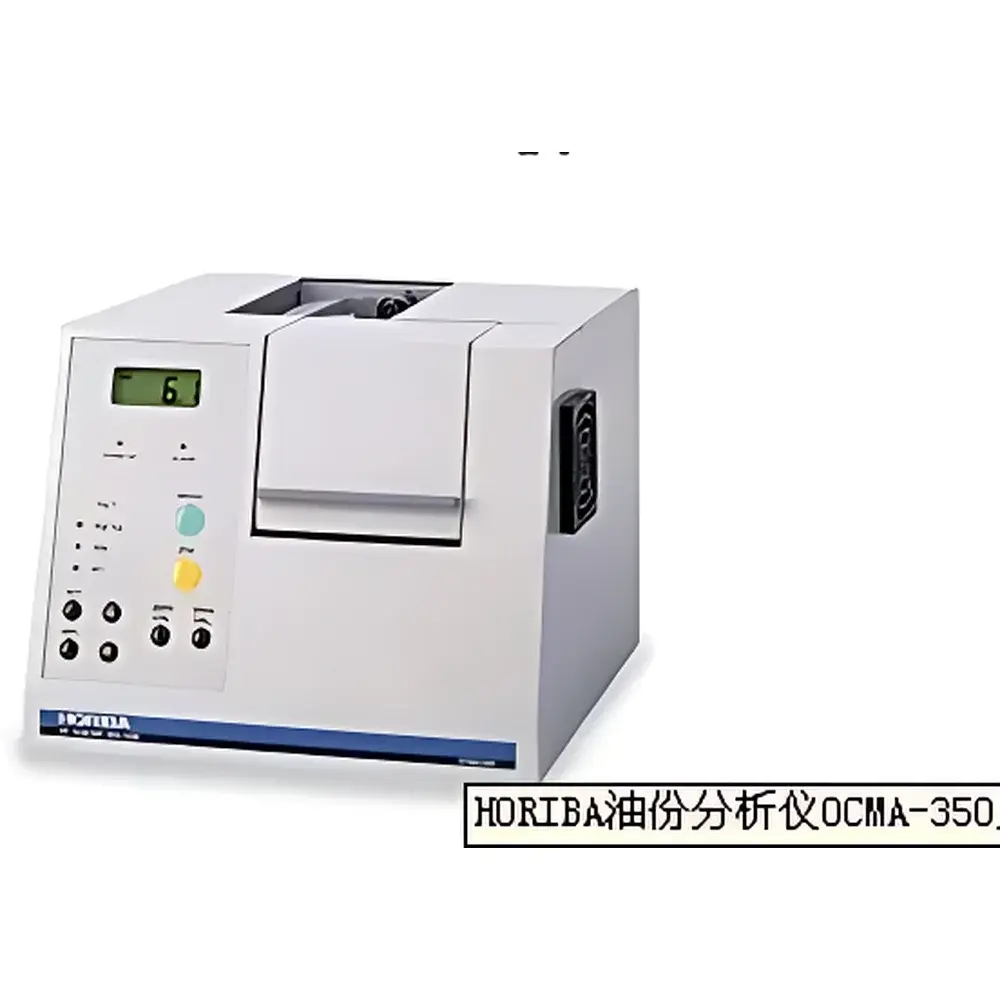
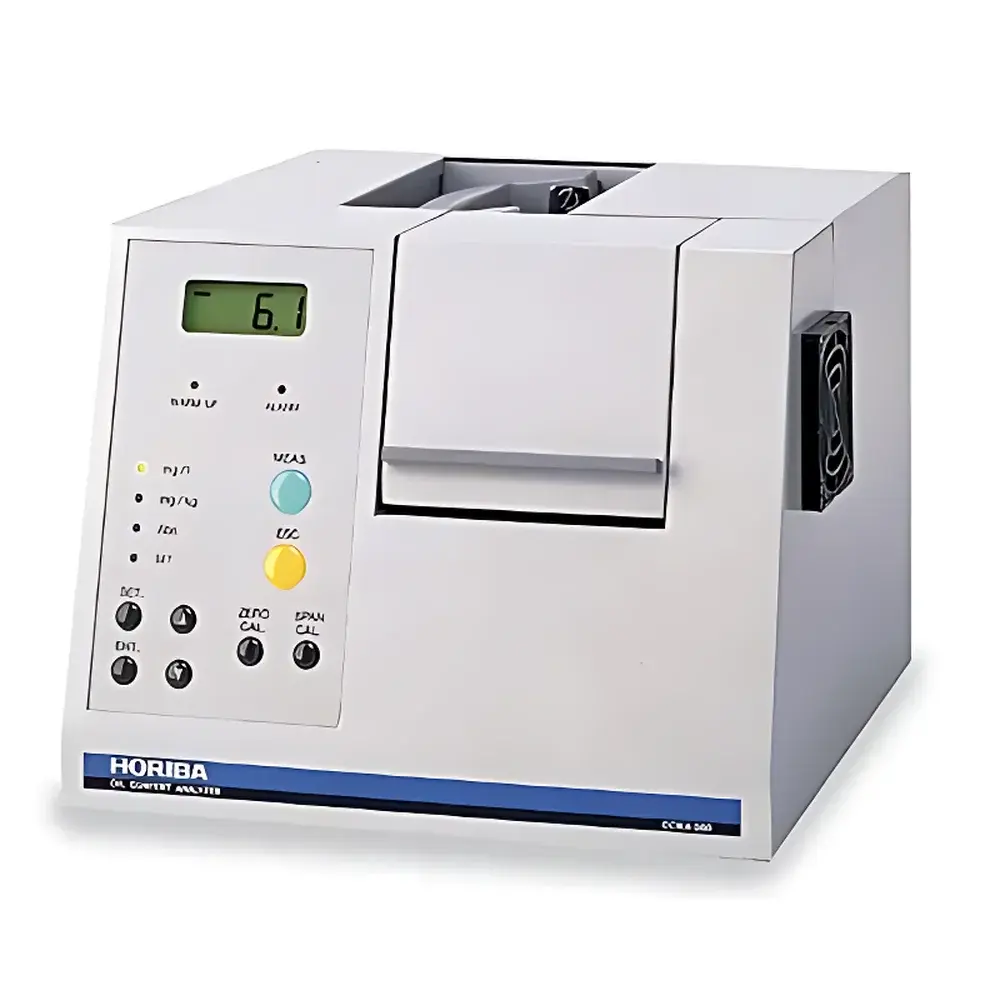
HORIBA OCMA-350/355 Oil Content Analyzer
| Brand | HORIBA |
|---|---|
| Origin | Japan |
| Model | OCMA-350/355 |
| Detection Method | Non-Dispersive Infrared (NDIR) Absorption |
| Extractant | S-316 (OCMA-350) / H-997 (OCMA-355) |
| Measurement Range | 0–200 mg/L, 0–1000 mg/kg, 0–1 Abs |
| Repeatability | ±0.4 mg/L (0–9.9 mg/L), ±2.0 mg/L (10.0–99.9 mg/L), ±4 mg/L (100–200 mg/L), ±1% F.S. (0–1 Abs) |
| Sensitivity | 1% of full-scale lower limit |
| Detector Type | Thermoelectric sensor |
| Display | Backlit LCD with timestamping |
| Interface | RS-232C serial port, parallel printer port |
| Power Supply | 230 V AC, 50 Hz |
| Dimensions | 250 × 200 × 285 mm (W × H × D) |
| Sample Cell | 200 mm pathlength quartz cuvette |
| Minimum Detectable Concentration | 0.1 ppm |
Overview
The HORIBA OCMA-350 and OCMA-355 are benchtop oil content analyzers engineered for high-precision quantification of hydrocarbon contamination in aqueous, solid, and surface-bound matrices. Both models operate on the principle of non-dispersive infrared (NDIR) absorption spectroscopy—specifically targeting the C–H stretching vibration band near 3.4 µm (2940 cm⁻¹), a region where aliphatic hydrocarbons exhibit strong, characteristic absorbance. Unlike broad-spectrum UV-Vis methods, NDIR ensures selectivity for petroleum-based oils while minimizing interference from humic substances, surfactants, or suspended solids. The OCMA-350 employs S-316 (1,1,2-trichloro-1,2,2-trifluoroethane) as the extraction solvent, whereas the OCMA-355 uses H-997 (a proprietary chlorinated hydrocarbon blend), both chosen for their spectral transparency at the measurement wavelength and efficient oil solubilization. This solvent-based liquid-liquid extraction protocol complies with established regulatory frameworks for hydrocarbon analysis—including ASTM D7066 (Standard Test Method for Determination of Oil and Grease in Water by Infrared Spectrophotometry) and ISO 9377-2:2000 (Water quality — Determination of hydrocarbon oil index — Part 2: Infrared spectrometric method). The instrument delivers trace-level sensitivity down to 0.1 ppm (µg/L) and supports three reporting units—mg/L (for water extracts), mg/kg (for soil/sediment extracts), and absorbance (Abs)—enabling direct alignment with site-specific regulatory thresholds.
Key Features
- Thermoelectric infrared detector optimized for stability and low drift over extended operation cycles
- 200 mm pathlength quartz flow cell enabling high optical sensitivity and compatibility with low-concentration samples
- Backlit LCD display with integrated real-time timestamping for GLP-compliant result documentation
- Single-button measurement workflow following solvent extraction—no manual calibration required between analyses
- Auto-zero function with built-in reference baseline initialization prior to each measurement sequence
- Dual communication interfaces: RS-232C serial port for integration into LIMS environments and parallel printer port for hard-copy audit trails
- Compact footprint (250 × 200 × 285 mm) suitable for field laboratories, wastewater treatment control rooms, and semiconductor cleanroom QC benches
Sample Compatibility & Compliance
The OCMA-350/355 accommodates diverse sample types after standardized solvent extraction. It is routinely deployed for monitoring effluent from metalworking operations, post-rinse validation in precision machining lines, residual oil assessment on silicon wafers and optical components, and leachate screening at hazardous waste landfills. Soil and sediment samples are homogenized, spiked with internal standard if required, and extracted per EPA Method 1664B (n-Hexane Extractable Material, HEM) or equivalent protocols. Aqueous samples—including oily wastewater, cooling tower blowdown, and membrane filtrates—are subjected to liquid-liquid extraction using S-316 or H-997 under controlled pH and salinity conditions. The system meets essential requirements for regulated environments: data integrity is preserved through timestamped records; operator actions are traceable via manual log entries; and the absence of moving optical parts enhances long-term reproducibility—critical for ISO/IEC 17025-accredited testing laboratories. While not inherently 21 CFR Part 11 compliant, the RS-232 output supports third-party electronic record systems validated for GMP/GLP workflows.
Software & Data Management
The OCMA-350/355 operates as a standalone analytical endpoint without embedded software. All data acquisition and storage occur externally via connected PCs or printers. Raw absorbance values, concentration results, unit selection, and timestamps are transmitted in ASCII format over RS-232 at 9600 baud. This architecture allows seamless ingestion into laboratory information management systems (LIMS), statistical process control (SPC) platforms, or custom Python/Matlab scripts for trend analysis, outlier detection, and compliance reporting. Users may configure automated CSV logging, generate PDF reports with embedded metadata (operator ID, sample ID, extraction date), and implement audit-trail-enabling middleware. Optional solvent recovery hardware (e.g., SR-305 regeneration column) extends reagent lifecycle but does not interface digitally with the analyzer—its use is tracked manually per batch log.
Applications
- Validation of aqueous cleaning efficacy in semiconductor front-end fabrication and MEMS device manufacturing
- Regulatory compliance testing of industrial discharge per EU WFD (Water Framework Directive) and US Clean Water Act limits
- Residual hydrocarbon verification on machined aluminum, stainless steel, and titanium components prior to plating or coating
- On-site screening of groundwater contamination at brownfield redevelopment sites
- Quality assurance of recycled solvents used in vapor degreasing processes
- Quantitative assessment of oil carryover in ultrapure water (UPW) distribution loops serving photolithography tools
FAQ
What extraction solvents are compatible with the OCMA-350 and OCMA-355?
The OCMA-350 requires S-316 (1,1,2-trichloro-1,2,2-trifluoroethane); the OCMA-355 is calibrated for H-997. Substitution is not recommended due to spectral interference and calibration mismatch.
Can the instrument measure emulsified or dissolved oil fractions directly?
No. The method requires prior liquid-liquid extraction to isolate hydrophobic oil phases. Emulsions must be broken using acidification, centrifugation, or demulsifiers before extraction.
Is the 200 mm cuvette included with the base configuration?
Yes—a sealed, matched-pair quartz cuvette with integrated cap is supplied as standard equipment.
Does the analyzer support multi-point calibration curves?
No. It performs single-point zero-reference measurement only. Linearity across range is factory-verified per ISO 8466-1; users must validate linearity independently if operating outside specified ranges.
What maintenance is required for long-term accuracy?
Annual verification of detector response using certified oil standards (e.g., NIST SRM 2781) and periodic cleaning of the cuvette compartment with lint-free wipes and isopropanol are recommended.
Related Products







