
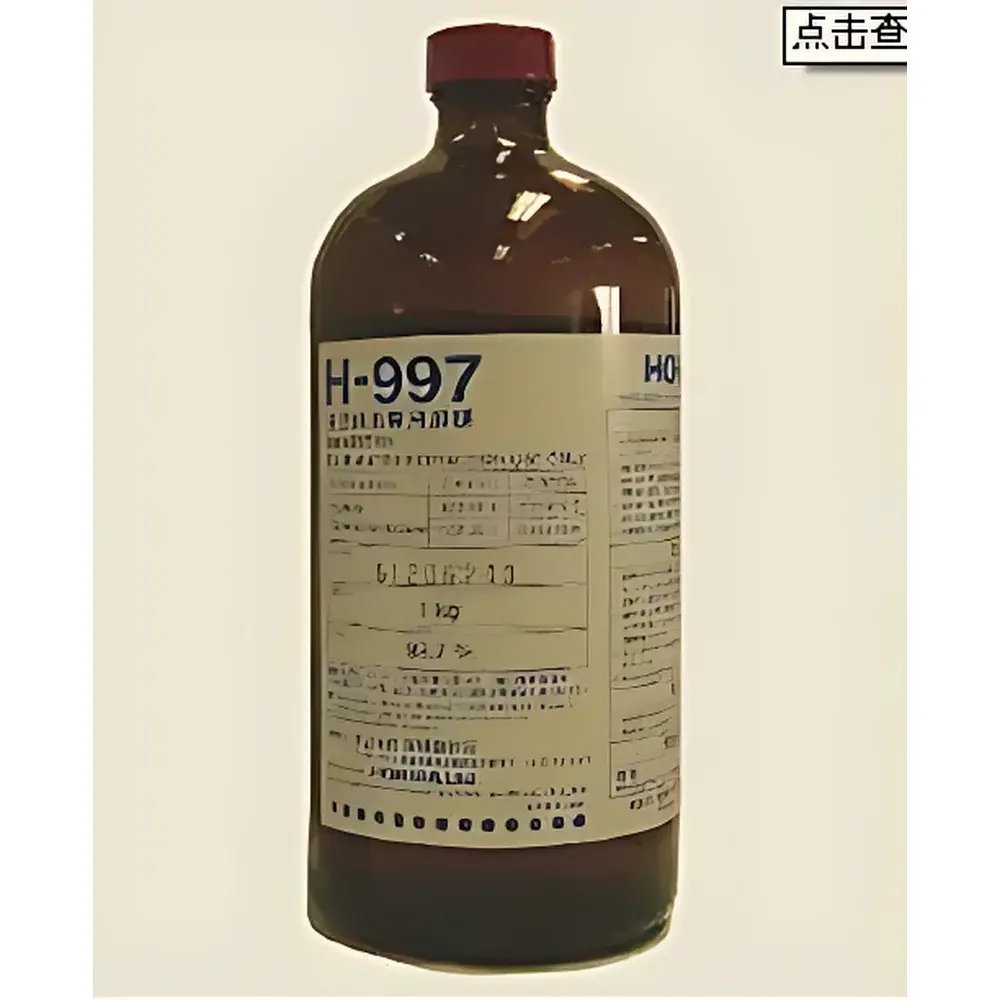
HORIBA H-997 Extraction Reagent for OCMA-305/315/355 Oil Content Analyzers
| Brand | HORIBA |
|---|---|
| Origin | Japan |
| Model | 3200044462 |
| Application | Dedicated extraction reagent for OCMA-series oil analyzers |
| Compatibility | Designed for use with SR-305 solvent recovery system |
| Regulatory Context | Compliant with ISO 9377-2 (petroleum hydrocarbons in water) and EPA Method 1664A (n-hexane extractable material) |
Overview
The HORIBA H-997 Extraction Reagent is a high-purity, non-halogenated organic solvent formulation engineered specifically for quantitative oil-in-water, oil-on-surface, and soil hydrocarbon extraction in compliance with standardized environmental testing protocols. Unlike generic solvents, H-997 is chemically optimized to maximize extraction efficiency for aliphatic and aromatic hydrocarbons—including mineral oils, lubricants, diesel, and crude oil fractions—while minimizing co-extraction of polar interferences such as humic substances or surfactants. Its spectral characteristics are precisely matched to the non-dispersive infrared (NDIR) detection optics of HORIBA OCMA-305, OCMA-315, and OCMA-355 oil content analyzers, ensuring minimal baseline drift and high photometric linearity across the 2.9–3.5 µm C–H stretching absorption band. The reagent operates within the fundamental measurement principle of infrared absorbance quantification: after phase separation, the extracted H-997 layer is introduced into the NDIR cell, where hydrocarbon concentration is calculated via Beer–Lambert law calibration against certified reference standards traceable to NIST SRM 2781.
Key Features
- Optimized spectral transparency: Low absorbance in the critical 2900–3500 cm⁻¹ IR window ensures maximal signal-to-noise ratio for hydrocarbon detection.
- Controlled volatility profile: Boiling point range (60–65 °C) supports efficient phase separation and compatibility with automated extraction modules without excessive evaporation loss.
- Recyclability-integrated chemistry: Formulated for stable performance over ≥5 cycles when processed through the HORIBA SR-305 solvent recovery unit, maintaining consistent extraction yield and IR response per ASTM D7066 validation guidelines.
- Low water miscibility (<0.1% v/v): Enables clean biphasic separation from aqueous matrices, reducing emulsion formation and improving repeatability in wastewater and leachate analysis.
- Non-halogenated composition: Meets EU REACH Annex XIV exclusion criteria and eliminates risks associated with chlorinated solvent disposal, supporting ISO 14001-compliant laboratory operations.
Sample Compatibility & Compliance
H-997 is validated for direct extraction of liquid, solid, and semi-solid matrices per internationally recognized methods. It is suitable for wastewater influent/effluent, cooling tower water, industrial process streams, sediment cores, and wiped surface samples (e.g., machinery parts, pipelines). The reagent enables full method alignment with ISO 9377-2:2000 (water quality — determination of hydrocarbons — part 2: method using gas chromatography), EPA Method 1664A (n-hexane extractable material), and JIS K 0102 (Japanese Industrial Standard for water analysis). All batch certifications include GC-FID residual impurity profiling and IR transmittance verification at 3.4 µm. Documentation supports GLP audit readiness, including lot-specific CoA, stability data (24-month shelf life unopened), and compatibility reports with OCMA instrument firmware versions ≥v3.2.
Software & Data Management
While H-997 itself is a consumable reagent, its usage is fully integrated into the HORIBA OCMA instrument control software (OCMA Control Suite v5.1+). The software logs reagent lot numbers, extraction cycle counts, and SR-305 recovery efficiency metrics (mass balance tracking) automatically during assay execution. Audit trails comply with FDA 21 CFR Part 11 requirements, including electronic signatures, time-stamped metadata, and immutable storage of calibration curves generated with H-997–based standard solutions. Exportable CSV and PDF reports include reagent consumption analytics per sample batch—enabling cost-per-analysis calculation and sustainability reporting aligned with corporate ESG frameworks.
Applications
- Regulatory wastewater discharge monitoring for petrochemical, automotive, and metalworking facilities.
- Leachate analysis from landfill and remediation sites under RCRA Subtitle D compliance.
- Verification of cleaning validation in pharmaceutical manufacturing equipment (USP analytical instrument qualification).
- Soil screening at brownfield redevelopment projects per ASTM D5369.
- Oil film thickness estimation on marine infrastructure via wipe sampling and gravimetric correlation.
FAQ
Is H-997 compatible with instruments other than HORIBA OCMA series?
No—H-997’s spectral and physical properties are calibrated exclusively for OCMA-305/315/355 optical path lengths and detector response curves. Use with non-HORIBA analyzers may result in inaccurate calibration or invalid regulatory reporting.
What is the recommended storage condition for unopened H-997?
Store at 15–25 °C in original amber HDPE container, protected from direct sunlight and ambient humidity. Do not refrigerate or freeze.
How many extraction cycles can be achieved using the SR-305 recovery system?
Validation data supports ≥5 reuse cycles while maintaining ≤±2% deviation in recovery yield relative to fresh reagent, provided SR-305 distillation parameters (vacuum level, condenser temperature) are maintained per HORIBA Technical Bulletin TB-OCMA-017.
Does H-997 require special waste handling after final disposal?
Spent H-997 must be managed as hazardous waste under local jurisdiction (e.g., US EPA D018 listing for spent nonhalogenated solvents); however, its non-chlorinated nature reduces incineration byproduct toxicity versus traditional CCl₄ or Freon-based alternatives.
Related Products







