
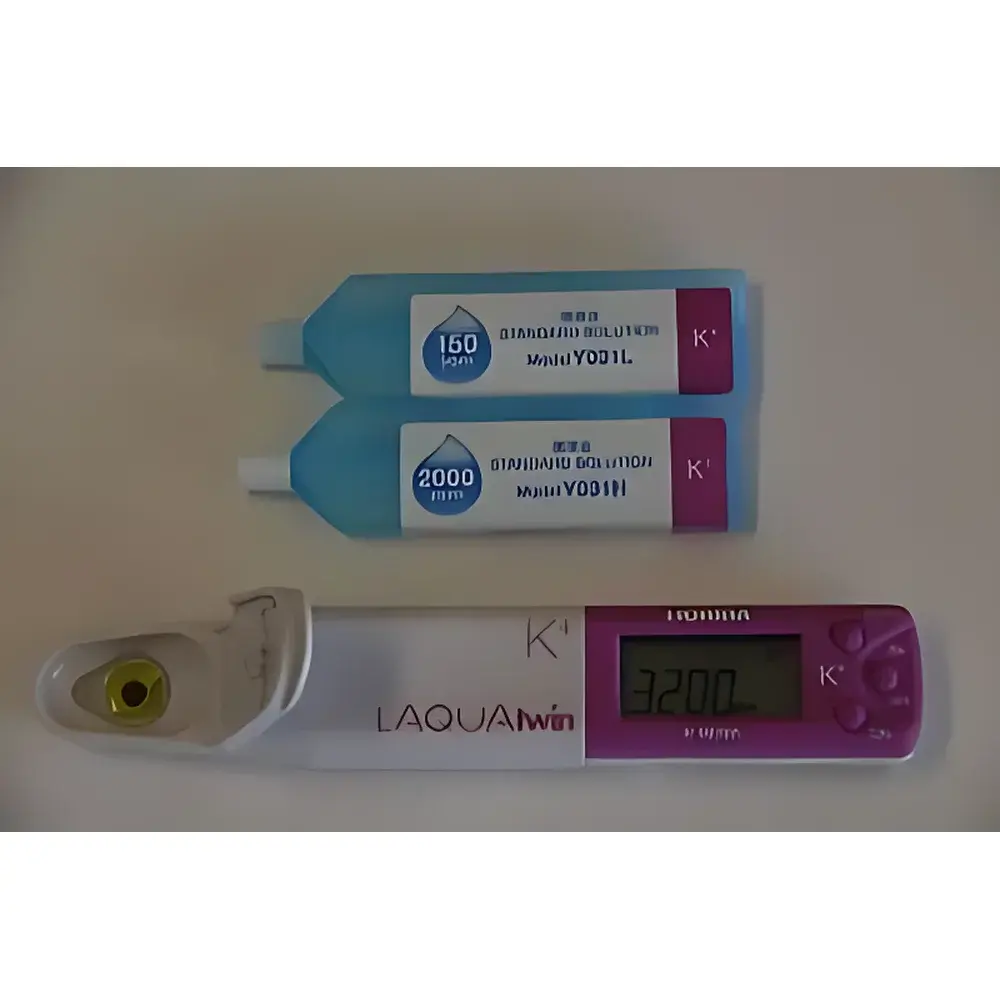
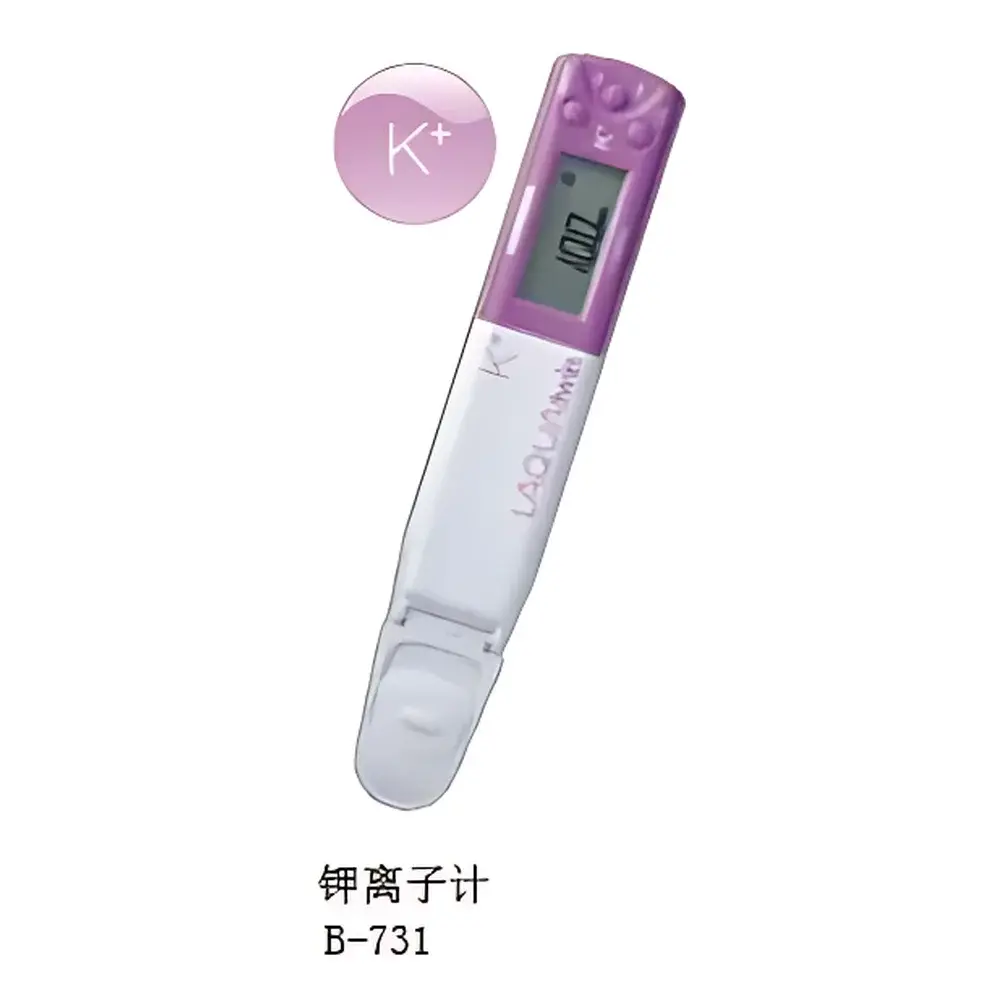
HORIBA B-731 Portable Potassium Ion Meter
| Brand | HORIBA |
|---|---|
| Origin | Japan |
| Model | B-731 |
| Measurement Principle | Solid-State Ion-Selective Electrode (ISE) Method |
| Detection Parameter | Single-Parameter (K⁺) |
| Portability | Pen-Type Design |
| Sample Volume Requirement | 0.05 mL (minimum, dual measurement) or ≥0.3 mL |
| Measurement Range | 39–3900 ppm (mg/L), equivalent to 1.0 × 10⁻³ – 1.0 × 10⁻¹ mol/L |
| Calibration | Two-Point Calibration |
| Accuracy | ±10% of reading |
| Temperature Compensation | Automatic (2%/°C fixed coefficient) |
| Resolution | 0.1 ppm (mg/L) |
| Temperature Measurement Range | 0–40 °C |
| Temperature Accuracy | ±0.5 °C |
| IP Rating | IP67 |
| Operating Environment | 5–40 °C, ≤85% RH (non-condensing) |
| Power Supply | Two CR2032 lithium coin cells |
| Dimensions | 164 × 29 × 20 mm (excluding probe protrusion) |
| Weight | Approx. 50 g (instrument only, excluding batteries) |
Overview
The HORIBA B-731 is a compact, pen-style potassium ion (K⁺) meter engineered for rapid, field-deployable ion concentration analysis in aqueous solutions. It operates on the solid-state ion-selective electrode (ISE) principle—utilizing a proprietary potassium-selective membrane that generates a Nernstian potential response proportional to the logarithm of K⁺ activity in solution. This electrochemical transduction enables direct, single-parameter quantification without requiring complex sample preparation or laboratory infrastructure. Designed for routine monitoring in environmental water assessment, hydroponics nutrient management, wastewater effluent screening, and agricultural soil leachate testing, the B-731 delivers reliable semi-quantitative data where portability, speed, and ruggedness are critical. Its miniaturized architecture conforms to ISO 15197:2013 principles for portable electrochemical analyzers and aligns with ASTM D1129 and ISO 10523 for field-compatible ion measurement practices.
Key Features
- Pen-type ergonomic form factor optimized for one-handed operation and pocket-portability—ideal for spot-checking in greenhouses, irrigation channels, or mobile environmental labs.
- Integrated solid-state potassium-selective electrode with stable membrane chemistry, minimizing drift and enabling repeatable measurements across multiple field deployments.
- Automatic temperature compensation (ATC) using a built-in thermistor (2%/°C fixed coefficient), ensuring consistent readings across the operational range of 5–40 °C.
- IP67-rated enclosure provides full protection against dust ingress and immersion in water up to 1 m for 30 minutes—validated per IEC 60529, supporting use in humid, outdoor, or splash-prone environments.
- Auto-hold function freezes the stabilized reading upon signal convergence, eliminating manual timing errors during handheld measurement.
- Two-point calibration protocol (using standard K⁺ solutions at 100 ppm and 1000 ppm recommended) supports traceable accuracy verification and maintains compliance with GLP documentation requirements for field instruments.
- Low-power design powered by two replaceable CR2032 lithium batteries, delivering >2000 measurements per set under typical usage conditions.
Sample Compatibility & Compliance
The B-731 is validated for use with clear, low-turbidity aqueous samples—including freshwater, nutrient solutions, diluted wastewater effluents, and soil extracts—provided total suspended solids (TSS) remain below 50 mg/L and pH falls within 2.0–10.0. It is not intended for highly viscous, protein-rich, or strongly chelating matrices (e.g., seawater with high Ca²⁺/Mg²⁺ interference or EDTA-containing buffers) without prior validation. The instrument meets CE marking requirements under the EU Electromagnetic Compatibility Directive (2014/30/EU) and RoHS 2011/65/EU. While not FDA 21 CFR Part 11 compliant due to its standalone, non-networked architecture, it supports audit-ready calibration logs when paired with HORIBA’s optional PC-based data capture utility (sold separately). All performance specifications adhere to ISO/IEC 17025 general requirements for field instrumentation used in accredited testing laboratories.
Software & Data Management
As a dedicated handheld instrument, the B-731 does not feature onboard data logging or Bluetooth/Wi-Fi connectivity. However, it supports manual transcription of results into LIMS or Excel via standardized output format (K⁺ concentration in ppm or mol/L, temperature in °C, and timestamp inferred from user annotation). For regulated environments, HORIBA recommends pairing the B-731 with its optional B-700 Series Calibration & Reporting Kit (B-700-CRK), which includes traceable K⁺ standard solutions, certified reference materials (CRM), and GLP-compliant calibration record templates aligned with ISO/IEC 17025 clause 7.7. Firmware updates are not applicable; hardware revision control is maintained through serial-number-tracked manufacturing batches compliant with JIS Z 8401.
Applications
- Hydroponic nutrient solution monitoring—tracking K⁺ depletion between feedings to optimize dosing schedules.
- River, lake, and reservoir water quality screening—assessing potassium as an indicator of agricultural runoff or wastewater discharge.
- Soil extract analysis (1:5 water extraction method)—estimating plant-available K⁺ in agronomic testing workflows.
- Educational laboratory instruction—demonstrating ion-selective electrode theory, Nernst equation application, and calibration best practices.
- Pre-screening prior to lab-based ICP-OES or flame photometry—triaging samples to reduce analytical cost and turnaround time.
FAQ
What sample volume is required for accurate measurement?
A minimum of 0.05 mL is sufficient for dual-point verification; however, ≥0.3 mL is recommended to ensure stable electrode immersion and minimize surface tension effects.
Can the B-731 measure potassium in seawater or brackish water?
No—high ionic strength and competing ions (e.g., Na⁺, Ca²⁺, Mg²⁺) cause significant interference; use only in low-salinity matrices (<1,000 µS/cm conductivity) unless validated per ASTM D511 Annex A4.
Is calibration required before each use?
Two-point calibration is recommended daily when used in regulated settings; for routine field screening, calibration every 8–12 hours or after exposure to extreme temperature shifts is sufficient.
Does the instrument store calibration data internally?
No—the B-731 lacks non-volatile memory; users must manually record calibration dates, standards used, and slope/mV offset values per GLP practice.
How often should the electrode be cleaned or conditioned?
Rinse with deionized water after each measurement; soak in 0.1 M KCl solution for 30 minutes weekly if used daily, or before first use after storage exceeding 72 hours.






