
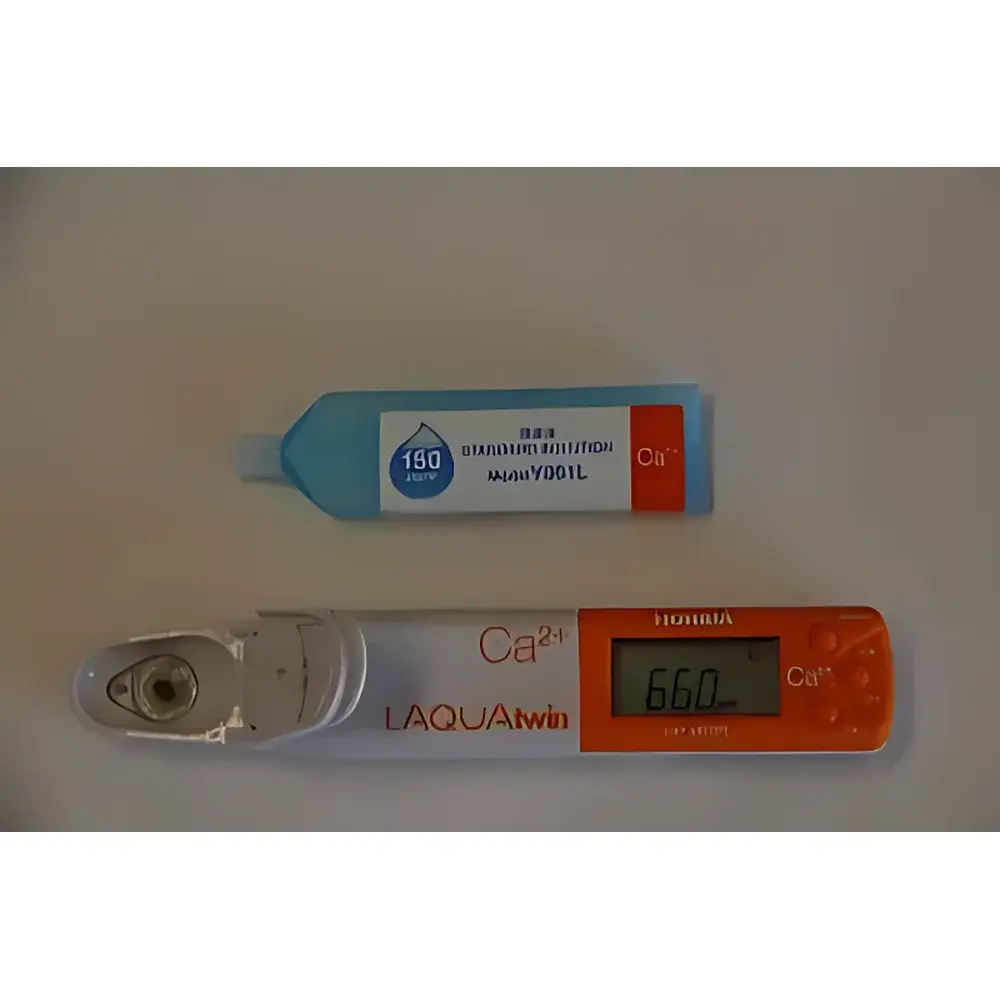
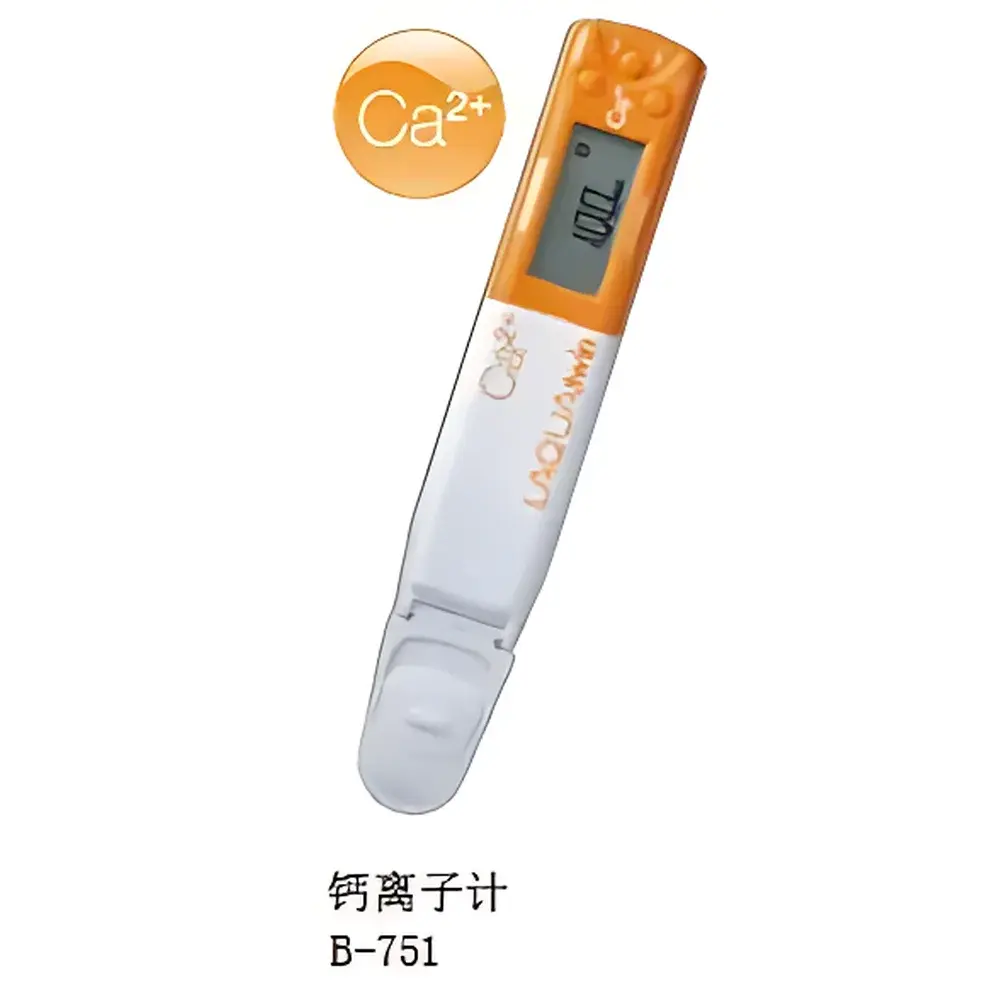
HORIBA B-751 Portable Calcium Ion Meter
| Brand | HORIBA |
|---|---|
| Origin | Japan |
| Model | B-751 |
| Measurement Principle | Ion-Selective Electrode (ISE) Method |
| Measuring Range | 40–4000 ppm (mg/L) [1.0 × 10⁻³ – 1.0 × 10⁻¹ mol/L Ca²⁺] |
| Minimum Sample Volume | 0.05 mL × 2 or ≥0.3 mL |
| Calibration | Two-Point Calibration |
| Accuracy | ±20% of reading |
| Temperature Compensation | Automatic (2%/°C fixed coefficient) |
| Auto-Hold Function | Yes |
| Ingress Protection Rating | IP67 |
| Operating Environment | 5–40 °C, <85% RH (non-condensing) |
| Power Supply | Two CR2032 batteries |
| Dimensions (L×W×H) | 164 × 29 × 20 mm (excl. protrusions) |
| Weight | Approx. 50 g (instrument only, excl. batteries) |
Overview
The HORIBA B-751 is a compact, handheld calcium ion meter engineered for rapid, on-site quantification of free Ca²⁺ concentration in aqueous samples using solid-state ion-selective electrode (ISE) technology. Designed around a potentiometric measurement principle, the instrument detects the electrochemical potential difference generated across a calcium-specific membrane—typically a PVC-based polymer matrix doped with a calcium ionophore—relative to a built-in reference electrode. This voltage signal, governed by the Nernst equation, is converted into a calibrated concentration value (ppm or mol/L) after temperature compensation and two-point calibration. Unlike laboratory-grade benchtop ISE analyzers, the B-751 prioritizes field deployability without compromising fundamental electrochemical integrity: its miniature form factor (164 mm × 29 mm × 20 mm), IP67-rated enclosure, and low sample volume requirement (as little as 0.05 mL per measurement) make it suitable for spot-checking in wastewater treatment plants, aquaculture facilities, irrigation reservoirs, boiler feedwater systems, and environmental monitoring stations where portability and ruggedness are critical.
Key Features
- Ion-selective electrode (ISE) sensor optimized for Ca²⁺ detection in complex matrices, including moderately turbid or low-conductivity waters
- Two-point calibration protocol supporting standard solutions traceable to NIST-certified reference materials (e.g., 100 ppm and 1000 ppm Ca²⁺ standards)
- Integrated automatic temperature compensation (ATC) with fixed 2%/°C coefficient—aligned with common ISE response characteristics for alkaline earth metals
- Auto-hold function freezes stable readings for reliable data capture under variable field conditions
- IP67-rated housing ensures full protection against dust ingress and immersion in water up to 1 m for 30 minutes—validated per IEC 60529
- Low-power operation via two replaceable CR2032 coin-cell batteries, delivering >5000 measurements per set under typical usage
- Compact ergonomic design (≈50 g net weight) enables one-handed operation and storage in standard lab coat pockets or field kits
Sample Compatibility & Compliance
The B-751 is validated for use with natural waters (surface water, groundwater), treated effluents, nutrient solutions, and industrial process streams exhibiting pH 4–10 and conductivity ≥50 µS/cm. Samples containing high concentrations of interfering ions—such as Mg²⁺ (>500 ppm), K⁺ (>2000 ppm), or NH₄⁺ (>1000 ppm)—may require matrix-matched calibration or dilution to minimize cross-sensitivity. While not certified for regulatory reporting under EPA Method 300.0 or ISO 10523, the device supports GLP-aligned field screening workflows when used with documented calibration logs, environmental condition records, and operator training verification. Its measurement range (40–4000 ppm Ca²⁺) covers key thresholds relevant to hardness classification (e.g., WHO guidelines), scaling potential assessment (Langelier Saturation Index inputs), and biological availability estimation in aquatic ecosystems.
Software & Data Management
The B-751 operates as a standalone instrument with no embedded memory or Bluetooth connectivity; all measurements are displayed in real time on a high-contrast LCD screen and must be manually recorded. This architecture eliminates firmware update dependencies and cybersecurity vulnerabilities associated with wireless transmission—advantageous in secure industrial or government-controlled environments. For traceability, users are advised to maintain external logbooks or digital spreadsheets that capture date/time, calibration history (standard values, mV offsets), ambient temperature/humidity, sample ID, and operator initials. When integrated into larger QA/QC frameworks, the B-751’s consistent ±20% accuracy (per manufacturer specification) serves as a Tier-2 verification tool alongside primary methods such as atomic absorption spectroscopy (AAS) or ICP-OES—particularly during routine checks between formal laboratory analyses.
Applications
- Rapid assessment of calcium hardness in municipal drinking water distribution networks and desalination plant permeate lines
- Monitoring Ca²⁺ depletion or accumulation in recirculating aquaculture systems (RAS) to optimize shell formation in crustaceans and mollusks
- Field validation of lime dosing efficacy in acid mine drainage (AMD) neutralization processes
- Pre-screening of boiler feedwater and cooling tower make-up water to prevent scale formation in HVAC infrastructure
- Educational demonstrations of ion-selective sensing principles in undergraduate analytical chemistry laboratories
- Environmental baseline surveys for karst aquifer characterization and soil leaching studies
FAQ
What sample preparation is required before measurement?
No filtration or acidification is needed for clear, low-turbidity samples. For suspended solids or organic-rich waters, centrifugation or 0.45-µm membrane filtration is recommended to prevent sensor fouling.
Can the B-751 measure total calcium or only free Ca²⁺?
It measures only the thermodynamically active (free hydrated) Ca²⁺ fraction—not total calcium bound in complexes or precipitates—making it ideal for bioavailability and saturation index calculations.
Is the electrode replaceable or serviceable?
The Ca²⁺-selective sensor is integrated and non-user-replaceable; HORIBA recommends annual performance verification and end-of-life replacement per instrument serial number tracking.
Does the device comply with FDA 21 CFR Part 11 or ISO/IEC 17025?
No—it lacks electronic audit trails, user access controls, or certified uncertainty statements required for regulated GxP environments; it is intended for non-GMP field screening only.
How often should calibration be performed?
Calibrate before each measurement session and re-calibrate if ambient temperature shifts >5 °C or after measuring >10 samples in heterogeneous matrices.
Related Products







