
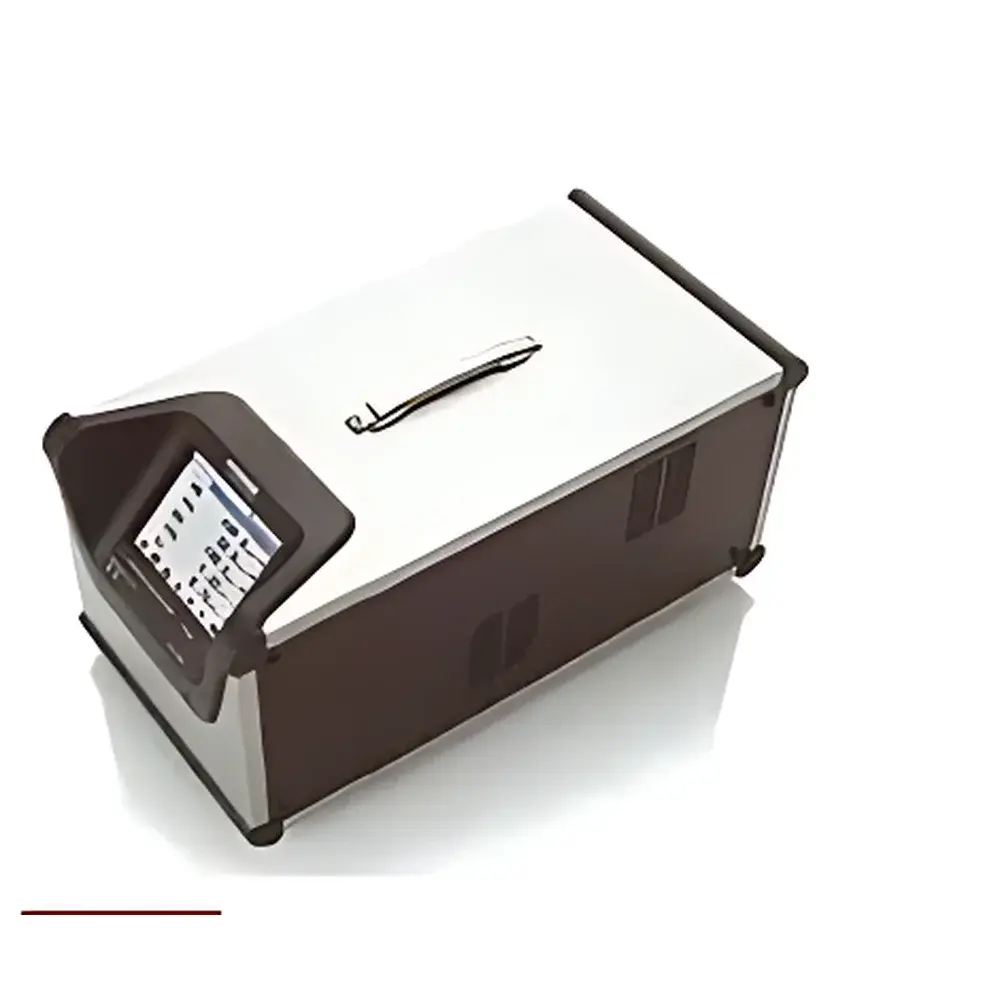
HORIBA PG-350 Portable Multi-Gas Emission Analyzer
| Brand | HORIBA |
|---|---|
| Origin | Japan |
| Model | PG-350 Series |
| Instrument Type | Portable |
| Measured Gases | NOₓ, SO₂, CO, CO₂, O₂ |
| Measurement Principles | Pulsed Chemiluminescence (NOₓ), Modulated NDIR (SO₂, CO, CH₄), Broadband NDIR (CO₂), Galvanic Cell (O₂) |
| Range Options | 0–5/10/25 vol% (O₂, CO₂) |
| Repeatability | ±1.0% FS |
| Drift | ±1.0% FS/day (SO₂: ±2.0% FS/day) |
| Linearity | ±2.0% FS |
| T₉₀ Response Time | ≤45 s (all gases except SO₂) |
| Sample Flow Rate | ~0.5 L/min |
| Warm-up Time | 30 min |
| Operating Environment | 5–40 °C, ≤85% RH |
| Dimensions | 226 × 265 × 510 mm (W×H×D) |
| Weight | ~14 kg |
| Data Storage | SD card (user-configurable interval) |
| Outputs | 4–20 mA analog, Ethernet |
| Certifications | TÜV (EU), MCERTS (UK), GOST-R (Russia), ETV (USA), CNAS/CMA (China), KOLAS (Korea), JIS (Japan) |
Overview
The HORIBA PG-350 Portable Multi-Gas Emission Analyzer is an engineered field-deployable instrument designed for high-fidelity, real-time quantification of up to five critical flue gas and ambient emission components—NOₓ, SO₂, CO, CO₂, and O₂—in compliance with international regulatory measurement protocols. Built upon HORIBA’s proprietary pulsed chemiluminescence detection for nitrogen oxides and modulated non-dispersive infrared (NDIR) spectroscopy for sulfur dioxide, carbon monoxide, and methane—complemented by broadband NDIR for CO₂ and galvanic electrochemical sensing for oxygen—the PG-350 delivers laboratory-grade accuracy under variable environmental conditions. Its core architecture eliminates optical cross-sensitivity through flow-modulation and spectral bandpass isolation, enabling stable baseline performance across dynamic stack environments. The analyzer operates at atmospheric pressure without vacuum pumping or cryogenic cooling, reducing power demand and mechanical complexity while maintaining trace-level sensitivity and long-term stability.
Key Features
- Modular multi-principle detection platform: Pulsed chemiluminescence (NOₓ), modulated NDIR (SO₂, CO, CH₄), broadband NDIR (CO₂), and galvanic cell (O₂) ensure orthogonal selectivity and minimal interferences.
- Integrated electronic condensate management system with automatic and manual drainage modes, supporting continuous operation in high-humidity sampling streams.
- Touch-enabled color LCD interface with real-time trend visualization, on-screen operational guidance, and context-aware alarm logging.
- Full-system calibration capability—including sample probe, heated line, and analyzer module—traceable to NIST-certified reference gases and aligned with ISO 12039, EN 14181, and EPA Method 7E requirements.
- Embedded SD card data logger with configurable sampling intervals; supports timestamped capture of raw sensor outputs, diagnostic flags, and calibration events.
- Power-flexible AC input (100–120 V / 200–240 V, 50/60 Hz); low thermal mass design achieves functional readiness within 30 minutes.
- Ruggedized chassis rated for transport vibration (IEC 60068-2-64) and impact resistance (IEC 60068-2-27), optimized for repeated field deployment without recalibration drift.
Sample Compatibility & Compliance
The PG-350 accepts conditioned extractive gas samples at nominal flow rates of 0.5 L/min, compatible with standard heated sampling lines (up to 180 °C) and particulate filtration per ISO 12039 Annex B. It meets the performance criteria of multiple international certification frameworks: TÜV-certified per EN 15267-3 (QAL1), UK MCERTS System Certification (Tier 2), Russian GOST R IEC 61508-1, US EPA ETV Protocol for Continuous Emission Monitoring Systems (CEMS), China’s JJG 968–2019 verification regulation, Korea’s KOLAS ILAC-G13-compliant validation, and Japan’s JIS B 7982. All measurement algorithms incorporate built-in zero/span drift compensation, auto-diagnostic flagging, and audit-trail metadata generation—fully supporting GLP/GMP-aligned data integrity workflows and 21 CFR Part 11-compliant electronic record retention when paired with HORIBA’s optional data management software.
Software & Data Management
Data acquisition, visualization, and reporting are managed via embedded firmware with dual-output capability: isolated 4–20 mA analog channels (per gas component) and IEEE 802.3-compliant Ethernet interface supporting Modbus TCP and HTTP-based RESTful API access. Raw sensor values, calibration timestamps, fault codes, and environmental telemetry (internal temperature/humidity) are logged to removable SD cards with FAT32 formatting and CRC-32 error checking. Optional HORIBA EmissionLink™ software enables remote configuration, historical trend overlay, automated report generation (PDF/CSV), and integration into SCADA or DCS architectures. All stored records include cryptographic hash signatures for data authenticity verification—critical for regulatory submission and third-party audit preparedness.
Applications
The PG-350 serves as a primary or backup CEMS verification tool in thermal power plants, cement kilns, and waste incinerators; supports catalyst efficiency testing in R&D laboratories; enables mobile combustion diagnostics for boiler tuning and engine emissions mapping; facilitates teaching and method validation in university environmental engineering programs; and provides field-validated benchmarking for fuel cell exhaust characterization and biogas composition analysis. Its CH₄-capable variant (PG-350-M) extends applicability to landfill gas monitoring, anaerobic digester optimization, and fugitive methane leak surveys—fully compliant with ISO 13864 and ASTM D6522 methodologies.
FAQ
What gas components does the PG-350 measure by default?
The standard PG-350 measures NOₓ, SO₂, CO, CO₂, and O₂ simultaneously. Methane (CH₄) detection is available as an optional configuration.
Does the PG-350 require external calibration gas cylinders during routine operation?
Yes—zero and span calibration must be performed using certified reference gases traceable to national standards; however, the instrument supports automated zero-check cycles and stores full calibration history with operator ID and timestamp.
Can the PG-350 operate unattended for extended periods?
It supports scheduled power-on/off and sleep mode, but continuous unattended operation beyond 24 hours requires external environmental conditioning (e.g., climate-controlled enclosure) and periodic condensate drain verification.
Is the PG-350 suitable for measuring wet stack gases?
Yes—its integrated thermoelectric cooler and programmable condensate ejection system maintain consistent dew point control, enabling direct measurement of saturated flue gas without external chiller units.
How is measurement uncertainty quantified for regulatory reporting?
Uncertainty budgets follow EURACHEM/CITAC Guide CG4 principles and incorporate repeatability (±1.0% FS), drift (±1.0% FS/day), linearity (±2.0% FS), and response time contributions—documented in the instrument’s QAL1 certificate and type approval reports.
Related Products







