
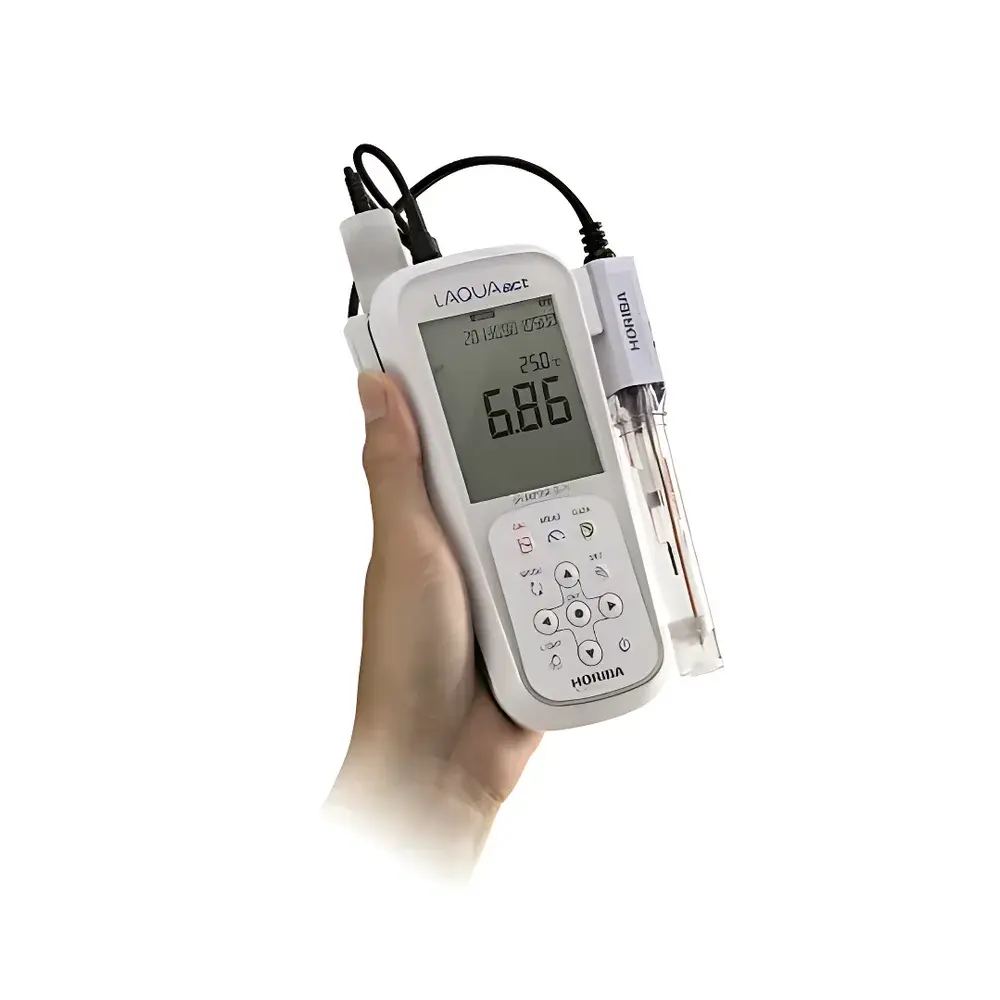
HORIBA LAQUAact D-74 Portable Multiparameter Water Quality Analyzer
| Brand | HORIBA |
|---|---|
| Origin | Japan |
| Model | D-74 |
| Instrument Type | Portable/Handheld Water Quality Analyzer |
| Measurable Parameters | pH, mV (ORP), Conductivity, Resistivity, Salinity, Total Dissolved Solids (TDS), Temperature |
| Protection Rating | IP67 |
| Display | Backlit Monochrome LCD |
| Data Storage | 1,000 measurements with timestamp, ID, and channel metadata |
| Calibration | Auto-buffer recognition (5-point pH), NIST/USA standard support, automatic temperature compensation (ATC), auto-ranging conductivity |
| Compliance | Designed for GLP/GMP environments with audit-ready data logging (time-stamped, user-ID enabled), meets requirements for ISO 5667-3, ASTM D1293, ASTM D5391, and USP <645> for conductivity validation |
Overview
The HORIBA LAQUAact D-74 is a field-deployable, IP67-rated multiparameter water quality analyzer engineered for high-reliability environmental monitoring in demanding outdoor, wastewater, aquaculture, and municipal utility applications. It operates on the fundamental electrochemical principles of potentiometric pH measurement (glass electrode method), redox potential (mV/ORP) detection, and AC two-electrode conductivity analysis—enabling simultaneous, real-time quantification of pH, oxidation-reduction potential, specific conductivity, resistivity, salinity, total dissolved solids (TDS), and temperature. Its dual-channel architecture supports concurrent measurement and display of two independent parameters (e.g., pH + conductivity), eliminating sequential switching and reducing field measurement time. The instrument’s compact form factor (67 × 28 × 170 mm), lightweight design (270 g without batteries), and robust housing—constructed from alcohol-resistant, impact-tolerant polymer—ensure operational integrity during transport and extended use in humid, dusty, or splash-prone environments. All sensor interfaces are sealed to prevent electrolyte leakage and cross-contamination, and the unit maintains metrological stability across ambient temperatures from 0 °C to 45 °C and relative humidity up to 80% non-condensing.
Key Features
- IP67-certified enclosure for dust-tight and immersion-resistant operation (1 m for 30 min), validated per IEC 60529
- Capacitive touch-responsive monochrome LCD with adjustable backlight for low-light field conditions
- Dual-channel measurement capability with synchronized timestamping and parameter pairing (e.g., pH + conductivity)
- Auto-buffer recognition for 5-point pH calibration with selectable NIST or USA buffer standards; real-time electrode response diagnostics
- Automatic temperature compensation (ATC) for conductivity, resistivity, salinity, and TDS using integrated Pt1000 thermistor (±0.1 °C accuracy)
- Auto-ranging conductivity measurement (0.0 μS/cm to 200.0 mS/cm) with full-scale accuracy of ±0.5% F.S. and resolution down to 0.01 μS/cm
- GLP/GMP-compliant data management: 1,000 internal records with date/time stamp, operator ID, calibration history, and measurement mode flags
- Extended battery life (>1,000 hours typical with AAA alkaline cells); supports Ni-MH rechargeables and optional AC adapter (100–240 V, 50/60 Hz)
- Self-diagnostic system providing real-time electrode status indicators—including slope, offset, and response time metrics—for traceable QA/QC
Sample Compatibility & Compliance
The D-74 is optimized for aqueous matrices including freshwater, seawater, wastewater effluent, drinking water, cooling tower fluids, and aquaculture ponds. It accommodates standard DIN/ISO-compliant combination pH electrodes (e.g., HORIBA 9615S-10D), ORP electrodes, and conductivity cells with cell constants of 0.1, 1.0, or 10 cm⁻¹. Its measurement algorithms conform to internationally recognized methodologies: pH per ISO 7888 and ASTM D1293; conductivity per ASTM D5391 and USP ; and salinity/TDS derived via standardized conversion factors per ISO 7888 Annex C. The device supports regulatory data integrity requirements through immutable timestamped storage, user-accessible calibration logs, and configurable ID tagging—making it suitable for audits under ISO/IEC 17025, EPA Method 150.1, and FDA 21 CFR Part 11 when paired with validated software export protocols.
Software & Data Management
Data export is facilitated via USB interface to PC using HORIBA’s LAQUA Software (Windows-compatible), enabling CSV or Excel-formatted reports with full metadata (calibration dates, electrode IDs, environmental conditions). The software supports batch calibration verification, trend plotting, statistical summary (mean, SD, CV%), and deviation flagging against user-defined acceptance criteria. Audit trails include operator login timestamps, parameter configuration changes, and calibration event histories—all retained within the instrument memory even after power cycling. No cloud dependency or subscription model is required; all firmware updates and configuration backups are performed locally via encrypted USB drive.
Applications
- Field-based compliance monitoring for NPDES permits and EPA Clean Water Act reporting
- Real-time process control in municipal water treatment plants (coagulation, disinfection, filtration stages)
- Salinity and conductivity profiling in estuarine and coastal zone studies
- QA/QC of pharmaceutical water systems (PW, WFI) per USP and EU GMP Annex 1
- Education and student laboratories requiring rugged, intuitive instrumentation with traceable calibration
- Rapid-response environmental assessments following spills, algal blooms, or infrastructure failures
- Long-term unattended monitoring when deployed with optional external power and datalogger integration
FAQ
Does the D-74 support automatic temperature compensation for all measured parameters?
Yes—ATC is applied in real time to pH, conductivity, resistivity, salinity, and TDS calculations using the built-in Pt1000 sensor.
Can the D-74 perform 5-point pH calibration with non-HORIBA buffers?
Yes—the instrument auto-identifies standard pH 1.68, 4.01, 6.86, 7.00, 9.18, and 10.01 buffers per NIST or USA specifications; custom buffer values may be entered manually.
Is the internal data log compliant with FDA 21 CFR Part 11?
The D-74 meets technical prerequisites (electronic signatures, audit trail, secure storage); full Part 11 compliance requires implementation of validated software workflows and organizational SOPs for electronic records.
What is the maximum depth and duration for IP67-rated submersion?
Per IEC 60529, the unit withstands immersion at 1 meter depth for up to 30 minutes—intended for accidental drops or rain exposure, not continuous underwater deployment.
How does the D-74 handle high-conductivity samples above 100 mS/cm?
The auto-ranging circuit dynamically selects optimal gain and cell constant; for samples >200 mS/cm, a dedicated high-range conductivity cell (e.g., HORIBA 3551-10D) is recommended.
Related Products







