
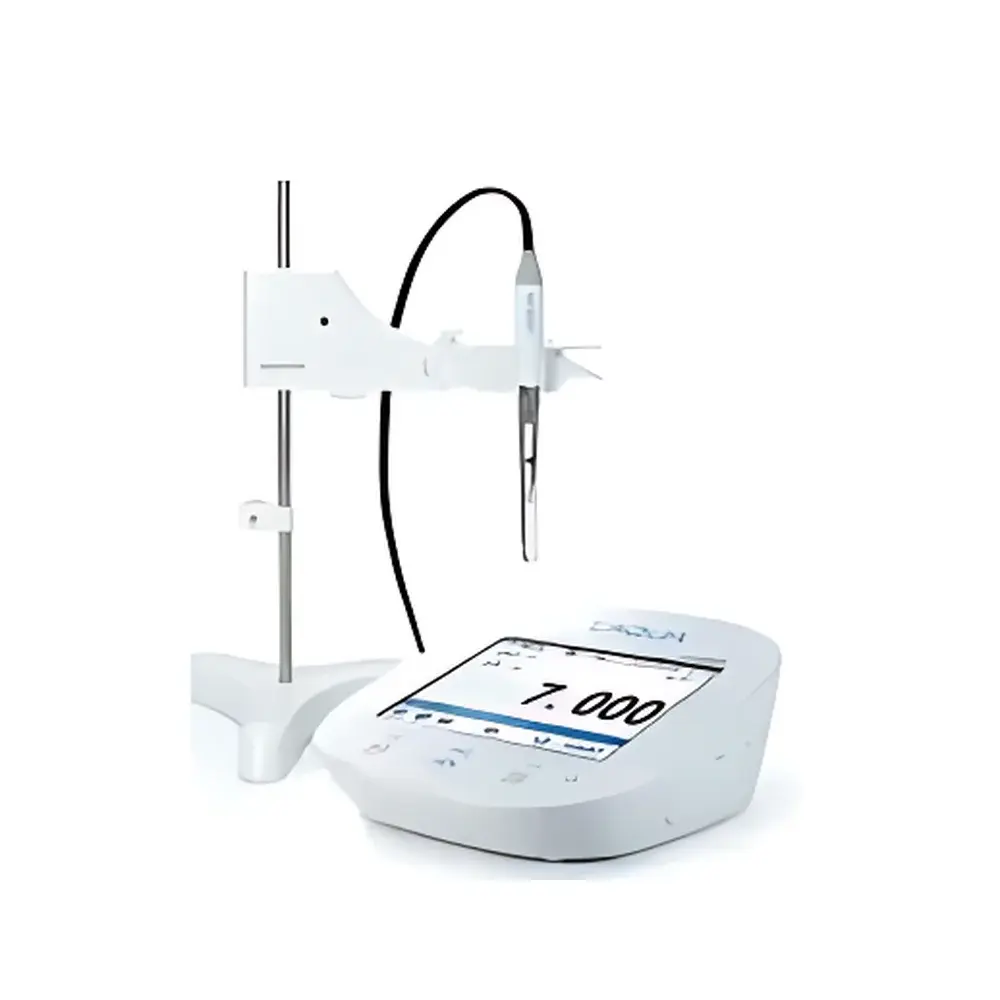
HORIBA F-71 Benchtop pH and ORP Analyzer
| Brand | HORIBA |
|---|---|
| Origin | Japan |
| Model | F-71 |
| Measurement Parameters | pH, ORP, Temperature |
| pH Range | 0.000–14.000 |
| pH Resolution | 0.001 |
| pH Repeatability | ±0.005 pH ±1 digit |
| ORP Range | ±1999.9 mV |
| ORP Resolution | 0.1 mV |
| ORP Repeatability | ±0.1 mV ±1 digit |
| Temperature Range | −30.0 to 130.0 °C |
| Temperature Resolution | 0.1 °C |
| Temperature Repeatability | ±0.1 °C ±1 digit |
| Data Storage Capacity | 999 measurements |
| Power Supply | AC adapter, 100–240 V, 50/60 Hz |
| Power Consumption | ~0.7 VA |
| Net Weight | ~500 g |
| Compliance | JIS, USP, EP, JP, CP |
| Display | Capacitive touchscreen |
| Interface | USB (device & host), GLP/GMP-ready data export |
Overview
The HORIBA F-71 is a precision benchtop pH and redox (ORP) analyzer engineered for laboratory-grade accuracy and operational reliability in regulated water quality testing environments. It employs a high-stability glass electrode measurement principle for pH determination—compliant with ISO 3696, ASTM D1125, and USP —and utilizes platinum or Ag/AgCl reference electrodes for robust ORP quantification. Designed exclusively for single-channel operation, the F-71 delivers traceable, repeatable measurements across the full aqueous pH scale (0.000–14.000) with 0.001-unit resolution and ≤±0.005 pH repeatability under controlled calibration conditions. Its integrated Pt1000-compatible temperature sensor enables automatic temperature compensation (ATC) with 0.1 °C resolution and ±0.1 °C repeatability over an extended range (−30.0 to 130.0 °C), supporting both ambient and elevated-temperature sample analysis. The instrument’s architecture follows modular design principles common to regulatory-compliant analytical platforms, with sealed electronics, low-power consumption (~0.7 VA), and electromagnetic compatibility certified per IEC 61326-1.
Key Features
- Capacitive touchscreen interface with intuitive, icon-driven navigation—designed for glove-compatible operation and reduced mechanical wear compared to resistive alternatives.
- On-screen diagnostic guidance for electrode conditioning, calibration validation, and fault resolution—including step-by-step prompts aligned with JIS Z 8401 and USP verification protocols.
- GLP-compliant data handling: Each stored measurement (up to 999 entries) includes timestamp, operator ID (configurable), electrode serial number, calibration history, and environmental metadata (temperature, date/time).
- Modular electrode support: Compatible with HORIBA’s standardized BNC + mini-DIN connector system, enabling rapid swap of pH, ORP, and temperature sensors without recalibration drift.
- Regulatory-ready configuration: Preloaded compliance templates for pharmaceutical purified water (USP , EP 2.2.38, JP XVI), industrial boiler feedwater (ASTM D4582), and environmental monitoring (ISO 5667-3).
- Low-energy design: Operates via universal-input AC adapter (100–240 V, 50/60 Hz); no internal battery or fan—minimizing thermal drift and maintenance requirements.
Sample Compatibility & Compliance
The F-71 is validated for use with aqueous samples across diverse matrices including purified water, process streams, wastewater effluents, and buffer solutions. Its glass electrode system meets ISO 7027 for turbidity-immune pH measurement in suspensions up to 50 NTU, while ORP mode supports oxidation-reduction potential assessment per ASTM D1498 for disinfectant residual monitoring. Regulatory alignment includes full traceability to national pharmacopoeias: USP (pH), USP (conductivity—via optional F-72/F-74 upgrade path), EP 2.2.38 (water for injection), JP XVI General Tests 2.05, and CP 2020 Appendix XIX A. All firmware and calibration routines are auditable under FDA 21 CFR Part 11 when paired with HORIBA’s optional LabSolutions software and electronic signature module.
Software & Data Management
Data export is supported via native USB device mode (mass storage class) for direct CSV transfer to Windows/macOS systems, and USB host mode for connection to compatible thermal printers (e.g., Brother QL-720NW). No proprietary drivers required—plug-and-play functionality ensures interoperability with LIMS and ELN platforms. Each measurement record contains embedded calibration certificate data (slope, offset, asymmetry potential), electrode impedance diagnostics, and ATC parameters. Firmware updates are delivered via signed HEX files through HORIBA’s secure customer portal, with version rollback capability and SHA-256 integrity verification. Audit trail logging—including user login/logout, method changes, and calibration events—is enabled by default and exportable in PDF/A-1b format for GxP submissions.
Applications
- Pharmaceutical QC labs: Routine pH verification of Water for Injection (WFI), Purified Water (PW), and cleaning validation rinse samples per USP .
- Environmental testing: Field-deployable lab verification of surface water, groundwater, and wastewater treatment plant influent/effluent per ISO 5667-3 and EPA Method 150.1.
- Academic research: Teaching and method development in electrochemistry, corrosion science, and aquatic toxicology where stable ORP baselines are critical.
- Food & beverage production: Monitoring pH stability during fermentation, pasteurization, and CIP cycle validation.
- Power generation: Boiler feedwater and condensate pH control in accordance with ASME PTC 19.11 and VGB-R 450-L.
FAQ
Does the F-71 support automatic calibration recognition (ACR) for pH buffers?
Yes—the instrument identifies standard NIST-traceable buffers (pH 4.01, 7.00, 10.01 at 25 °C) via slope and offset validation; non-standard buffers require manual entry of nominal values.
Can measurement data be exported in compliant formats for FDA 21 CFR Part 11 submission?
When used with HORIBA LabSolutions v3.2+ and configured with electronic signatures, audit trails, and role-based access control, the F-71 meets ALCOA+ data integrity criteria for regulated environments.
Is the touchscreen operable with laboratory gloves?
The capacitive display responds reliably to nitrile and latex gloves (thickness ≤0.15 mm) and includes haptic feedback confirmation for critical actions such as calibration initiation.
What is the recommended electrode maintenance interval for GLP compliance?
HORIBA recommends daily hydration check, weekly storage solution replacement, and quarterly impedance verification using the built-in diagnostics—documented in the instrument’s maintenance log.
Does the F-71 meet IP rating requirements for wet-lab environments?
While not rated to IP65/IP67, its front-panel seal and conformal-coated PCBs provide protection against incidental splashes and humidity exposure typical of ISO Class 7/8 cleanrooms and analytical labs.
Related Products







