
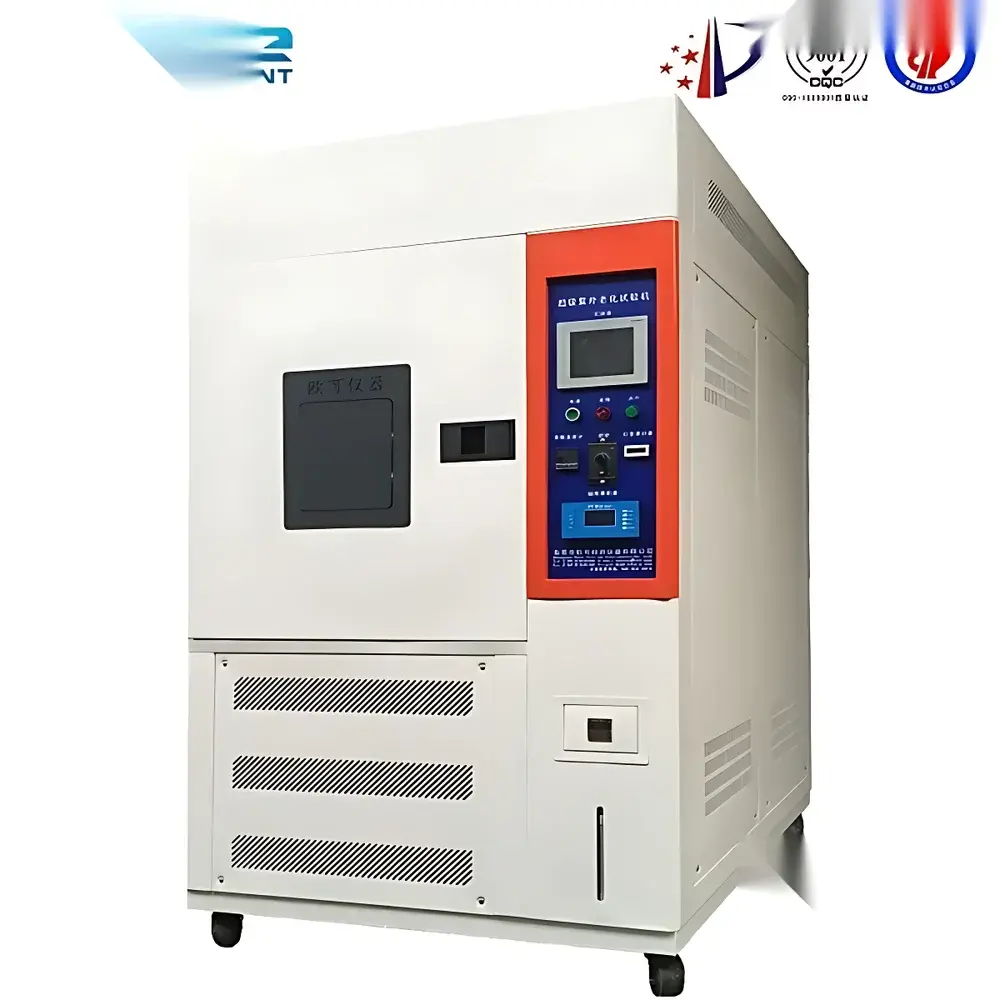
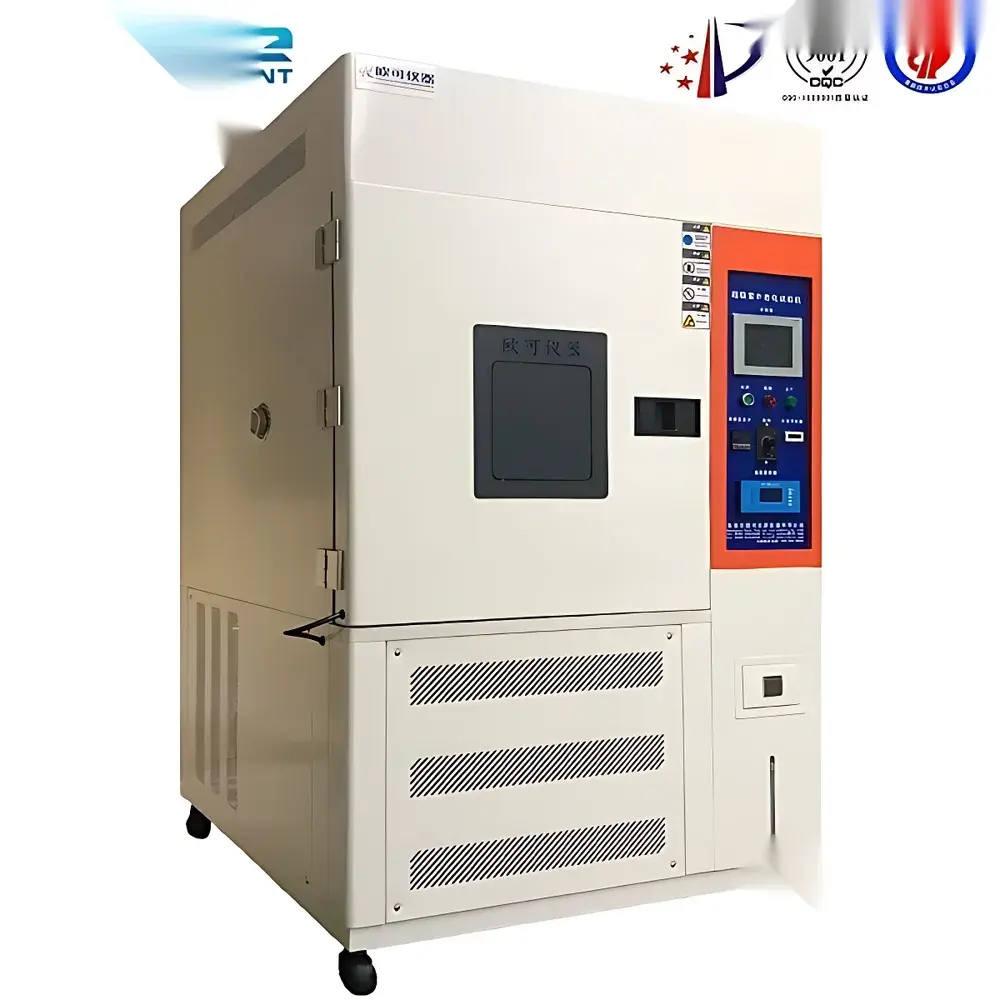
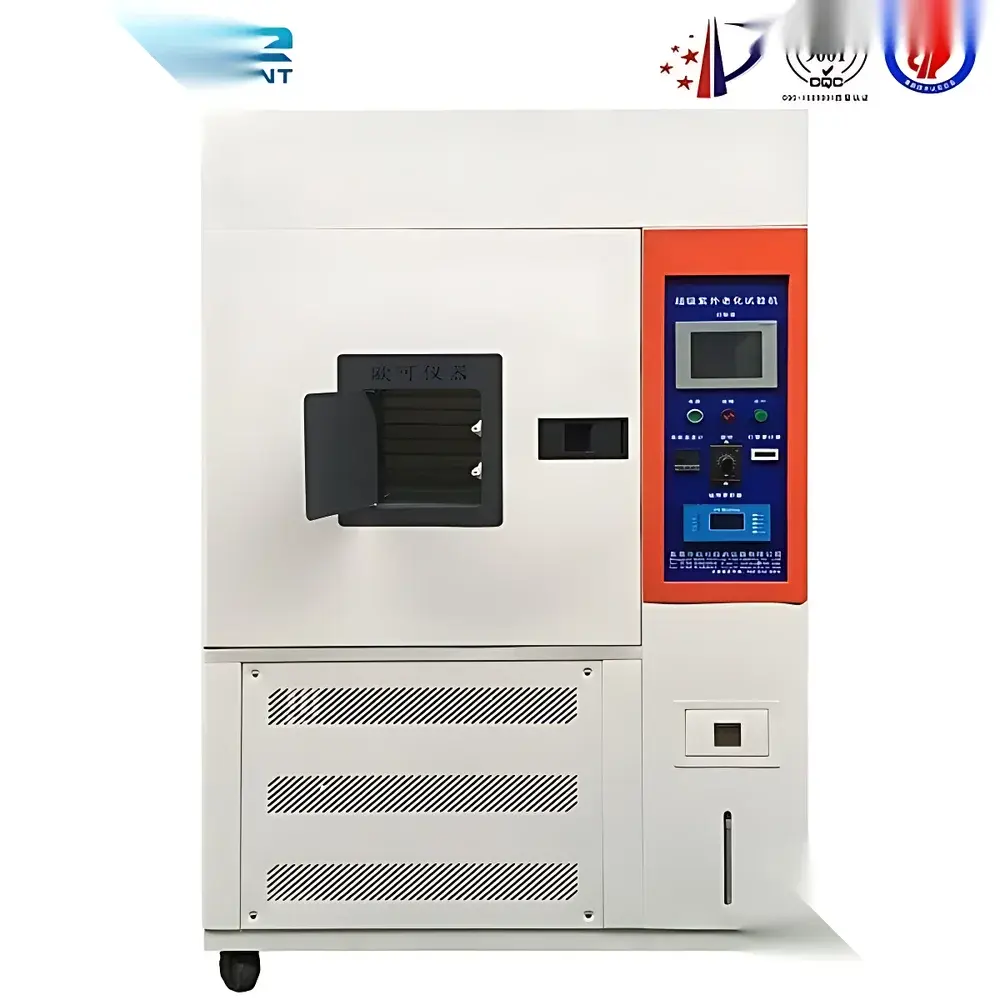
SuperUV Advanced Metal Halide UV Accelerated Weathering Test Chamber
| Brand | Other Brands |
|---|---|
| Origin | Imported |
| Manufacturer Type | General Distributor |
| Price | USD 21,500 (approx.) |
| Sample Rack Dimensions | 500 × 400 mm |
| Irradiation Source | Air-Cooled Metal Halide Lamp(s) |
| Spectral Range | 295–450 nm |
| Irradiance | 200 ± 8 W/m² |
| Irradiance Uniformity | ≥90% |
| Black Panel Temperature Range | 40–85 °C |
| Cooling Method | Internal Forced-Air Circulation |
| Filter | Custom High-Borosilicate Glass (IR-Reduction ~30%) |
| UV Radiometer | Integrated Spectral Irradiance Transmitter (calibrated per ISO 4892-2) |
| Control Display | LCD-Based Irradiance Integration & Cumulative Dose Monitoring |
Overview
The SuperUV Advanced Metal Halide UV Accelerated Weathering Test Chamber is an engineered environmental simulation system designed to replicate the photochemical and thermal degradation mechanisms induced by natural solar exposure—particularly ultraviolet radiation, temperature cycling, and moisture condensation—in a controlled laboratory setting. Unlike fluorescent UV lamps, this chamber employs high-intensity air-cooled metal halide lamps whose spectral output (295–450 nm) closely matches the terrestrial solar UV–visible irradiance profile after atmospheric filtering—enabling accelerated yet physically representative aging of polymeric coatings, automotive trim, photovoltaic encapsulants, and electronic enclosures. The system operates on the principle of controlled radiant exposure under defined black panel temperature (BPT) and humidity conditions, conforming to the fundamental irradiance calibration and specimen exposure protocols outlined in ISO 4892-2, ASTM G155, and SAE J2527. Its architecture supports both continuous irradiation and cyclic test profiles—including light/dark, irradiation/condensation, and optional water spray—thereby simulating diurnal weathering stressors with metrological traceability.
Key Features
- High-fidelity spectral match: Metal halide lamp output filtered through custom high-borosilicate glass delivers a relative spectral power distribution (SPD) aligned with AM1.5G solar irradiance below 450 nm, validated per ISO/CIE spectral matching criteria.
- Precision irradiance control: Integrated UV radiometer (developed in collaboration with the 622 Institute) enables real-time monitoring and closed-loop regulation of irradiance at the specimen plane (200 ± 8 W/m²), with cumulative dose tracking and auto-compensation for lamp aging.
- Uniform exposure field: Optimized lamp array geometry and reflective top-mounted irradiation design ensure ≥90% irradiance uniformity across the 500 × 400 mm sample rack—critical for inter-laboratory reproducibility and comparative ranking studies.
- Thermal management architecture: Internal forced-air circulation system maintains stable black panel temperature (40–85 °C) independent of irradiance level, minimizing thermal gradients that compromise degradation kinetics fidelity.
- Modular filtration: Standard IR-reducing filter attenuates ~30% of infrared energy, preventing non-photochemical heating artifacts while preserving UV-driven reaction pathways.
- Compliance-ready operation: All irradiance logging, temperature setpoint history, and cycle sequencing are timestamped and stored locally—supporting audit trails required under GLP and ISO/IEC 17025 quality systems.
Sample Compatibility & Compliance
The chamber accommodates flat-panel specimens up to 500 × 400 mm and is routinely deployed for testing coated steel, ABS/PC automotive fascias, EVA encapsulants in PV modules, silicone gaskets, and printed circuit board conformal coatings. It meets the core operational requirements of ISO 4892-2 (Methods A and B), ASTM G155 (Cycle A, B, C), SAE J2527 (for automotive exterior materials), and IEC 61215-2 MQT10 (UV preconditioning for photovoltaic modules). While not certified to UL or FM standards directly, its irradiance stability and spectral fidelity enable qualification testing compliant with UL 746C (polymeric materials) and IEC 60068-2-5 when paired with documented validation reports.
Software & Data Management
The embedded controller features an industrial-grade LCD interface with dedicated irradiance integration firmware. All critical parameters—including real-time irradiance (W/m²), black panel temperature (°C), elapsed exposure time, and cumulative radiant dose (kJ/m²)—are logged at user-defined intervals (1–60 min) and exportable via USB to CSV format. The system supports manual program entry or preloaded standard cycles (e.g., ISO 4892-2 Cycle 1, ASTM G155 Cycle A). For laboratories operating under FDA 21 CFR Part 11 or EU Annex 11, optional Ethernet connectivity and third-party SCADA integration allow secure remote monitoring, electronic signatures, and full audit trail generation—including operator ID, parameter changes, and alarm events.
Applications
This test chamber serves as a primary tool for R&D labs and QC departments evaluating long-term outdoor durability of materials exposed to solar radiation. Typical use cases include: predicting gloss retention and color shift (ΔE) in automotive clearcoats; assessing delamination resistance of multilayer polymer films; quantifying yellowing index (YI) in optical adhesives; validating UV-stabilizer efficacy in PVC window profiles; screening backsheet materials for bifacial solar modules; and qualifying conformal coatings for aerospace avionics subjected to tropical coastal environments. Its ability to decouple UV dose from thermal load enables mechanistic studies of photooxidation vs. thermally activated chain scission.
FAQ
What spectral standard does the lamp/filter combination emulate?
It replicates the global solar spectral irradiance (AM1.5G) between 295–450 nm after transmission through 3 mm borosilicate glass—matching the reference spectrum specified in ISO 4892-2 Annex A.
Is calibration traceable to national standards?
Yes—integrated radiometer calibration is traceable to NIM (China National Institute of Metrology) or NIST-equivalent UV reference detectors; annual recalibration is recommended per ISO/IEC 17025.
Can the system perform combined UV + water spray cycles?
Yes—optional spray nozzles and programmable timing enable ASTM G155 Cycle C (irradiation + intermittent water spray) and custom condensation-spray sequences.
What maintenance intervals are recommended for lamp replacement?
Metal halide lamps exhibit measurable spectral drift beyond 1,200 hours; replacement is advised at 1,000–1,200 h to maintain irradiance accuracy within ±5% of initial output.
Does the chamber support multi-specimen temperature profiling?
No—black panel temperature is measured at a single standardized location per ISO 4892-2; however, optional auxiliary PT100 sensors can be mounted on test specimens for supplementary thermal mapping.



