
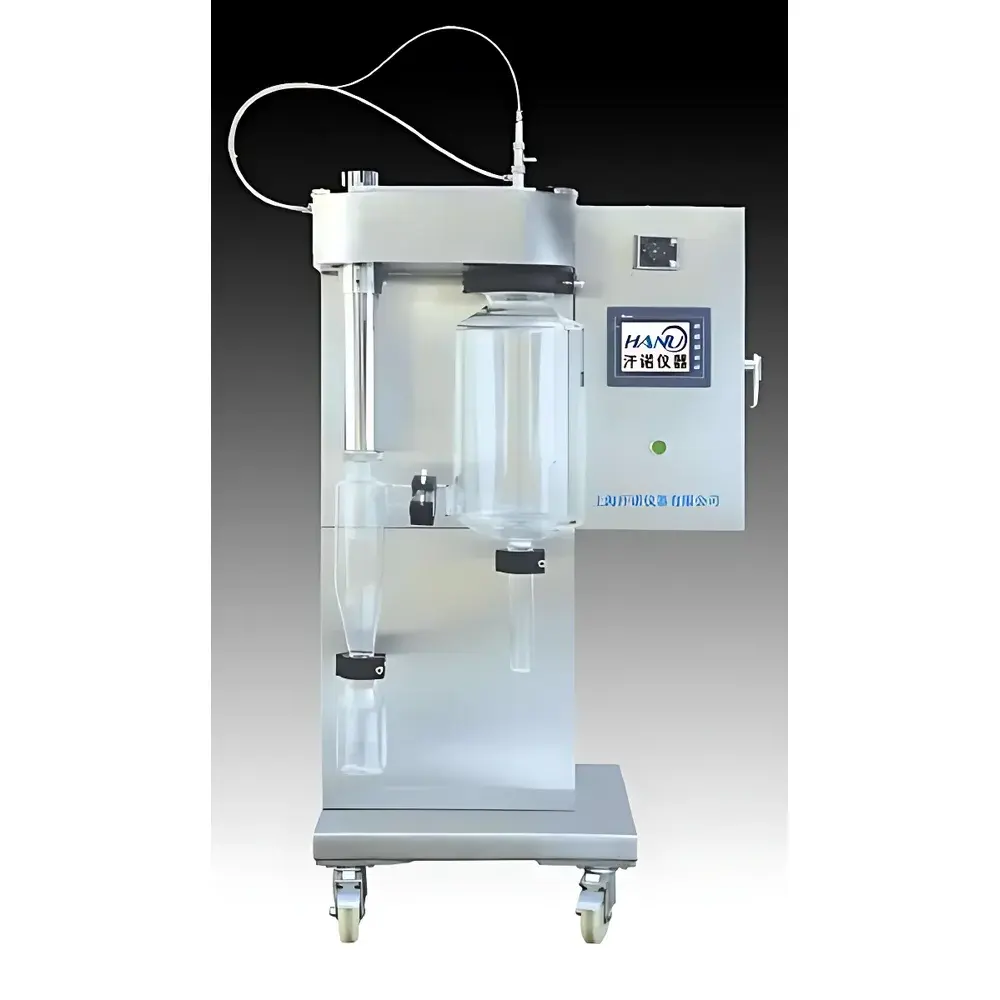
Hanuo HN-1500P Benchtop Spray Dryer
| Brand | Hanuo |
|---|---|
| Origin | Shanghai, China |
| Model | HN-1500P Benchtop Laboratory Spray Dryer |
| Max Feed Volume | 2000 mL/h |
| Inlet Temperature Range | 30–300 °C |
| Outlet Temperature Range | 30–140 °C |
| Evaporation Capacity | 1500–2500 mL/h |
| Feed Rate Adjustment | 30–2500 mL/h (via peristaltic pump) |
| Temperature Control Accuracy | ±1 °C |
| Drying Residence Time | 1.0–1.5 s |
| Power Supply | 3 kW / 220 V |
| Dimensions (H×L×W) | 1300 × 650 × 500 mm |
| Construction | Full 316 stainless steel frame + high-borosilicate glass drying chamber & collection system |
| Nozzle Type | Two-fluid pneumatic atomizer |
| Cleaning | Automatic needle clearing (adjustable frequency) |
| Display | Color LCD touchscreen showing inlet/outlet temperature, peristaltic pump speed, airflow, and needle actuation frequency |
Overview
The Hanuo HN-1500P Benchtop Spray Dryer is a compact, fully integrated laboratory-scale spray drying system engineered for precise, reproducible conversion of liquid feedstocks—including aqueous solutions, emulsions, and suspensions—into free-flowing micro-powders. It operates on the principle of flash evaporation: liquid samples are atomized into fine droplets via a two-fluid pneumatic nozzle, then rapidly dried by concurrent hot air flow within a high-borosilicate glass drying chamber. With an adjustable inlet temperature range of 30–300 °C and real-time PID-controlled thermal management (±1 °C accuracy), the system enables gentle, millisecond-scale thermal exposure—critical for preserving thermolabile compounds such as proteins, enzymes, probiotics, monoclonal antibodies, and natural extracts. Its 1.0–1.5 second residence time ensures minimal thermal degradation while maintaining particle integrity and functional activity post-drying.
Key Features
- Two-fluid pneumatic atomization system with precision-engineered stainless steel nozzle for consistent droplet size distribution and high-efficiency雾化 (atomization efficiency >95% typical for aqueous feeds)
- Full 316 stainless steel structural framework and fluid-contact components, ensuring corrosion resistance and compliance with ISO 8573-1 compressed air quality standards for pharmaceutical-grade operation
- High-borosilicate glass drying chamber and cyclonic collection vessel—optically transparent, chemically inert, and rated for continuous service up to 500 °C (thermal shock resistant)
- Color LCD touchscreen interface displaying real-time parameters: inlet/outlet temperature, peristaltic pump RPM, volumetric airflow rate, and automatic needle clearance cycle frequency
- Intelligent needle-clearing mechanism with programmable actuation intervals—prevents nozzle clogging during extended runs with viscous or particulate-laden feeds
- Thermal safety interlock system: upon shutdown command, heating elements deactivate immediately while the blower continues until chamber temperature drops below 60 °C—preventing thermal stress and residual carbonization
- PID-based temperature regulation with dual-sensor feedback (RTD probes at inlet and outlet ducts) and adaptive tuning algorithms for stable setpoint maintenance under dynamic load conditions
Sample Compatibility & Compliance
The HN-1500P accommodates a broad spectrum of aqueous-based formulations, including protein solutions (e.g., BSA, lysozyme), microbial broths, plant extracts, polymer dispersions, and nanoemulsions. It supports GMP-aligned process development workflows through traceable parameter logging, user-access-level controls, and hardware-level safeguards against uncontrolled thermal excursions. While not certified to FDA 21 CFR Part 11 out-of-the-box, its architecture permits integration with third-party electronic lab notebook (ELN) systems supporting audit trails, electronic signatures, and data integrity requirements per ALCOA+ principles. The system meets general laboratory safety standards per IEC 61010-1 and complies with CE marking directives for electromagnetic compatibility (EMC) and low-voltage equipment.
Software & Data Management
Data acquisition is handled locally via embedded microcontroller firmware with non-volatile memory storage (≥10,000 cycle history). All operational parameters—including timestamped temperature profiles, pump speed ramps, and needle activation logs—are exportable in CSV format via USB port. Optional RS-485 Modbus RTU interface enables integration into centralized LabVantage or DeltaV environments for batch record generation and SPC charting. No cloud connectivity or proprietary software installation is required; configuration remains accessible via intuitive touchscreen navigation without administrative privileges.
Applications
- R&D-scale formulation of inhalable dry powders (e.g., insulin, budesonide) meeting USP & Ph. Eur. aerosol performance criteria
- Stabilization of labile biologics for long-term storage—preserving secondary structure confirmed via FTIR and CD spectroscopy post-reconstitution
- Encapsulation of essential oils and nutraceuticals into amorphous matrix carriers (e.g., maltodextrin, gum arabic) with controlled release profiles
- Production of catalyst precursors (e.g., Ni/Al₂O₃, Cu/ZnO) with narrow PSD (Dv50 = 1–10 µm) and high surface area (>80 m²/g)
- Process mapping studies for scale-up correlation using dimensionless numbers (e.g., Weber, Reynolds, and dimensionless drying time τ*)
FAQ
What is the minimum sample volume required for a valid drying run?
The system supports feed volumes as low as 30 mL when using the calibrated peristaltic pump—ideal for precious or early-stage R&D materials.
Can organic solvents be processed in the HN-1500P?
No. The standard configuration is validated exclusively for aqueous feeds. Processing flammable solvents requires explosion-proof modifications, ATEX certification, and inert gas purging—available only as custom-engineered variants.
Is the glassware autoclavable?
Yes. All borosilicate components comply with DIN ISO 3585 and withstand repeated autoclaving at 121 °C for 20 minutes without optical or mechanical degradation.
How is particle size distribution influenced by operating parameters?
Droplet size—and thus final powder Dv50—is primarily governed by feed concentration, nozzle orifice diameter, atomizing gas pressure, and inlet temperature. Empirical correlations (e.g., Bayvel equation) apply; users are advised to perform Design of Experiments (DoE) for critical quality attributes.
Does the system support GLP-compliant documentation?
Raw parameter logs meet GLP Annex 11 foundational requirements. For full compliance, customers must implement supplementary procedural controls—including defined user roles, change control logs, and periodic instrument calibration per ISO/IEC 17025 guidelines.



