
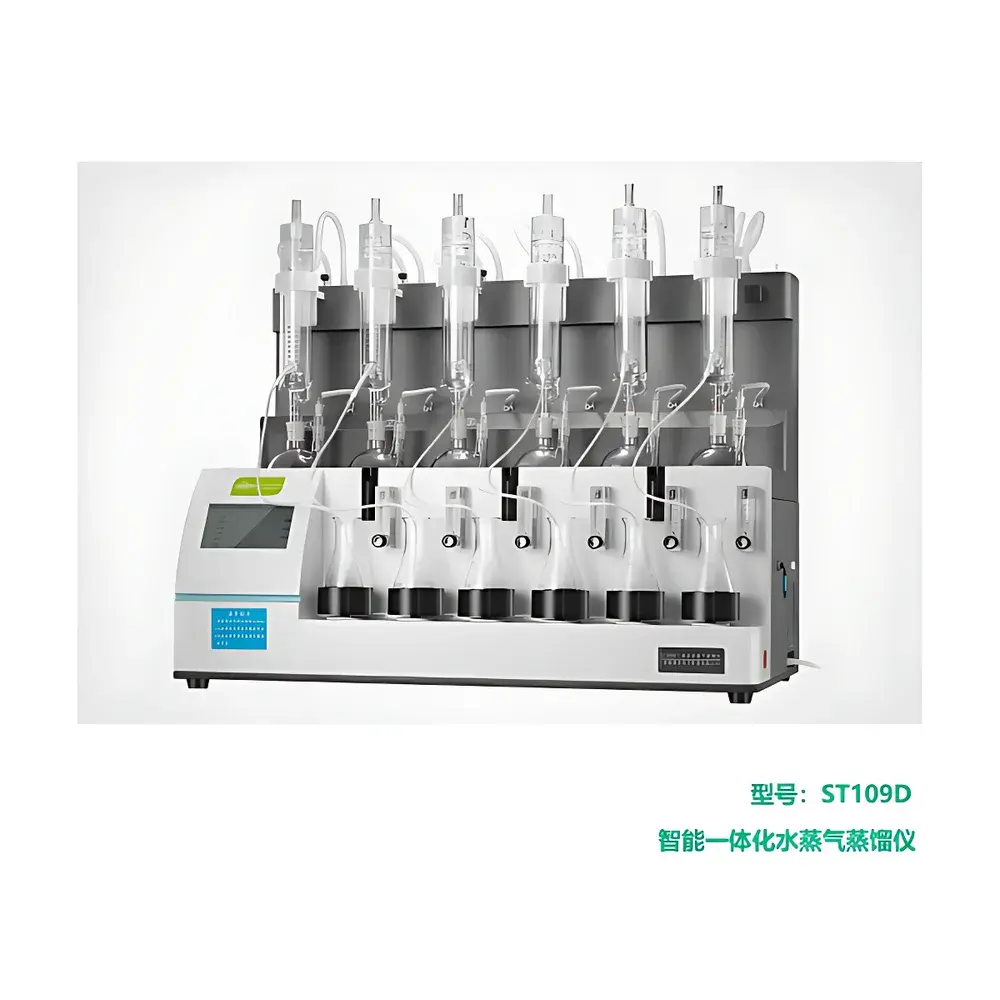
Shengtai ST109D Intelligent Integrated Steam Distillation System for Sulfur Dioxide Determination in Food Samples
| Brand | Shengtai (Jinan Shengtai Instrument Co., Ltd.) |
|---|---|
| Origin | Shandong, China |
| Manufacturer Type | Direct Manufacturer |
| Product Category | Domestic |
| Model | ST109D |
| Price Range | USD 7,000 – 14,000 |
| Type | Intelligent Automated System |
| Detection Limit | 1 mg/kg |
Overview
The Shengtai ST109D Intelligent Integrated Steam Distillation System is an automated, laboratory-grade instrument engineered specifically for sulfur dioxide (SO₂) determination in food matrices according to GB 5009.34–2022, Method III — Ion Chromatographic Determination after Nitrogen-Protected Steam Distillation. This method relies on quantitative conversion of sulfite species (e.g., SO₃²⁻, HSO₃⁻, bound SO₂) into gaseous SO₂ under acidic conditions, followed by selective distillation under inert nitrogen atmosphere and steam co-distillation. The liberated SO₂ is swept into a hydrogen peroxide absorption solution, where it is quantitatively oxidized to sulfate (SO₄²⁻), enabling subsequent ion chromatographic separation and conductivity detection. The ST109D replaces manual, multi-step steam distillation setups with a fully integrated, programmable platform—eliminating operator variability, improving inter-laboratory reproducibility, and ensuring strict adherence to the procedural constraints defined in the standard (e.g., N₂ flow control, distillate rate ≤2 mL/min, total distillation time 30–40 min, final volume 95 mL ±5 mL). Its architecture conforms to core principles of analytical pre-treatment integrity: thermal stability, gas-tight sealing, controlled vapor generation, and precise endpoint detection.
Key Features
- Integrated steam generation chamber housed within the main unit—eliminates external steam boilers and associated safety hazards, ensures consistent steam temperature and pressure without external calibration drift.
- Programmable acid addition module with independent per-channel control; supports volumetric dispensing of 6 mol/L HCl (±0.1 mL accuracy), optional acid line calibration, and automated tubing rinse cycles to prevent carryover and crystallization.
- Digital mass-flow-controlled nitrogen supply with adjustable range of 200–2000 mL/min per channel; maintains inert atmosphere throughout distillation to prevent SO₂ oxidation or loss prior to absorption.
- Distillate volume endpoint sensing via precision liquid-level detection in the 100 mL Nessler tube absorber; triggers automatic heating shutdown, audible/visual alarm, and data logging upon reaching user-defined target volume (e.g., 95 mL).
- Modular, corrosion-resistant fluid path constructed from borosilicate glass, PTFE, and chemically inert elastomers—compatible with HCl, H₂O₂, and acidic digestates per GB 5009.34–2022 Section 3.2.
Sample Compatibility & Compliance
The ST109D accommodates solid, semi-solid, and liquid food samples as specified in GB 5009.34–2022: homogenized solids (10 g ±0.01 g), viscous matrices (e.g., jams, sauces), and liquids (10–50 mL, diluted to 50 mL with deionized water if necessary). All wetted components comply with ISO 8573-1 (compressed air purity) and USP for extractables/leachables in contact with aqueous acidic media. The system supports GLP-compliant operation through audit-trail-enabled method storage, user-access controls, and timestamped event logs (e.g., acid dispense confirmation, N₂ flow verification, endpoint trigger). While not FDA 21 CFR Part 11–certified out-of-the-box, its digital control architecture permits integration with validated LIMS environments for electronic record retention.
Software & Data Management
The embedded touchscreen interface runs firmware v2.1+ with dual-language support (English/Chinese) and stores up to 200 customizable distillation protocols. Each run generates a CSV log containing start/stop timestamps, actual N₂ flow (recorded every 10 s), acid dispense volume, detected distillate volume, and system fault codes. Export is supported via USB 2.0 port; no cloud connectivity or remote access is implemented—ensuring full data sovereignty. Calibration records (acid delivery accuracy, level sensor offset) are stored separately and require password-protected access. Raw data files are compatible with common chromatography data systems (CDS) for seamless import into IC quantitation workflows.
Applications
Primary use is SO₂ quantification in regulatory food testing laboratories performing routine analysis per GB 5009.34–2022, including but not limited to dried fruits, wine, preserved vegetables, seafood, and starch-based products. Secondary applications include method development for alternative SO₂ release kinetics studies, validation of sample homogenization efficiency, and comparative assessment of bound vs. free SO₂ fractions when coupled with sequential extraction protocols. The system’s modularity also allows adaptation for other volatile acid-labile analytes (e.g., cyanide, formaldehyde) where nitrogen-steam co-distillation is prescribed—subject to revalidation per ICH Q2(R2).
FAQ
Does the ST109D include ion chromatography capability?
No. It performs only the regulated distillation and absorption step. Final sulfate quantification requires external ion chromatography with conductivity detection.
Can the system be used for non-food matrices such as soil or pharmaceutical excipients?
Not without full method revalidation. Its design and validation scope are strictly aligned with GB 5009.34–2022 for foodstuffs; application to other matrices requires demonstration of recovery, precision, and robustness per AOAC 2020.01 or ISO/IEC 17025 requirements.
Is maintenance documentation available in English?
Yes. Full technical manuals—including parts diagrams, preventive maintenance schedules, and error code reference—are provided in English PDF format with each unit.
What is the expected service life of the steam generator heating element?
Rated for ≥5,000 operational hours under normal usage (2–4 runs/day); replacement is field-serviceable using standard torx tools and takes <15 minutes.
Does the system meet CE or UL safety certification?
It complies with GB 4793.1–2019 (equivalent to IEC 61010-1:2010) for laboratory electrical equipment. CE marking is not affixed, as the device is classified as industrial lab instrumentation not requiring EU Declaration of Conformity under current MDR scope.






