
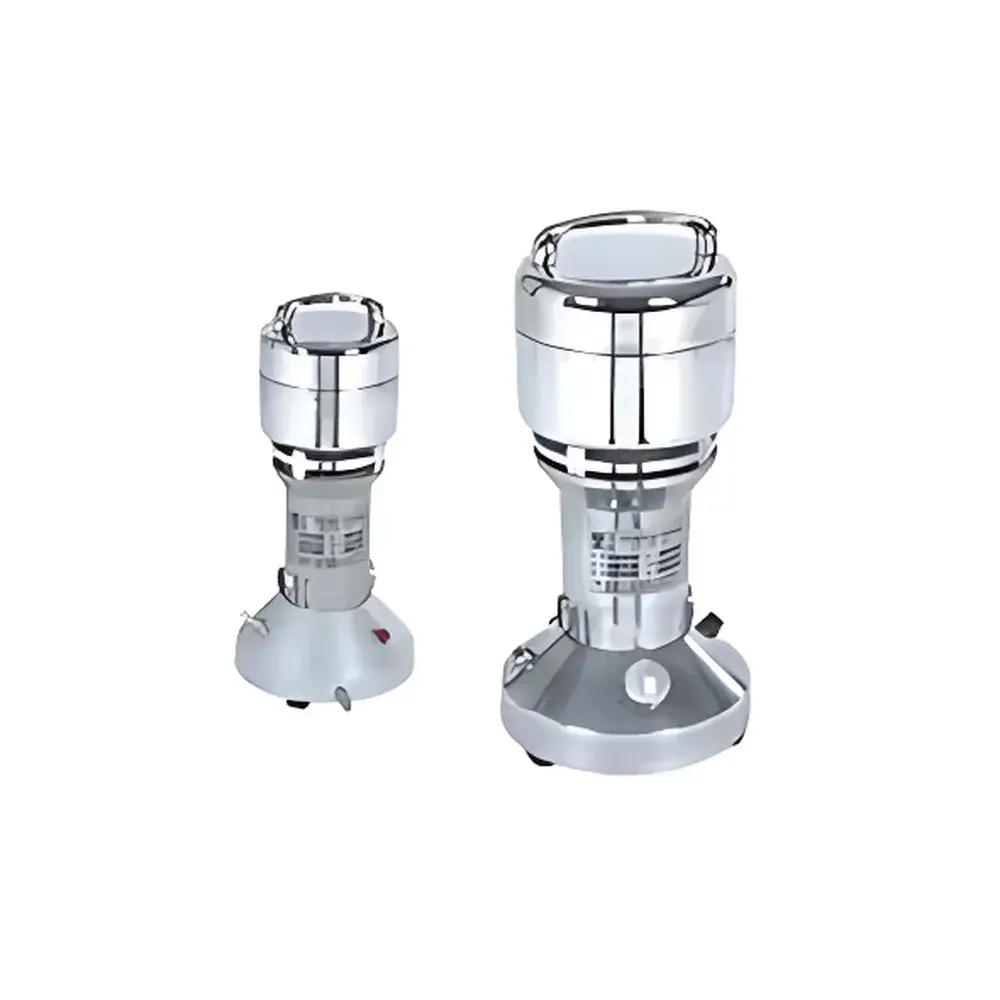
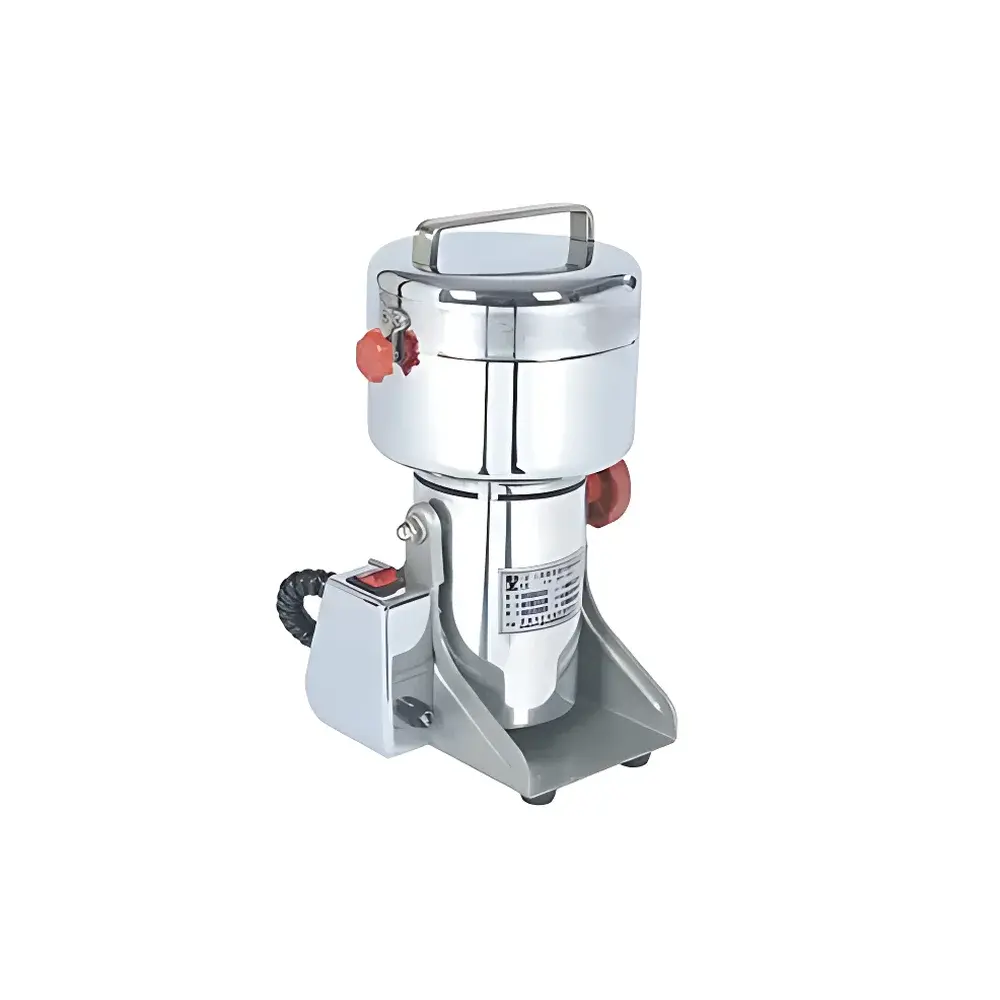
Hanuo DFT-100A Portable Handheld Grinder
| Brand | Hanuo |
|---|---|
| Origin | Shanghai, China |
| Model | DFT-100A |
| Instrument Type | Benchtop Grinder |
| Sample Applicability | Hard and brittle materials |
| Output Particle Size | 20–200 mesh |
| Maximum Batch Capacity | 100 g |
| Grinding Chamber Material | Stainless steel |
| Blade Material | Stainless steel |
| Motor | Imported high-efficiency DC motor |
| Rated Power | 400 W |
| No-Load Speed | ~11,500 rpm |
| Grinding Bowl Dimensions | Ø115 × 75 mm |
| Overall Dimensions | 14 × 14 × 28 cm |
| Weight | ~1.8 kg |
Overview
The Hanuo DFT-100A Portable Handheld Grinder is a compact, high-speed benchtop grinding instrument engineered for rapid, reproducible size reduction of hard, brittle, and fibrous botanical and pharmaceutical samples in laboratory, QC, and R&D environments. It operates on the principle of high-speed rotor–stator impact comminution: a precision-machined stainless-steel blade rotates at up to 11,500 rpm within a sealed stainless-steel grinding chamber, subjecting solid samples to repeated mechanical shear, impact, and attrition forces. This mechanism enables consistent particle size distribution without thermal degradation—critical for heat-sensitive herbal powders, traditional Chinese medicine (TCM) formulations, and analytical reference standards. Unlike planetary ball mills or cryogenic grinders, the DFT-100A delivers sub-200 mesh fineness in seconds with minimal operator intervention and no external cooling required. Its design prioritizes containment integrity, dust suppression, and cross-contamination prevention—features validated through routine use in GLP-compliant herbal extract preparation and pharmacopoeial testing workflows.
Key Features
- High-efficiency imported DC motor delivering stable 400 W output power and extended service life with low acoustic emission (<65 dB(A) at 1 m)
- Sealed stainless-steel grinding chamber (Ø115 × 75 mm) and hardened stainless-steel blade assembly resistant to corrosion, abrasion, and chemical exposure
- Single-button operation with adjustable grinding duration (3 s to 2 min), enabling precise control over final particle size and energy input
- Zero material loss design: no internal crevices or dead zones; complete sample recovery via gravity discharge and optional scraper tool
- No cross-contamination: non-porous surfaces, tool-free disassembly, and compatibility with ethanol, isopropanol, and hot water cleaning protocols
- Compact footprint (14 × 14 × 28 cm) and lightweight construction (≤1.8 kg) support mobility across lab benches, fume hoods, and field deployment scenarios
Sample Compatibility & Compliance
The DFT-100A is validated for dry grinding of hard botanicals—including but not limited to *Panax notoginseng* (Sanqi), *Astragalus membranaceus* (Huangqi), *Glycyrrhiza uralensis* (Gancao), *Pteria martensii* (pearl powder), and processed animal-derived materials such as *Asini Corii Colla* (ejiao). It accommodates samples with Mohs hardness ≤6.5 and moisture content <10% w/w. The unit meets general electrical safety requirements per IEC 61010-1 and complies with ISO 14644-1 Class 8 cleanroom handling practices when used with appropriate PPE. While not certified to FDA 21 CFR Part 11, its manual operation and absence of electronic data logging ensure full auditability in non-regulated QC settings. Documentation supports alignment with Chinese Pharmacopoeia (ChP) General Chapter 0212 “Powder Fineness Test” and ASTM D5630-22 for particle size classification by sieve analysis.
Software & Data Management
The DFT-100A is a standalone electromechanical device with no embedded firmware, touchscreen interface, or digital connectivity. All operational parameters—including run time, batch ID, and material identity—are recorded manually in laboratory notebooks or integrated LIMS platforms. This architecture eliminates cybersecurity vulnerabilities, reduces validation burden, and ensures uninterrupted performance in environments where electromagnetic interference (EMI) or network downtime may compromise connected instrumentation. For laboratories requiring traceability, users may pair the grinder with barcode-scanned sample vials and timestamped digital logs to satisfy internal SOPs and basic GLP documentation requirements.
Applications
- Routine preparation of homogenized herbal powders for HPLC, GC-MS, and UV-Vis quantitative analysis
- Pre-grinding step prior to cryomilling or jet milling for ultrafine micronization (e.g., targeting D90 < 10 µm)
- QC release testing of raw TCM materials per ChP monographs requiring defined sieve retention profiles
- Small-batch formulation development of solid dosage forms, including tablet granules and capsule fills
- Field-deployable comminution for botanical survey sampling where portability and battery independence are essential
- Teaching laboratories demonstrating mechanical size reduction principles in pharmaceutical technology courses
FAQ
What types of materials can be processed in the DFT-100A?
Hard, dry, brittle botanicals, minerals, and animal-derived solids with moisture content below 10% and particle hardness ≤6.5 on the Mohs scale. Not suitable for oily, sticky, fibrous, or thermolabile materials.
Is the grinding chamber autoclavable?
Yes—the stainless-steel grinding bowl and lid are fully autoclavable at 121°C for 20 minutes; blade assembly requires manual cleaning only.
How is particle size verified post-grinding?
Via standard sieve shaker analysis (e.g., ASTM E11) using certified test sieves ranging from 20 to 200 mesh; laser diffraction is not recommended due to sample heterogeneity and static charge effects.
Can the DFT-100A be used in GMP environments?
Yes—as a Class II ancillary equipment item, provided it is included in equipment qualification (IQ/OQ), assigned a unique asset ID, and maintained per written SOPs covering cleaning, calibration (timer verification), and preventive maintenance.
Does the unit include a safety interlock?
Yes—a mechanical lid lock prevents motor activation unless the grinding chamber is fully seated and latched, complying with IEC 61010-1 Clause 7.3.3 for enclosure integrity.
Related Products



