
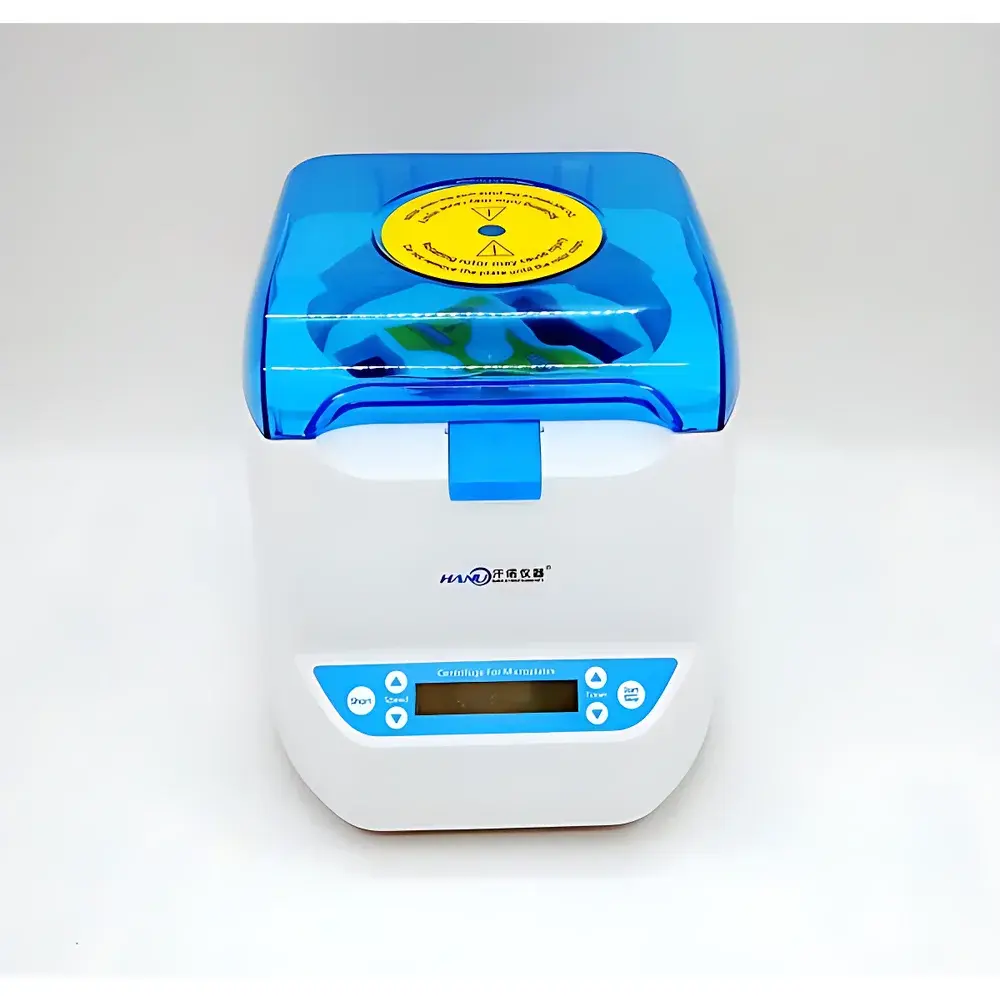
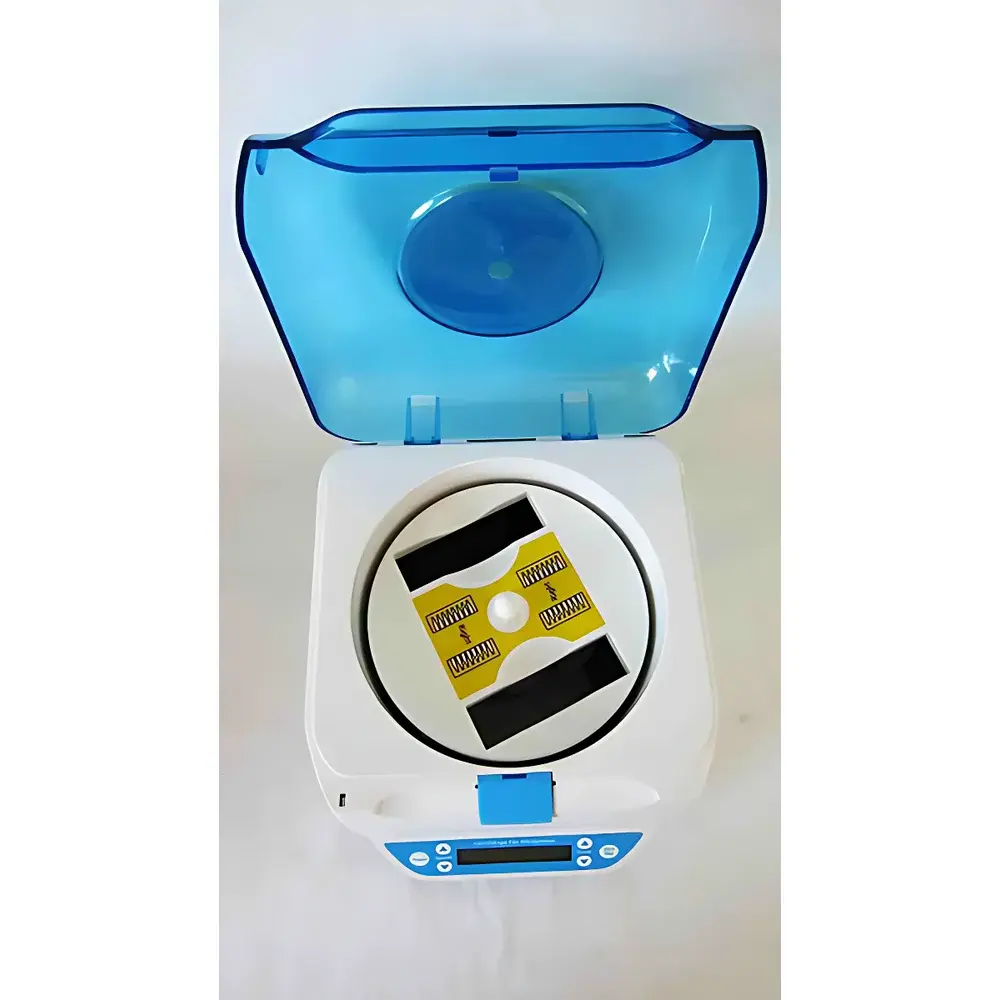
Hanuo MINIP-2500 Microplate Mini Centrifuge
| Brand | Hanuo |
|---|---|
| Origin | Shanghai, China |
| Model | MINIP-2500 |
| Instrument Type | Benchtop Centrifuge |
| Speed Range | 0–2500 rpm |
| Max RCF | 500 × g |
| Capacity | 2 × 96-well microplates (standard PCR plates, skirted or unskirted) |
| Rotor Type | Fixed-angle vertical rotor |
| Dimensions | 219 × 190 × 186 mm (W × D × H) |
| Weight | 3 kg |
| Power Supply | AC 100–230 V, 50–60 Hz |
| Motor | Brushless DC motor |
| Acceleration/Deceleration | Full speed in <3 s |
| Operating Modes | Momentary (pulse) and timed (1–99 s) |
| Safety | Lid interlock, auto-brake, over-speed protection |
| Noise Level | <45 dB(A) |
Overview
The Hanuo MINIP-2500 Microplate Mini Centrifuge is an engineered benchtop solution designed exclusively for rapid, low-force sedimentation of liquid droplets adhering to the walls of standard 96-well microplates. Unlike general-purpose centrifuges, it employs a fixed-angle vertical rotor architecture optimized for microplate geometry—ensuring uniform force distribution across all wells without plate deformation or cross-well contamination. Its operational principle relies on transient centrifugal acceleration (0–2500 rpm, max 500 × g), sufficient to overcome surface tension and gravitational adhesion while preserving sample integrity in sensitive molecular applications such as PCR setup, enzymatic reactions, and ELISA workflows. The device operates within Class I biosafety constraints and is intended for use in ISO 15189-accredited clinical labs, GLP-compliant research facilities, and academic core laboratories where space efficiency, repeatability, and hands-free plate handling are critical.
Key Features
- Fixed vertical rotor with precision-machined microplate slots—compatible with both skirted and non-skirted ANSI/SBS-standard 96-well PCR plates (including thin-wall and full-skirt formats)
- Brushless DC motor delivering consistent torque output, zero maintenance requirement, and >10,000-hour service life under routine usage
- Dual-mode operation: momentary (pulse) mode for instant spin-down (e.g., post-reagent addition); programmable timer mode (1–99 seconds) for reproducible cycle control
- Ergonomic 95° hinged lid with integrated safety interlock—prevents operation when open and ensures automatic rotor deceleration upon lid opening
- Ultra-compact footprint (219 × 190 × 186 mm) and lightweight design (3 kg) enabling placement directly on biosafety cabinets, PCR workstations, or laminar flow hoods
- Acoustic optimization yielding <45 dB(A) noise emission—meets ISO 7779 requirements for quiet laboratory environments
- Auto-braking system achieving full rotor stop within ~10 seconds, minimizing turnaround time between runs
Sample Compatibility & Compliance
The MINIP-2500 accommodates two stacked 96-well plates simultaneously, supporting common plate materials including polypropylene, polycarbonate, and cyclic olefin copolymer (COC). It is validated for use with commercially available qPCR master mixes, restriction enzyme buffers, and antibody conjugates—no leakage observed under nominal operating conditions due to capillary retention and vertical orientation during rotation. The unit complies with IEC 61010-1:2010 (Safety Requirements for Electrical Equipment for Measurement, Control, and Laboratory Use) and meets EMC directive 2014/30/EU. While not certified for sterile processing, its smooth, non-porous housing surface enables effective decontamination using 70% ethanol or 0.5% sodium hypochlorite—supporting adherence to CLSI GP26-A4 and ISO 13485 cleaning protocols.
Software & Data Management
The MINIP-2500 operates via embedded firmware with no external software dependency. All parameters—including run time, pulse duration, and rotor status—are displayed on a dual-digit LED interface. Though standalone, its timing consistency (±0.2 s accuracy over 10–99 s range) supports integration into documented laboratory procedures requiring traceability. For regulated environments, users may log run records manually or via LIMS-compatible timestamped entries. The absence of network connectivity or data export functionality aligns with FDA 21 CFR Part 11 Annex A guidance for “simple devices” where electronic records are not mandated—reducing validation burden in QC/QA settings.
Applications
- Pre-PCR centrifugation to collect condensate from thermal cycling tubes and ensure complete reagent mixing at well bottoms
- Post-ELISA wash steps to remove residual detergent before substrate addition
- Rapid pelleting of magnetic beads in nucleic acid extraction workflows (e.g., post-binding or post-elution)
- Centrifugal priming of microfluidic assay cartridges prior to instrument loading
- Removal of air bubbles from viscous samples (e.g., glycerol-stored enzymes or high-concentration antibodies) prior to pipetting
- Quality control checks in diagnostic kit manufacturing—verifying plate fill uniformity and meniscus stability
FAQ
Can the MINIP-2500 accommodate 384-well plates?
No—it is mechanically constrained to ANSI/SBS-compliant 96-well formats only. Attempting to load 384-well plates may compromise rotor balance and void warranty.
Is the rotor autoclavable?
No—the fixed vertical rotor is not removable or sterilizable by autoclaving. Surface disinfection per manufacturer guidelines is recommended.
Does it support variable speed control?
No—speed is fixed at 2500 rpm. This design prioritizes mechanical simplicity, reliability, and compliance with standardized microplate sedimentation protocols.
What is the maximum ambient temperature for continuous operation?
Rated for continuous use at 15–30 °C ambient, with relative humidity ≤80% non-condensing, per IEC 61010-1 environmental classification.
Can it be used inside a cold room?
Yes—provided ambient temperature remains ≥10 °C and condensation on internal electronics is prevented. Performance validation under sub-15 °C conditions is user-responsible.



