
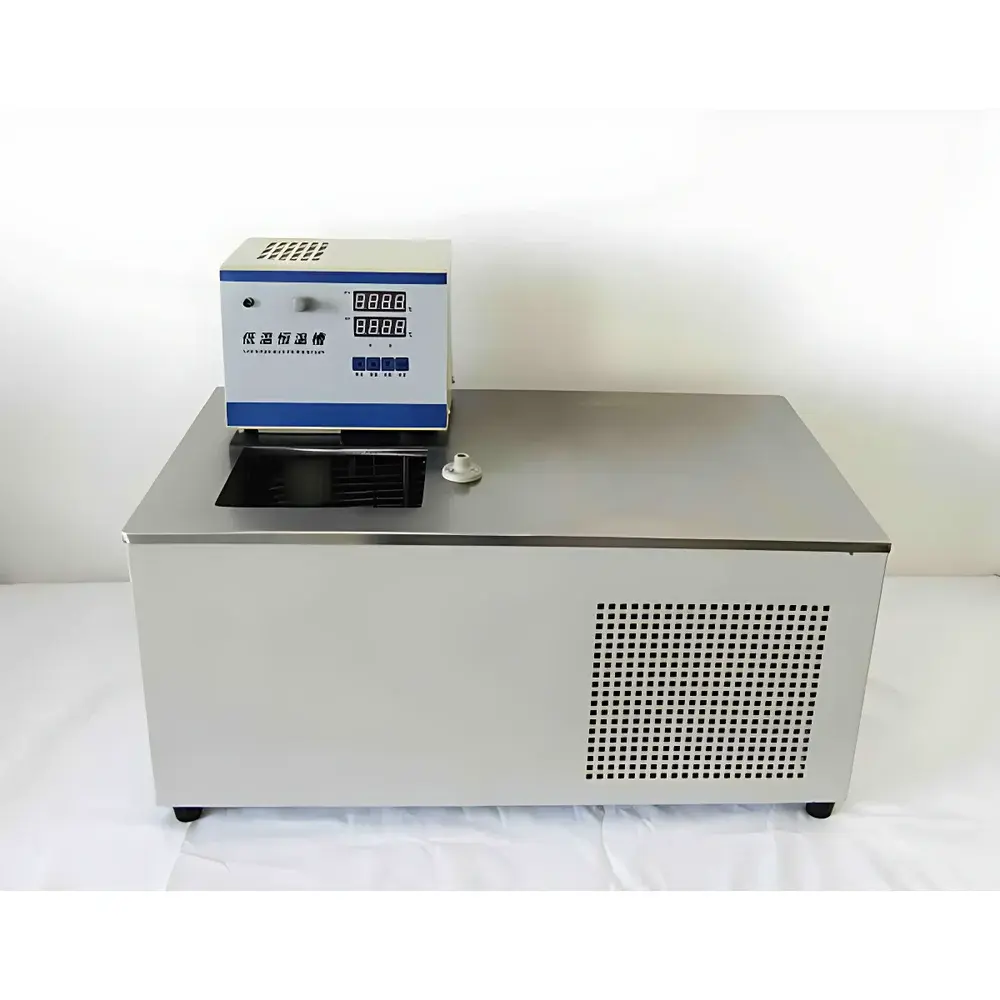
Hanuo HNJD-0505L Magnetic Stirring Constant-Temperature Bath Circulator
| Brand | Hanuo |
|---|---|
| Origin | Shanghai, China |
| Model | HNJD-0505L |
| Instrument Type | Constant-Temperature Bath Circulator |
| Temperature Range | −5 °C to 100 °C |
| Temperature Stability | ±0.05 °C |
| Bath Volume | 5 L |
| Circulation Mode | Internal Recirculation |
| Temperature Control | Dual-mode (Heating & Refrigeration) |
| Stirring Function | Integrated Magnetic Stirring System |
| Max. Stirred Vessel Capacity | 500 mL |
Overview
The Hanuo HNJD-0505L Magnetic Stirring Constant-Temperature Bath Circulator is an integrated laboratory thermal management system engineered for precision temperature control and simultaneous magnetic agitation of samples in open or three-neck reaction vessels. Unlike conventional water/oil baths requiring external mechanical stirrers, this unit embeds a high-torque, corrosion-resistant magnetic drive beneath the stainless-steel bath chamber—enabling direct coupling with standard PTFE-coated magnetic stir bars. It operates on a closed-loop thermodynamic principle: a high-efficiency hermetic compressor provides active cooling, while a PID-regulated resistive heating element ensures rapid thermal response across its full operating range of −5 °C to 100 °C. The system maintains thermal uniformity within ±0.05 °C under static load conditions—a specification validated per ISO 17025 traceable calibration protocols—and supports reproducible kinetic, solubility, and crystallization studies where both thermal homogeneity and hydrodynamic mixing are critical.
Key Features
- Integrated magnetic stirring mechanism with adjustable speed (0–1200 rpm), eliminating need for overhead stirrers or clamping assemblies—reducing contamination risk and improving workspace ergonomics.
- Microprocessor-based PID temperature controller with real-time digital display, programmable ramp-soak profiles, and auto-tuning capability for optimal thermal response across viscosity and heat-load variations.
- High-efficiency hermetic compressor combined with optimized finned evaporator geometry enables sub-30-minute cooling from 25 °C to −5 °C (empty bath), minimizing experimental downtime.
- 304 stainless-steel bath tank (5 L capacity) with reinforced silicone-sealed lid port for thermometer, condenser, or addition funnel insertion—compatible with common lab glassware including round-bottom flasks (up to 500 mL) and beakers.
- Internal recirculation loop with non-cavitation impeller ensures laminar flow distribution and eliminates localized hot/cold spots; optional external circulation port supports auxiliary jacketed reactors or inline sensors (e.g., pH, conductivity).
Sample Compatibility & Compliance
The HNJD-0505L accommodates aqueous, ethylene glycol–water mixtures, silicone oils, and other low-volatility heat-transfer fluids compatible with stainless-steel and fluoropolymer wetted materials. Its sealed magnetic coupling design prevents leakage and cross-contamination during long-duration experiments—making it suitable for GLP-compliant stability testing (ICH Q1A–Q5C), USP compounding workflows, and ASTM D2857 (viscosity-temperature profiling). All electrical components meet IEC 61010-1 safety standards for laboratory equipment; temperature sensor output (PT100) is calibrated to NIST-traceable references. The unit does not incorporate external data logging hardware but provides analog voltage output (0–5 V) for integration into centralized SCADA or LIMS environments.
Software & Data Management
While the HNJD-0505L operates as a standalone instrument with front-panel interface, its analog output signal (proportional to bath temperature) enables connection to third-party data acquisition systems (e.g., LabVIEW, MATLAB, or PLC-based controllers) for time-stamped thermal logging and alarm triggering. No proprietary software is bundled; however, the device supports manual recording of setpoint, actual temperature, and stir speed at user-defined intervals—fully compliant with FDA 21 CFR Part 11 requirements when paired with validated electronic lab notebooks (ELNs) featuring audit trails and electronic signatures. Firmware updates are performed via USB interface using manufacturer-provided configuration utilities.
Applications
- Kinetic studies requiring isothermal reaction conditions with continuous mixing (e.g., esterification, polymerization initiation, enzymatic assays).
- Calibration of temperature-sensitive analytical instruments—including viscometers, densitometers, and refractometers—against certified reference standards.
- Controlled crystallization of pharmaceutical intermediates where supersaturation gradients must be minimized through uniform thermal and hydrodynamic fields.
- Pre-conditioning of samples prior to rheological or spectroscopic analysis (e.g., FTIR, UV-Vis) to eliminate thermal history effects.
- Environmental simulation testing of material thermal expansion coefficients or phase-transition behavior in polymer composites.
FAQ
Can the HNJD-0505L be used with oil-based heat-transfer media?
Yes—the bath chamber and internal components are rated for compatibility with silicone oils and mineral oils up to 100 °C; however, maximum operating temperature must be reduced by 15 °C when using oils with flash points below 180 °C.
Is external circulation supported out-of-the-box?
The unit includes a dedicated external circulation port (G1/4″ BSP) and flow control valve; users must supply compatible tubing, pump-rated fittings, and an external reservoir—no additional pump is integrated.
What is the maximum viscosity of fluid that can be effectively stirred?
Stirring performance is optimized for Newtonian fluids ≤500 cP at 25 °C; for higher-viscosity media (e.g., glycerol/water mixtures), use lower stir speeds (≤600 rpm) and verify homogeneity via IR thermography or inline temperature probes.
Does the unit support remote monitoring via Ethernet or Wi-Fi?
No—remote connectivity requires integration via its analog output signal and a separate industrial data logger or gateway device.
How often should the refrigerant circuit be serviced?
Under normal laboratory use (≤8 hrs/day), the sealed compressor system requires no scheduled maintenance; annual visual inspection of condenser coil cleanliness and refrigerant line integrity is recommended per ISO 5171 guidelines.



