
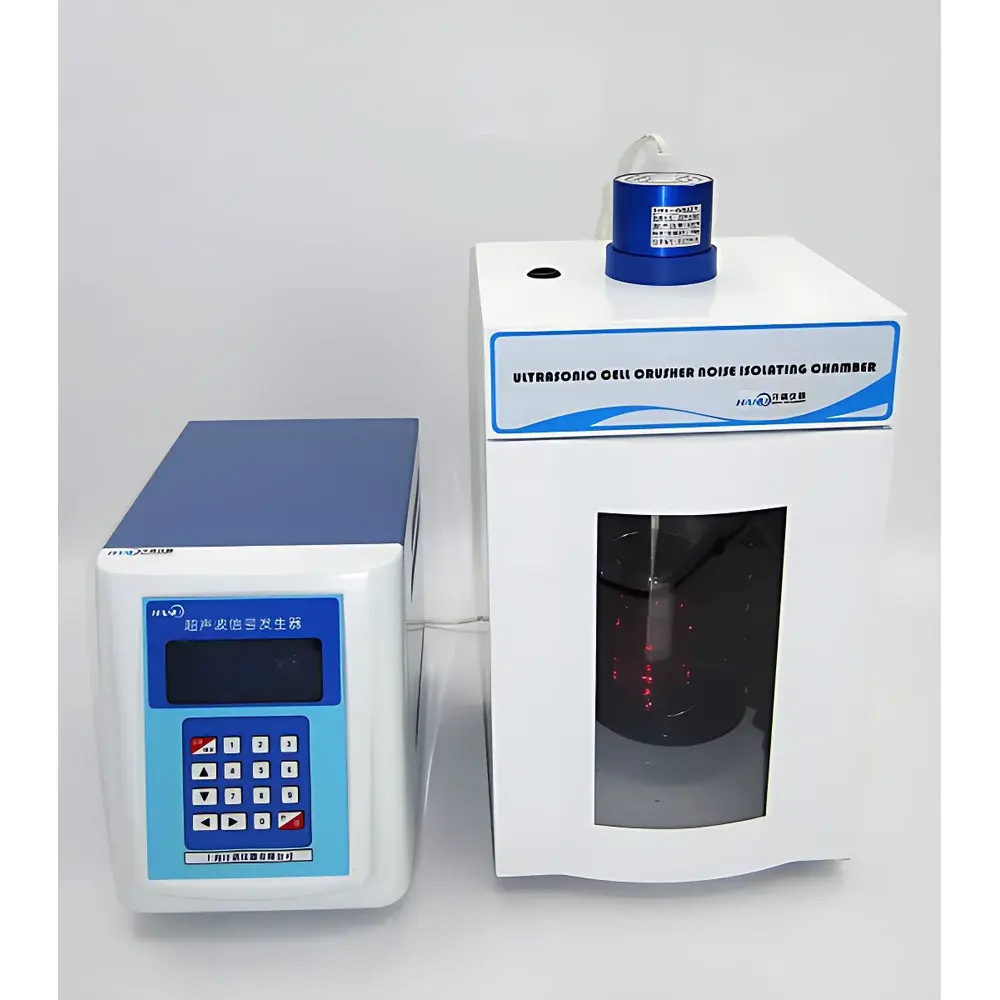
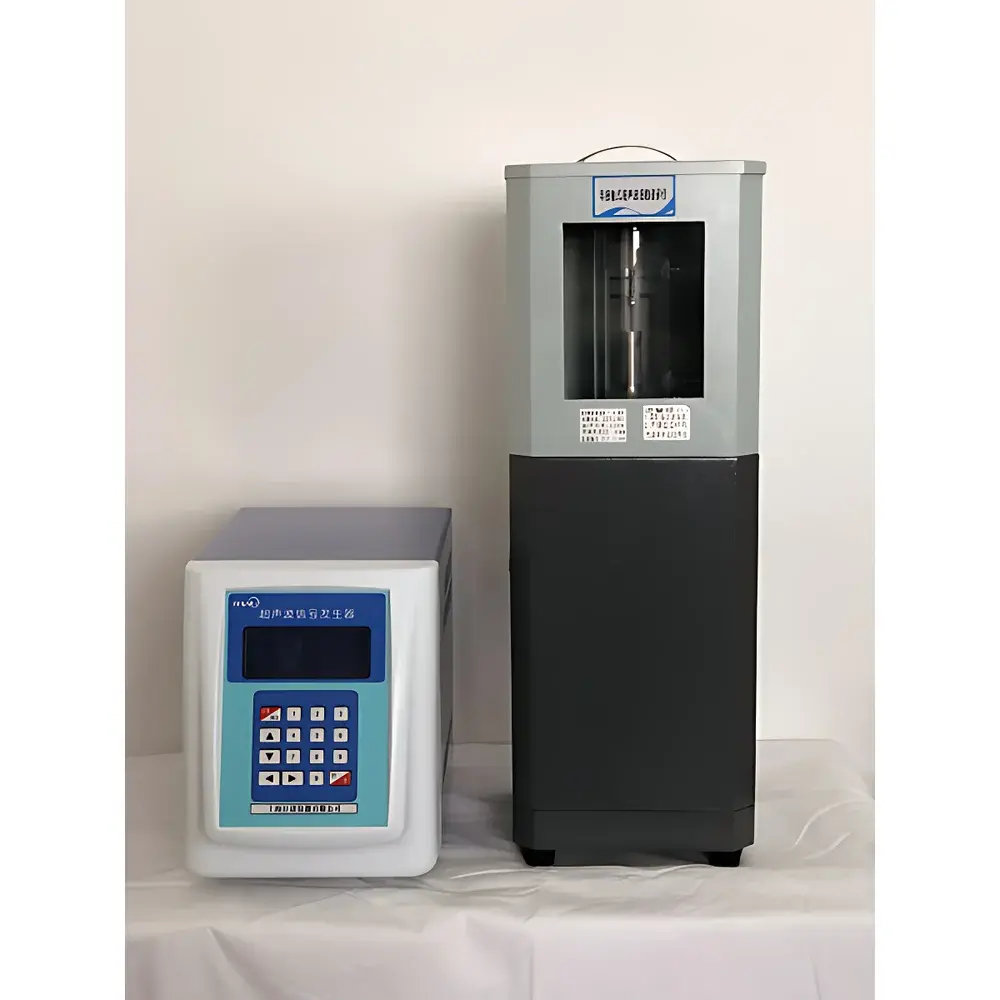
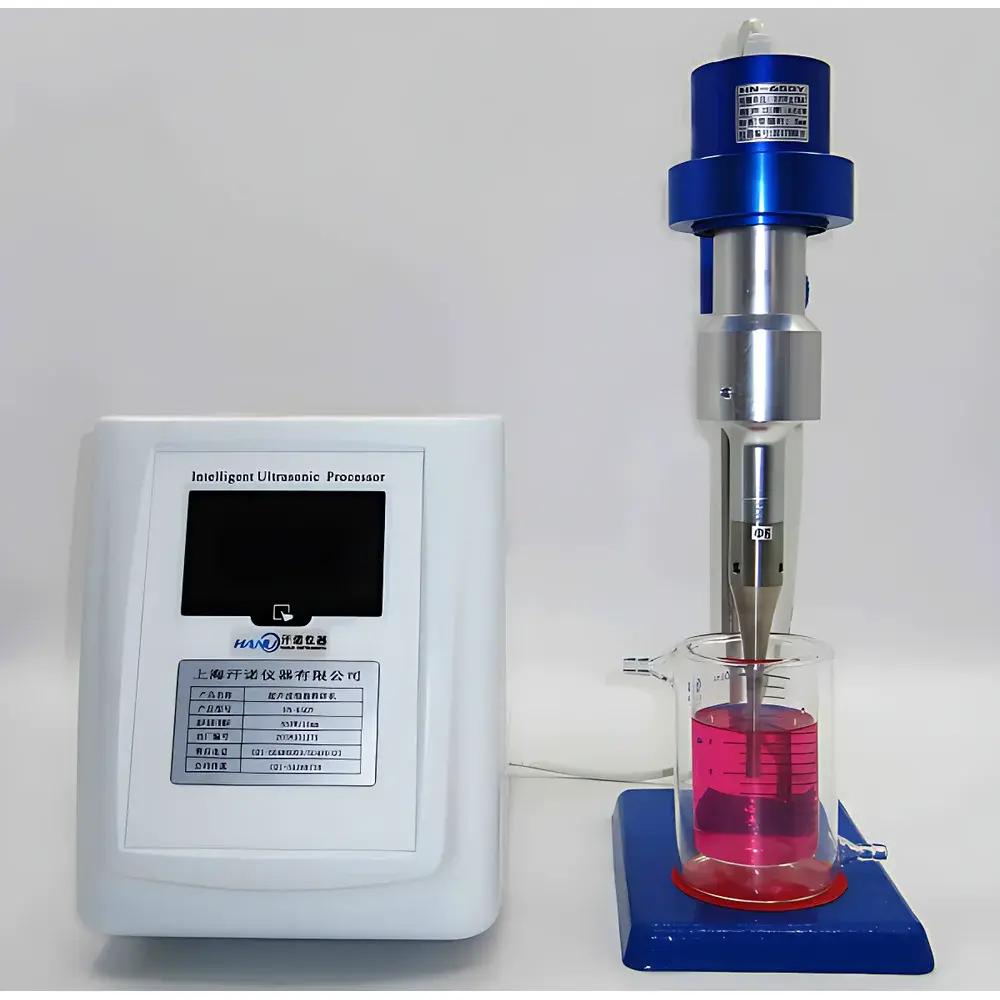
Hanuo HN96-II Ultrasonic Cell Disruptor
| Brand | Hanuo |
|---|---|
| Origin | Shanghai, China |
| Model | HN96-II |
| Instrument Type | Ultrasonic Cell Disruptor |
| Ultrasonic Power | 10–150 W |
| Operating Frequency | 20–25 kHz |
| Standard Probe | Φ6 mm |
| Sample Volume Capacity | 0.2–150 mL |
| Optional Probes | Φ2, Φ3, Φ8, Φ10 mm |
| Duty Cycle Range | 1–99.9% |
| Temperature Control Range | −5 to 100 °C |
| Probe Material | Titanium Alloy (Ti-6Al-4V) |
| Control System | Microprocessor-based, continuous power adjustment |
| Safety Features | Real-time temperature monitoring with thermal cutoff, automatic frequency tracking, fault diagnostics |
Overview
The Hanuo HN96-II Ultrasonic Cell Disruptor is a benchtop sonication system engineered for controlled, reproducible cell lysis and particle dispersion in life science and bioprocessing laboratories. It operates on the principle of high-intensity ultrasonic cavitation: piezoelectric transducers convert electrical energy into mechanical vibrations at 20–25 kHz, transmitted through a titanium alloy probe into liquid samples. This generates transient microbubbles that collapse violently near cellular structures—producing localized shear forces, microstreaming, and shockwaves sufficient to disrupt membranes, solubilize inclusion bodies, fragment chromatin, or disperse nanoparticles. Unlike enzymatic or mechanical homogenization methods, ultrasonic disruption offers rapid, scalable, and non-thermal (when properly cooled) lysis without introducing exogenous reagents—making it ideal for sensitive downstream applications including protein purification, nucleic acid extraction, and formulation development.
Key Features
- High-Efficiency Piezoelectric Transducer: Optimized ceramic stack design delivers stable acoustic output across the full 10–150 W power range, minimizing energy loss and thermal drift during extended operation.
- Microprocessor-Controlled Operation: Digital interface enables precise setting of sonication duration (1 s–99 min), duty cycle (1–99.9%), and real-time power modulation—critical for protocol standardization and GLP-compliant workflows.
- Integrated Temperature Management: Peltier-cooled sample chamber and optional external recirculating chiller support maintain sample integrity between −5 °C and 100 °C; automatic thermal cutoff prevents overheating-induced denaturation or aggregation.
- Titanium Alloy Probe System: Standard Φ6 mm probe fabricated from medical-grade Ti-6Al-4V ensures corrosion resistance, fatigue durability, and consistent acoustic impedance matching; optional probes (Φ2, Φ3, Φ8, Φ10 mm) accommodate varied vessel geometries and viscosity ranges.
- Intelligent Acoustic Regulation: Automatic frequency tracking compensates for load-dependent impedance shifts, preserving resonant efficiency during viscosity changes or probe wear; amplitude stabilization maintains constant cavitation intensity regardless of sample volume or density.
- Acoustic Containment: Acoustically damped enclosure lined with viscoelastic polymer foam attenuates airborne noise to <65 dB(A) at 1 m—meeting ISO 11201 occupational safety guidelines for routine lab use.
Sample Compatibility & Compliance
The HN96-II supports aqueous and low-viscosity organic suspensions (e.g., ethanol, isopropanol) commonly used in biomolecule extraction, nanomaterial synthesis, and emulsion preparation. It accommodates standard laboratory vessels—including 1.5–50 mL microcentrifuge tubes, 100–200 mL beakers, and jacketed reactors—with probe immersion depth adjustable to optimize energy transfer. The system complies with IEC 61000-6-3 (EMC emissions) and IEC 61000-6-2 (immunity), and its temperature-controlled operation aligns with USP sterility testing requirements for sample integrity. While not certified for GMP manufacturing environments, its audit-trail-capable software mode (via optional RS-232/USB logging) supports 21 CFR Part 11–aligned data recording when integrated with validated LIMS platforms.
Software & Data Management
The HN96-II features embedded firmware supporting parameter recall (up to 10 user-defined protocols), real-time display of instantaneous power, temperature, and elapsed time, and error-code diagnostics (e.g., E01 = overtemperature, E03 = probe detachment). An optional PC interface (RS-232 or USB-to-serial) enables remote control and timestamped data export in CSV format—facilitating SOP adherence, inter-laboratory method transfer, and QC documentation. All logged parameters meet minimum ALCOA+ criteria (Attributable, Legible, Contemporaneous, Original, Accurate) when paired with validated acquisition software and electronic signature modules.
Applications
- Cell lysis of bacterial (E. coli, Bacillus), yeast (S. cerevisiae), mammalian (HEK293, CHO), and plant tissue suspensions
- Chromatin shearing for ChIP-seq and ATAC-seq library preparation
- Preparation of subcellular fractions (mitochondria, nuclei, membrane vesicles)
- Nanoparticle dispersion and deagglomeration in drug delivery systems (liposomes, polymeric micelles)
- Emulsification of oil-in-water and water-in-oil formulations for cosmetic and pharmaceutical development
- Accelerated solvent extraction of metabolites, alkaloids, and polyphenols from botanical matrices
FAQ
What is the recommended maintenance interval for the titanium probe?
Probe inspection and surface cleaning with 70% ethanol or mild detergent should occur after each use; ultrasonic bath cleaning is discouraged. Annual calibration of power output and frequency stability is advised for labs operating under ISO/IEC 17025 or similar quality frameworks.
Can the HN96-II be used for continuous-flow processing?
No—it is designed exclusively for batch-mode sonication in static vessels. For continuous applications, consider dedicated flow-through ultrasonicators with integrated heat exchange and pressure regulation.
Is probe sterilization possible via autoclaving?
Titanium alloy probes are autoclavable at 121 °C, 15 psi for 20 minutes; however, repeated autoclaving may accelerate surface oxidation and affect acoustic coupling—chemical disinfection (e.g., 2% glutaraldehyde) is preferred for routine biocontainment.
How does duty cycle affect cavitation efficiency?
Lower duty cycles (e.g., 20%) extend probe lifespan and reduce bulk heating but require longer total treatment time to achieve equivalent disruption; higher duty cycles (>70%) maximize throughput but necessitate rigorous cooling to preserve macromolecular integrity.
Does the system support validation documentation for regulated environments?
The base unit includes a factory calibration certificate traceable to NIST standards; IQ/OQ documentation packages and 21 CFR Part 11 compliance add-ons (electronic signatures, audit trails) are available upon request through authorized distributors.




