
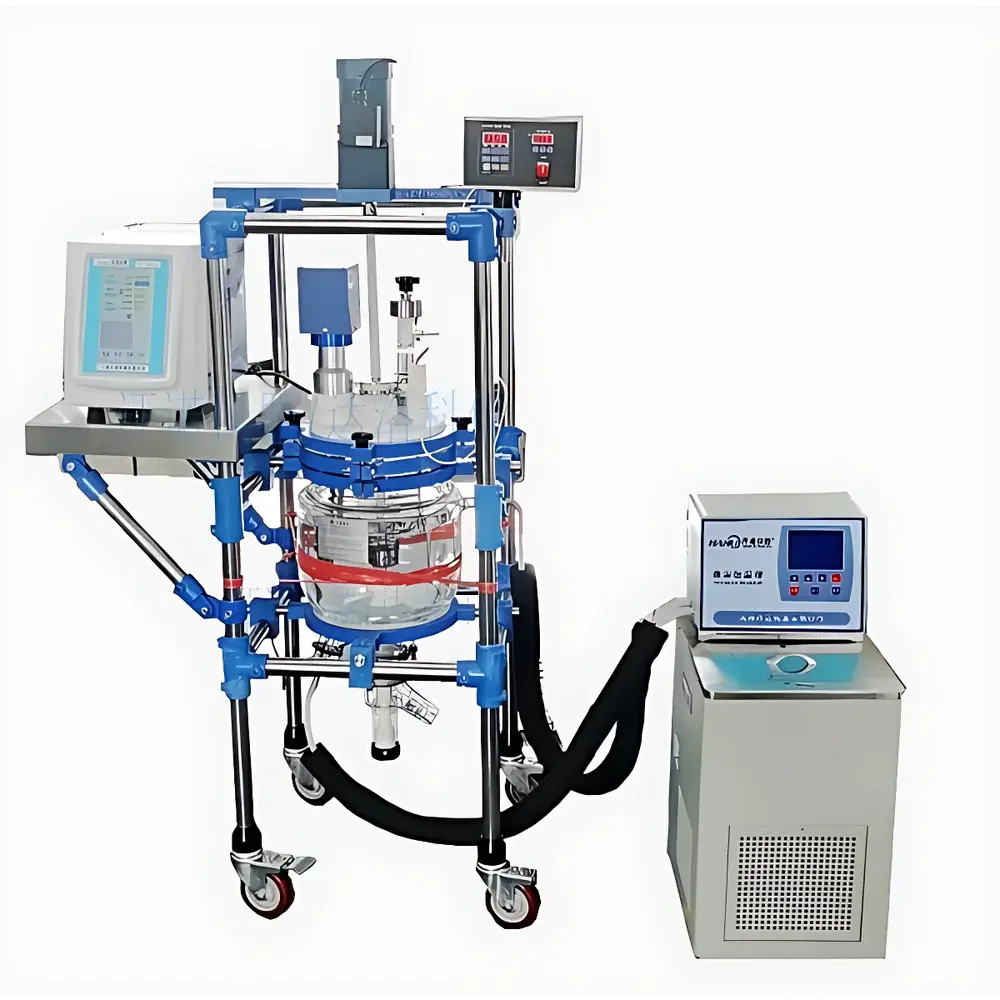
Daxluot Daxluot-5CTL Vertical Bench-Scale Ultrasonic Extraction Reactor
| Brand | Daxluot |
|---|---|
| Origin | Shanghai, China |
| Model | Daxluot-5CTL |
| Ultrasonic Power | 1800 W (continuously adjustable) |
| Frequency Range | 20–25 kHz |
| Heating Power | 1000 W |
| Temperature Range | −10 to 100 °C |
| Reactor Volume | 5000 mL |
| Stirring Power | 60 W |
| Stirring Speed | 10–1200 rpm |
| Ultrasonic Duty Cycle | 0.1–99.9% |
| Cooling Capacity | 500 W |
| Cooling Temperature Range | −5 °C to ambient |
| Power Supply | 220 V AC |
Overview
The Daxluot Daxluot-5CTL Vertical Bench-Scale Ultrasonic Extraction Reactor is an engineered platform for controlled, scalable ultrasonic-assisted extraction and reaction processes in laboratory and pilot-scale settings. It operates on the principle of high-intensity acoustic cavitation—generated by a focused ultrasonic transducer coupled via a titanium alloy probe (φ15 mm) directly immersed in the reaction medium. This direct energy coupling ensures efficient conversion of electrical input into mechanical acoustic energy, enabling rapid cell disruption, particle size reduction, emulsification, and enhanced mass transfer across solid–liquid and liquid–liquid interfaces. Integrated temperature control (−10 to 100 °C), programmable pulsed ultrasonication, and variable-speed mechanical agitation allow precise replication of process conditions required for method development, formulation optimization, and regulatory-compliant batch preparation.
Key Features
- Vertical double-jacketed reactor design with seamless 316 stainless steel construction—ensures structural integrity, chemical resistance, and absence of dead zones for uniform ultrasonic field distribution.
- 1800 W continuous ultrasonic power output, digitally adjustable from 1–99% amplitude, supporting reproducible energy delivery across diverse sample viscosities and densities.
- Programmable pulse mode: ultrasonic ON/OFF duration configurable from 0.1 s to 99.9 s, total cycle time up to 999 min—enabling thermal management during sensitive extractions.
- Integrated Peltier-assisted cooling system (500 W capacity) maintains sub-ambient temperatures down to −5 °C, critical for thermolabile compound preservation (e.g., flavonoids, enzymes, volatile oils).
- TFT color touchscreen interface with PLC + microcontroller architecture—supports intuitive operation, real-time parameter logging, and user-defined protocol storage (up to 100 methods).
- Simultaneous monitoring of internal temperature, ultrasonic duty cycle, stirring speed (10–1200 rpm), and elapsed time via on-screen dynamic curves.
- Dual-port fluid handling: dedicated inlet and outlet ports with standard glass joint fittings (e.g., ISO-KF or NS 29/32), compatible with external condensers, nitrogen purging, or inline filtration systems.
Sample Compatibility & Compliance
The Daxluot-5CTL accommodates heterogeneous matrices including plant biomass (dried herbs, roots, leaves), microbial cultures, food matrices (seeds, fruits), and synthetic polymer dispersions. Its sealed, jacketed configuration supports solvent-based (ethanol, methanol, ethyl acetate) and aqueous extractions under inert atmosphere or reflux conditions. The system meets fundamental design requirements for GLP-compliant documentation workflows: all operational parameters—including setpoints, actual readings, timestamps, and user IDs—are timestamped and exportable as CSV files. While not certified to IEC 61000-4 or UL 61010-1 out-of-box, its electrical architecture conforms to CE-marking baseline safety principles for laboratory equipment. Users performing pharmaceutical or nutraceutical extractions may align protocols with USP , ISO 17025 method validation guidelines, or Chinese Pharmacopoeia Chapter 2201 for ultrasonic extraction procedures.
Software & Data Management
The embedded control firmware provides local data acquisition at 1 Hz resolution for temperature, power output, and rotational speed. All sessions are auto-saved with metadata (operator ID, date/time stamp, protocol name). Export functionality supports USB flash drive transfer of raw time-series logs and summary reports. No cloud connectivity or remote access is implemented—ensuring full data sovereignty and alignment with institutional IT security policies. Audit trail capabilities include operator login history and parameter change logs, supporting internal QA reviews and pre-audit readiness for GMP-aligned laboratories.
Applications
- Natural product isolation: accelerated extraction of polysaccharides, alkaloids, terpenoids, and polyphenols from botanicals while minimizing thermal degradation.
- Biopharmaceutical processing: lysis of microbial cells (E. coli, yeast) for intracellular protein recovery; nanoparticle synthesis via sonochemical reduction.
- Food science research: stabilization of nanoemulsions, enzymatic hydrolysis enhancement, and allergen reduction in cereal-based matrices.
- Cosmetic ingredient development: dispersion of active botanical extracts into oil-in-water emulsions with narrow droplet size distribution (Dv50 < 200 nm, verified by complementary DLS analysis).
- Academic teaching labs: demonstration of cavitation physics, kinetic modeling of extraction rate constants, and comparative study of conventional vs. ultrasonic-assisted leaching efficiency.
FAQ
What is the maximum allowable working pressure inside the reactor?
The Daxluot-5CTL is designed for atmospheric and mild vacuum operation only (≤ −0.08 MPa gauge). Pressure-rated modifications are not supported.
Can the ultrasonic probe be replaced with custom geometries?
Yes—standard φ15 mm titanium probes are interchangeable with optional φ10 mm, φ20 mm, or stepped-tip variants (ordered separately); compatibility requires verification against transducer resonance matching.
Is calibration traceable to national standards?
Temperature sensors are factory-calibrated against NIST-traceable references; users may perform field verification using certified PT100 immersion probes—no built-in recalibration function is provided.
Does the system support external trigger signals for synchronization with analytical instruments?
No hardware trigger I/O (TTL, RS-232, or Ethernet) is integrated; temporal coordination must be achieved via manual timestamp alignment or third-party data acquisition software.
What maintenance intervals are recommended for sustained performance?
Ultrasonic horn tip inspection every 200 h of cumulative operation; cooling system descaling every 6 months if using hard water; annual verification of stirrer shaft seal integrity and thermal insulation efficiency.



