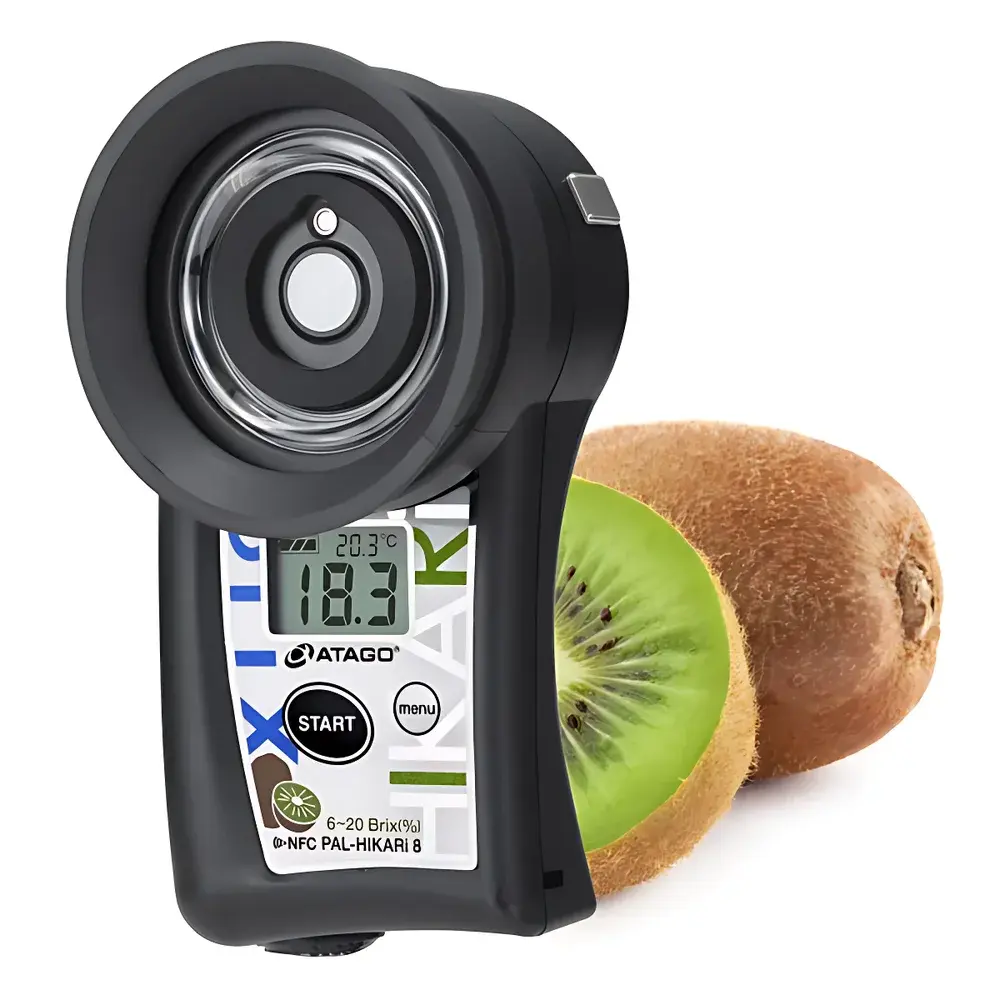
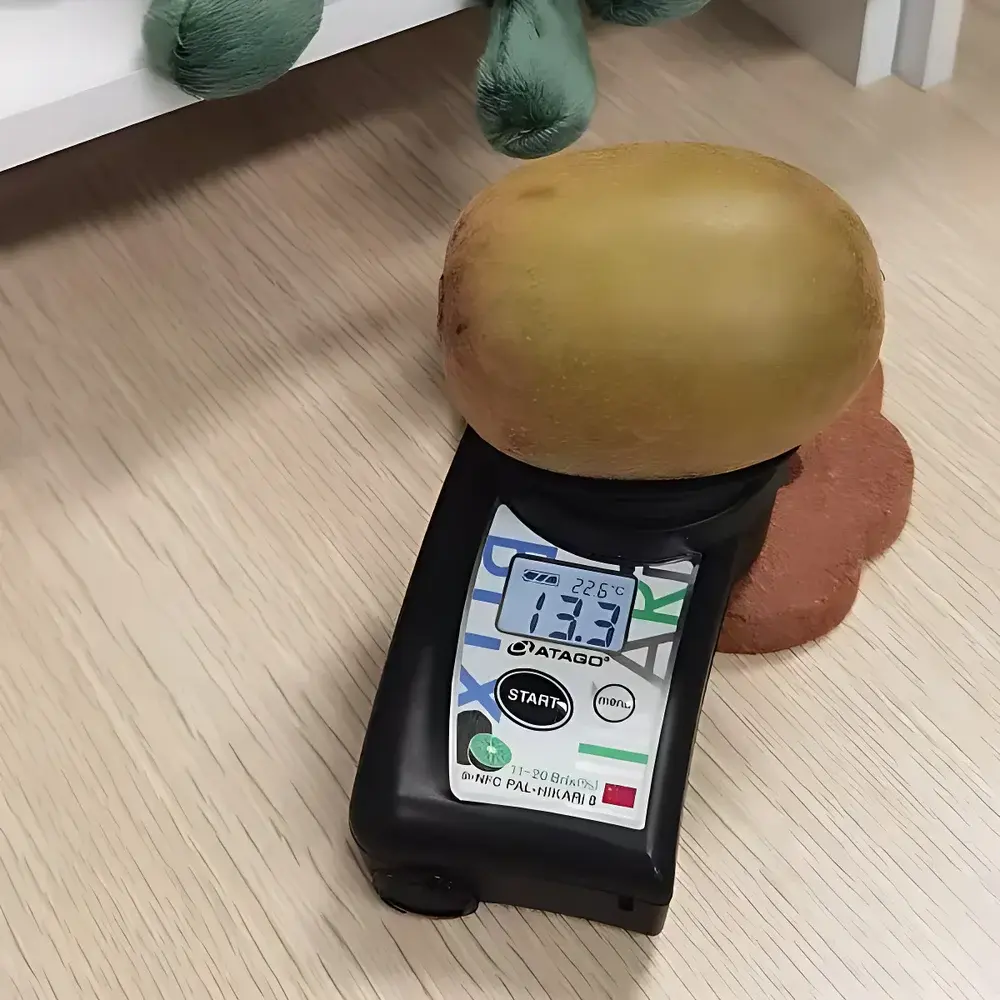
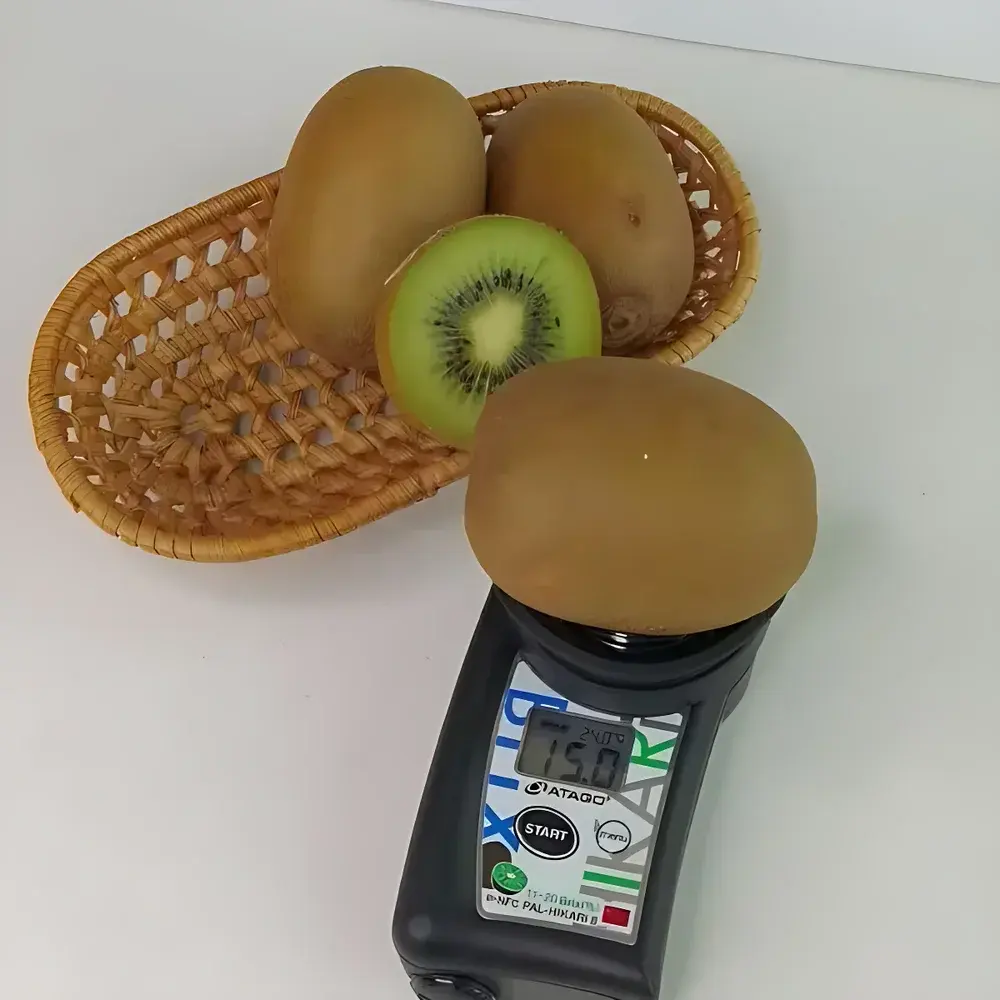
ATAGO PAL-HIKARi 8 Non-Destructive Infrared Brix Meter for Kiwifruit
| Brand | ATAGO |
|---|---|
| Origin | Japan |
| Model | PAL-HIKARi 8 |
| Instrument Type | Non-Destructive |
| Measurement Range | 6.0–20.0% Brix |
| Accuracy | ±1.5% Brix (varies by cultivar and ambient conditions) |
| Resolution | 0.1% Brix |
| Repeatability | ±1.5% Brix |
| Automatic Temperature Compensation | 5.0–35.0°C |
| IP Rating | IP64 |
| Power | Two AAA alkaline batteries |
| Dimensions | 6.1 × 4.4 × 11.5 cm |
| Weight | 120 g (instrument only) |
Overview
The ATAGO PAL-HIKARi 8 is a handheld, non-destructive infrared (IR) brix meter engineered specifically for in-situ ripeness assessment of kiwifruit (Actinidia deliciosa and Actinidia chinensis). Unlike conventional refractometers requiring juice extraction or destructive sampling, the PAL-HIKARi 8 employs near-infrared reflectance spectroscopy at optimized wavelengths to quantify soluble solids content (SSC) through intact fruit skin. This optical measurement principle relies on the characteristic absorption profile of sucrose, glucose, and fructose in the 700–1100 nm spectral region, enabling rapid (<3 s per measurement), operator-independent estimation of Brix without compromising fruit integrity. Designed for field deployment and post-harvest grading lines, the instrument meets the operational demands of commercial orchards, packing houses, and quality assurance laboratories seeking objective, repeatable metrics aligned with harvest readiness protocols and export compliance standards.
Key Features
- Non-invasive measurement: No fruit puncture, peeling, or juice expression required—preserves marketability and eliminates cross-contamination risk.
- Dedicated kiwifruit calibration: Factory-optimized spectral algorithm trained on multiple cultivars (e.g., Hayward, Zespri® SunGold™) across maturity stages and growing regions.
- Integrated temperature compensation: Real-time correction over 5.0–35.0°C ensures accuracy under variable orchard or storage conditions.
- Rugged industrial design: IP64-rated enclosure resists dust ingress and water splashes during outdoor use or humid cold-storage environments.
- Ergonomic handheld form factor: Compact dimensions (6.1 × 4.4 × 11.5 cm) and low mass (120 g) enable extended one-handed operation with minimal operator fatigue.
- Battery-powered portability: Dual AAA alkaline cells support >5,000 measurements per set; no external power supply or charging infrastructure needed.
Sample Compatibility & Compliance
The PAL-HIKARi 8 is validated exclusively for intact, unblemished kiwifruit with typical skin morphology (fuzzy or smooth) and surface moisture levels consistent with post-harvest handling. It is not intended for apples, pears, citrus, or other fruits lacking spectral calibration alignment. Measurements comply with ASTM D8197-21 (Standard Guide for Near-Infrared Spectroscopy in Agricultural Product Analysis) for non-destructive SSC estimation methodology. While not a regulatory-grade analytical instrument, its performance characteristics support Good Agricultural Practice (GAP) documentation, internal quality control checkpoints, and pre-shipment verification aligned with NZ Avocado Board, Zespri®, and EU UNECE FFV-20 standard reference thresholds for kiwifruit maturity (minimum 6.5–7.5% Brix at harvest).
Software & Data Management
The PAL-HIKARi 8 operates as a standalone field device with no embedded memory or Bluetooth connectivity. All measurements are displayed in real time on a high-contrast LCD screen and must be manually recorded. For traceability in GMP- or GLP-aligned environments, users integrate readings into external LIMS or Excel-based QC logs. ATAGO provides optional calibration verification kits (NIST-traceable sucrose standards) and service documentation compliant with ISO/IEC 17025 requirements for instrument verification. Firmware updates are not supported; calibration stability is maintained via biannual factory recalibration recommended per ISO 9001:2015 clause 7.1.5.2.
Applications
- Orchard harvest decision support: Objective Brix mapping across tree canopies to optimize picking windows and reduce under-/over-maturity losses.
- Packing house sorting: Rapid pass/fail screening of incoming lots against contractual SSC specifications prior to palletization.
- Post-harvest storage monitoring: Weekly non-destructive tracking of sugar accumulation during controlled-atmosphere ripening.
- Research trials: High-throughput phenotyping of breeding lines for SSC heritability studies without sacrificing experimental units.
- Extension services: On-farm demonstration tool for grower education on ripeness indicators and post-harvest physiology.
FAQ
Can the PAL-HIKARi 8 measure other fruits?
No. Its optical model and calibration are strictly limited to kiwifruit; using it on apples, grapes, or mangoes yields unreliable results due to divergent skin optical properties and sugar composition.
Does surface moisture affect accuracy?
Yes. Excess condensation or field-wet skin must be gently blotted before measurement; residual water alters IR reflectance and may bias readings downward by up to 0.8% Brix.
Is this instrument suitable for regulatory submission?
It is not certified for official export documentation or FDA/EFSA compliance reporting. It serves as a process control tool—not a primary analytical method per USP or ISO 5725.
How often should calibration be verified?
ATAGO recommends annual verification using supplied calibration check standards; full recalibration is advised every 24 months or after physical impact or extreme thermal cycling.
What does the ±1.5% Brix specification represent?
This reflects total measurement uncertainty encompassing instrument repeatability, sample heterogeneity (radial sugar gradients within fruit), and environmental variability—not inherent sensor error alone.