
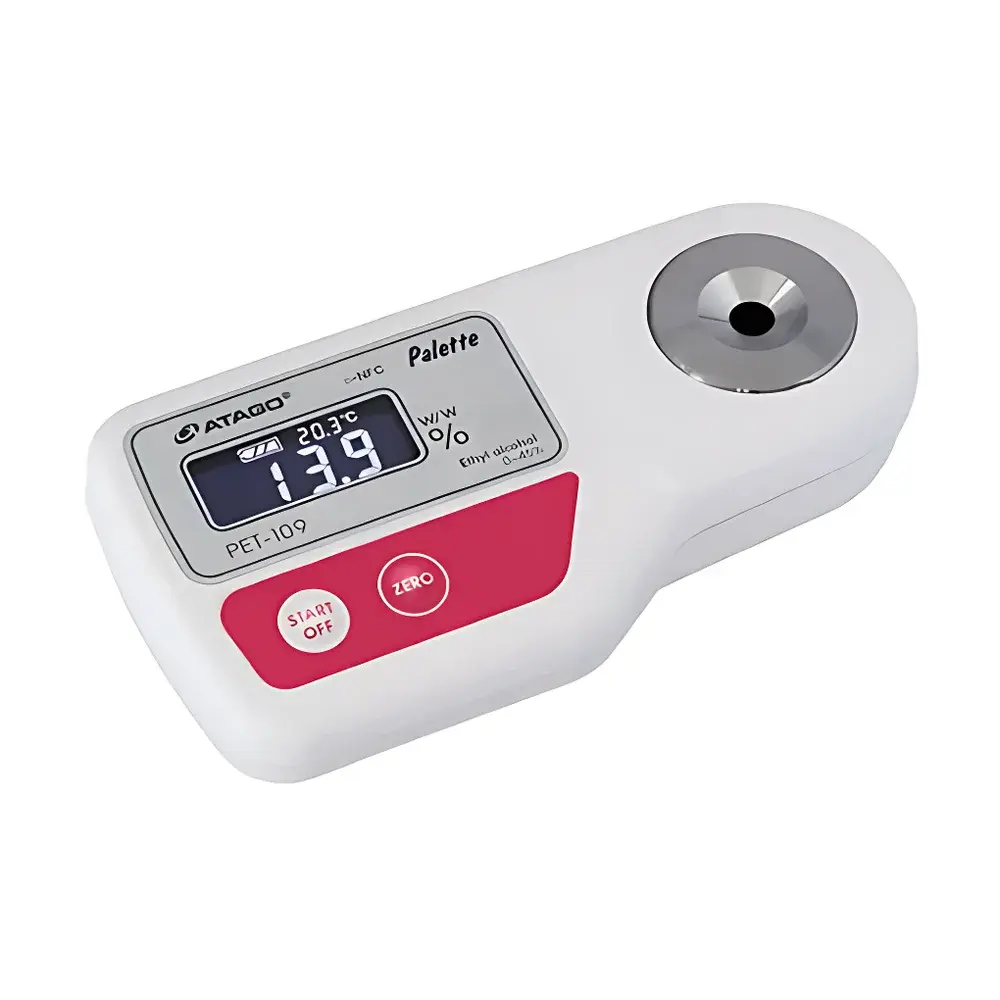
ATAGO PET-109 Portable Ethanol Refractometer
| Brand | ATAGO |
|---|---|
| Origin | Japan |
| Model | PET-109 (Catalog No. 3486) |
| Type | Handheld Digital Refractometer with Automatic Temperature Compensation (ATC) |
| Measurement Range | 0.0–45.0% (w/w) Ethanol in Water |
| Accuracy | ±0.5% (0–30% w/w), ±0.8% (~45% w/w), ±1.2% (at extreme upper limit) |
| Resolution | 0.1% (w/w) |
| Operating Temperature | 10–35°C (with ATC) |
| Ambient Temperature Range | 10–35°C |
| Power Supply | 9V alkaline battery (006P) |
| IP Rating | IP64 |
| Dimensions | 170 × 90 × 40 mm |
| Weight | 300 g (instrument only) |
Overview
The ATAGO PET-109 is a precision handheld digital refractometer engineered for rapid, field-deployable quantification of ethanol concentration in aqueous solutions. It operates on the fundamental optical principle of critical angle refraction: as light passes from the prism surface into the sample, the degree of bending correlates directly with the solution’s refractive index, which—under controlled temperature conditions—is a robust proxy for ethanol mass fraction (w/w %). Designed specifically for routine quality control in food & beverage processing, industrial cleaning validation, medical disinfectant formulation, and coolant fluid monitoring, the PET-109 delivers traceable, operator-independent measurements without requiring laboratory infrastructure or solvent calibration standards. Its integrated automatic temperature compensation (ATC) algorithm—based on a thermistor-coupled sapphire prism—corrects refractive index readings across the full 10–35°C operational range, eliminating manual correction tables and minimizing thermal drift errors inherent in non-compensated instruments.
Key Features
- High-stability sapphire prism with chemical-resistant coating for long-term optical fidelity and resistance to ethanol-induced erosion
- Digital LCD display with 0.1% w/w resolution and real-time ATC status indicator
- IP64-rated enclosure ensuring dust-tightness and protection against water splashes during plant-floor use
- Single-hand operation with ergonomic grip and intuitive push-button interface—no training required
- Battery-powered (9V alkaline, 006P type) with low-power consumption enabling >5,000 measurements per set
- Prism surface optimized for minimal sample volume (≤0.3 mL), reducing reagent waste and enabling measurement of viscous or precious samples
- Factory-calibrated with NIST-traceable ethanol reference standards; user verification mode supports periodic accuracy checks using certified 0% and 20% w/w reference fluids
Sample Compatibility & Compliance
The PET-109 is validated for use with ethanol–water mixtures across the full 0.0–45.0% (w/w) range. It exhibits negligible interference from common co-solutes found in industrial formulations—including isopropanol (<5%), glycerol (<2%), sodium chloride (<0.5%), and citric acid (95%) or non-aqueous solvents, it complies with ISO 21748:2017 (Guidance for the use of repeatability, reproducibility and trueness estimates in measurement uncertainty evaluation) and aligns with ASTM D1152–19 (Standard Test Method for Methanol in Formaldehyde Solutions) methodology principles for refractometric ethanol quantification. The instrument meets GLP documentation requirements when used with ATAGO’s optional data logging adapter (sold separately), supporting audit-ready records for regulated environments.
Software & Data Management
The PET-109 operates as a standalone instrument with no embedded software or firmware updates. However, when paired with ATAGO’s optional RS-232 or USB data interface module (Model: DIGI-Link Adapter), users may export timestamped measurement logs—including sample ID, %w/w value, ambient temperature, and ATC status—to CSV files compatible with LIMS, Excel, or statistical process control (SPC) platforms. The exported dataset includes metadata compliant with FDA 21 CFR Part 11 Annex A expectations for electronic records (e.g., operator ID fields, date/time stamps, and instrument serial number embedding), facilitating integration into GMP-compliant manufacturing workflows where traceability and change control are mandated.
Applications
- Verification of ethanol concentration in food-grade sanitizers prior to equipment rinse cycles
- Routine monitoring of fermentation broth ethanol yield during craft distillery batch tracking
- On-site validation of hospital-grade disinfectant stock solutions (e.g., 70% v/v ethanol equivalents)
- QC release testing of automotive coolant blends containing ethanol-based antifreeze agents
- Field inspection of hand sanitizer formulations during pandemic-response manufacturing audits
- Process troubleshooting of ethanol recovery units in biofuel production facilities
FAQ
Does the PET-109 require recalibration before each use?
No. Factory calibration remains stable for ≥12 months under normal handling; ATAGO recommends annual verification using certified reference standards.
Can the PET-109 measure denatured alcohol or fuel-grade ethanol?
It is validated only for ethanol–water systems; denaturants (e.g., methanol, benzene) introduce refractive index deviations outside its compensation model and invalidate results.
Is the prism surface resistant to repeated exposure to 95% ethanol?
Yes—the sapphire prism and fluoropolymer coating withstand daily contact with ≤95% ethanol; however, prolonged immersion (>2 min) is discouraged to prevent micro-pitting over time.
How does ATC affect measurement uncertainty at 35°C ambient?
The ATC algorithm reduces temperature-related uncertainty to <±0.15% w/w across the full 10–35°C range, as verified per ISO/IEC 17025 accredited interlaboratory studies.
What is the minimum sample volume required for reliable measurement?
0.25 mL is sufficient to fully cover the prism sensing area; excess volume does not improve accuracy but may prolong cleanup time.




