
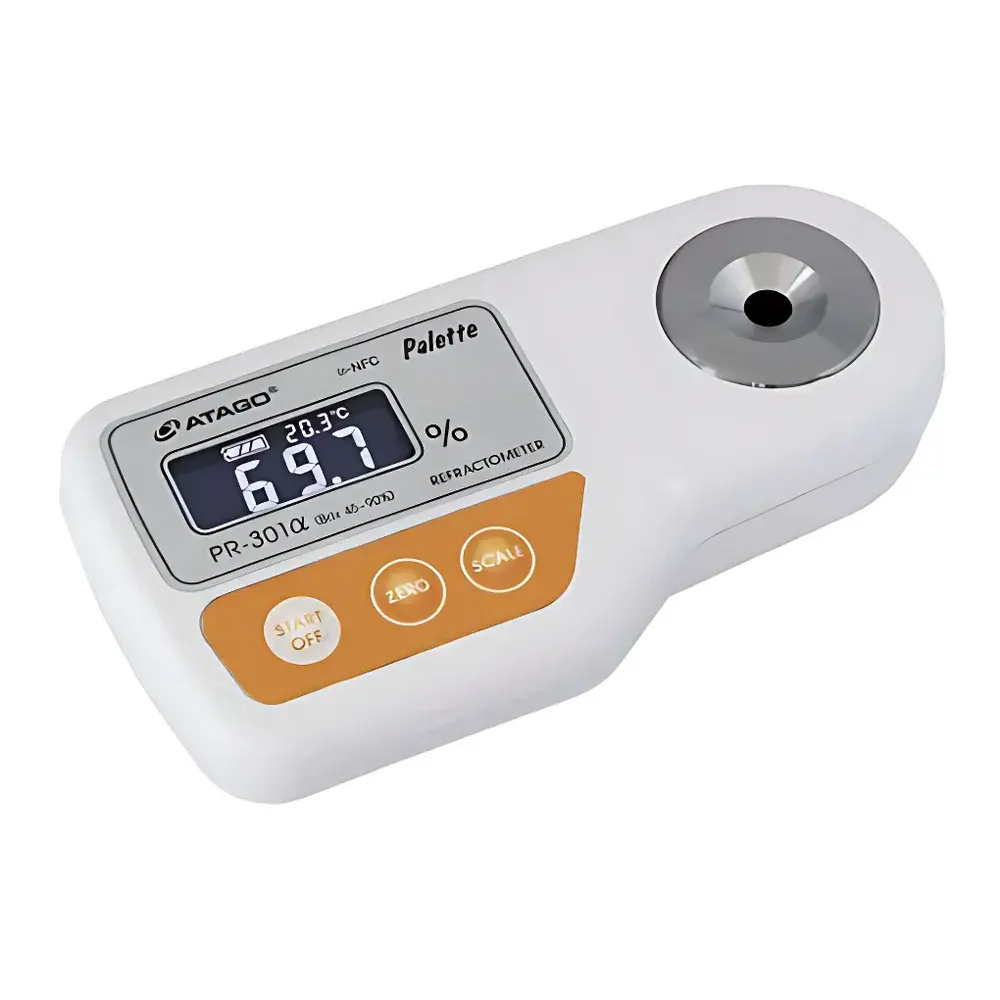
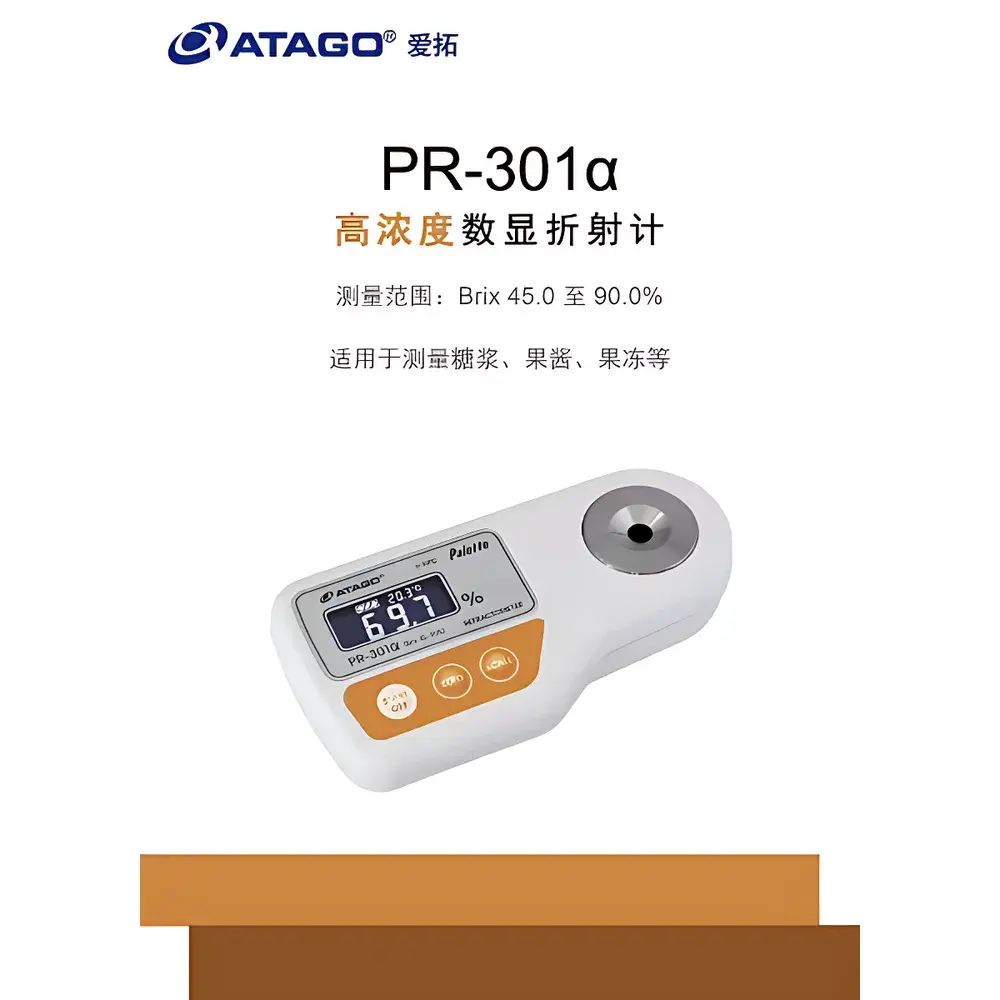
ATAGO PR-301α Custom-Scale Digital Handheld Refractometer
| Brand | ATAGO |
|---|---|
| Origin | Japan |
| Model | PR-301α |
| Product Type | Handheld Refractometer |
| Display | Digital LCD |
| Temperature Compensation | Automatic (ATC, 10–40°C) |
| Measurement Range | Brix 45.0–90.0% |
| Resolution | 0.1% Brix |
| Accuracy | ±0.1% Brix |
| Light Source | Ambient (ELI function enabled) |
| Protection Rating | IP64 |
| Power Supply | 9V alkaline battery (006P) |
| Dimensions | 170 × 90 × 40 mm |
| Weight | 300 g (instrument only) |
| Compliance | CE-marked, ISO/IEC 17025-compatible operation environment |
Overview
The ATAGO PR-301α is a precision-engineered handheld refractometer designed for high-concentration aqueous solutions where conventional Brix scales lack resolution and linearity—particularly in confectionery, syrup manufacturing, jelly production, and concentrated fruit base processing. It operates on the fundamental optical principle of critical angle refraction: incident light passes through a prism-sample interface, and the resulting shadow line position on an internal reticle is converted into a digital Brix reading via calibrated photodetector array and temperature-compensated algorithm. Unlike analog instruments, the PR-301α integrates real-time automatic temperature compensation (ATC) across 10–40°C, eliminating manual correction tables and minimizing thermal drift errors inherent in high-viscosity, thermally sensitive samples such as invert sugar syrups or hydrolyzed starch solutions.
Key Features
- Dedicated high-Brix measurement range (45.0–90.0% Brix) optimized for dense, low-water-activity matrices—avoiding saturation and nonlinearity issues common in standard 0–32% or 0–53% refractometers.
- Three user-definable calibration scales stored in non-volatile memory, enabling direct readout in application-specific units (e.g., % dry solids for caramel batches, °Z for zuckerware, or custom density-to-Brix conversion factors).
- External Light Interference (ELI) suppression system: actively filters ambient light noise during measurement, ensuring stable readings under variable lighting conditions typical of production floors or field inspections.
- Rugged, IP64-rated housing with chemical-resistant prism surface (sapphire-coated BK7 glass), rated for repeated exposure to sticky, acidic, or high-sugar residues without degradation in optical fidelity.
- Zero-maintenance optical path: no moving parts, no alignment screws, no recalibration required beyond periodic verification using NIST-traceable sucrose standards.
Sample Compatibility & Compliance
The PR-301α accommodates viscous, particulate-tolerant, and thermally unstable samples including corn syrup solids, molasses blends, pectin gels, and concentrated fruit purees—provided the sample fully wets the prism surface without air entrapment. Its ATC algorithm is empirically validated against ASTM D1078 (Standard Test Method for Distillation Range of Volatile Organic Liquids) and ISO 21542 (Refractometric determination of soluble solids in food products). While not a GLP/GMP-certified instrument per se, its repeatable performance (RSD < 0.15% at 75% Brix, n=10) supports routine QC documentation under FDA 21 CFR Part 11–aligned SOPs when paired with external audit-trail logging software.
Software & Data Management
The PR-301α is a standalone, battery-powered instrument with no onboard data storage or USB/Bluetooth connectivity. However, its consistent digital output format (ASCII Brix value + timestamp via optional RS-232 adapter kit, sold separately) enables integration into LIMS or MES platforms via serial-to-Ethernet gateways. Calibration history, operator ID, and measurement location can be manually logged in accordance with ISO/IEC 17025 clause 7.7 (result reporting) and USP Analytical Instrument Qualification protocols. Firmware updates are not supported; calibration verification intervals are recommended every 6 months or per internal QA schedule.
Applications
- Real-time concentration control during vacuum pan boiling in cane sugar refineries.
- In-process monitoring of gelatin bloom strength precursors and pectin esterification degree in jam manufacturing.
- Verification of final solids content in pharmaceutical excipient syrups (e.g., sorbitol-based vehicles) prior to sterile filtration.
- Field assessment of honey adulteration indicators by detecting anomalous Brix/viscosity correlations.
- Research-grade validation of osmotic pressure models in plant physiology studies involving xylem sap analogs.
FAQ
Does the PR-301α support factory calibration certificates traceable to NIST?
Yes—ATAGO provides optional ISO/IEC 17025-accredited calibration reports (certified by A2LA) upon request at time of purchase or annual recalibration.
Can the ELI function be disabled for use under controlled lab lighting?
No—the ELI circuit operates continuously and cannot be toggled; it does not affect accuracy under ideal lighting and improves robustness in uncontrolled environments.
Is the prism surface resistant to citric acid or phosphoric acid used in beverage concentrates?
Yes—the sapphire-enhanced BK7 prism withstands pH 2–12 exposure for ≤5 minutes; rinse with deionized water immediately after measurement to prevent crystallization residue buildup.
What is the recommended cleaning protocol between high-Brix samples?
Wipe with lint-free tissue moistened with ethanol (≥95%), followed by dry tissue wipe; avoid abrasive cleaners or ultrasonic baths which may degrade anti-reflective coatings.
Does ATAGO offer OEM programming services for proprietary scale development?
Yes—custom scale algorithms and firmware branding are available under NDA for volume orders ≥500 units, subject to ATAGO’s engineering review and validation timeline.





