
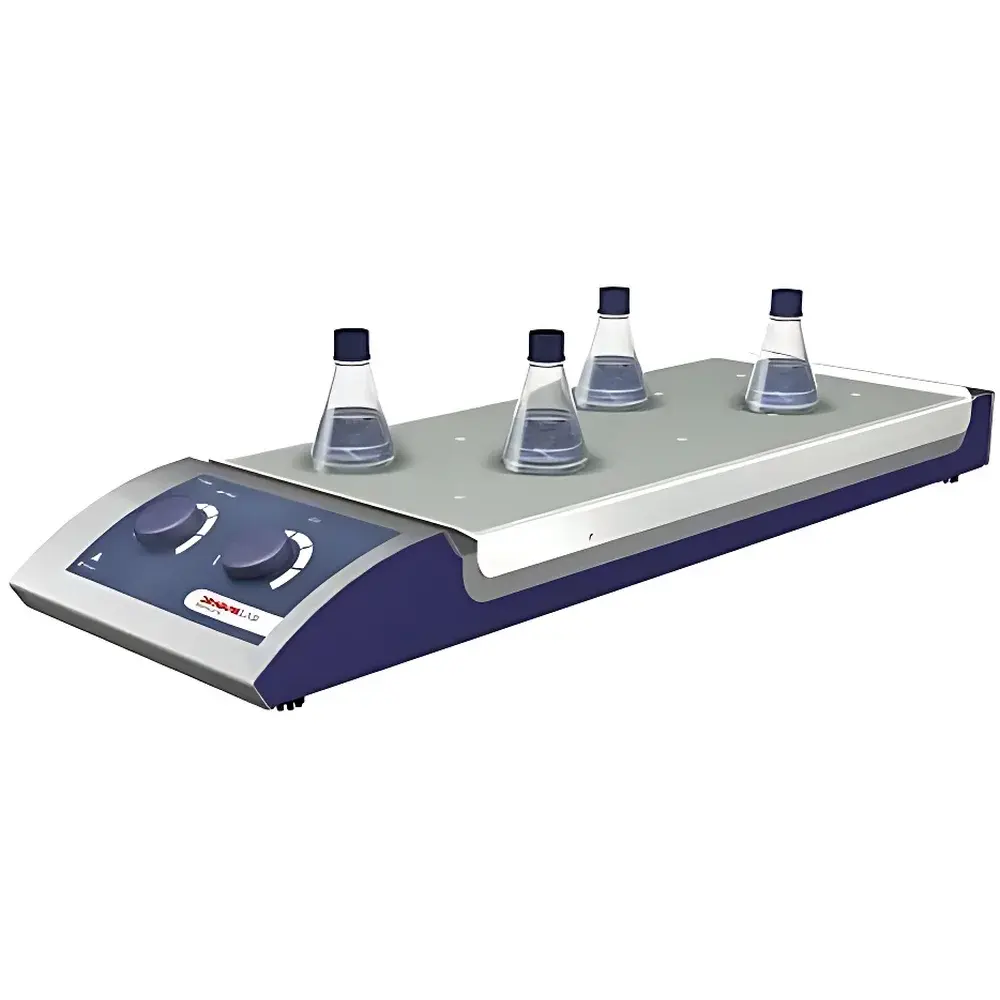
SCILOGEX MS-H-S10 10-Position Heated Magnetic Stirrer
| Brand | SCILOGEX |
|---|---|
| Origin | USA |
| Model | MS-H-S10 |
| Instrument Type | Heated Magnetic Stirrer |
| Max Total Stirring Volume (H₂O) | 4 L |
| Stirring Speed Range | 0–1100 rpm |
| Heating Temperature Range | Ambient to 120 °C |
| Number of Stirring Positions | 10 |
| Position Spacing | 90 mm |
| Max Stir Bar Length | 40 mm |
| Speed Uniformity per Position | ±5% |
| Power Supply | 220 VAC, 50/60 Hz |
| Total Power | 490 W |
| Heating Power | 470 W |
| Work Plate Material | Stainless Steel with Silicone Resin Coating |
| Work Plate Dimensions | 180 × 450 mm |
| Overall Dimensions | 182 × 552 × 65 mm |
| Weight | 3.2 kg |
| Environmental Operating Range | 5–40 °C, ≤80% RH |
| Ingress Protection | IP42 |
Overview
The SCILOGEX MS-H-S10 is a precision-engineered 10-position heated magnetic stirrer designed for high-throughput laboratory workflows requiring simultaneous, reproducible agitation and thermal control across multiple samples. Based on the fundamental principle of magnetic coupling—where a rotating permanent magnet beneath the work surface induces synchronous rotation of PTFE- or glass-coated stir bars immersed in liquid—the MS-H-S10 delivers consistent hydrodynamic shear and mass transfer conditions across all ten independent positions. Unlike conventional single-station stirrers, its parallel architecture eliminates inter-sample variability caused by sequential processing, making it especially suitable for reaction optimization, dissolution testing, buffer equilibration, and multi-well kinetic studies. The integrated heating system employs a uniform-resistance embedded heating element coupled with proportional temperature control, ensuring spatial temperature homogeneity within ±2 °C across the entire plate surface—critical for comparative experiments where thermal consistency directly impacts reaction kinetics and solubility profiles.
Key Features
- 10 independent stirring positions with fixed 90 mm center-to-center spacing—optimized for compatibility with standard 12–50 mL glass vials, 100 mL beakers, and multi-well reaction blocks
- Brushless DC motor drive per position—eliminates carbon brush wear, reduces acoustic noise (<45 dB at 1 m), and extends operational lifetime beyond 20,000 hours under continuous duty
- Closed-loop speed regulation via real-time back-EMF feedback—maintains set rpm within ±5% tolerance despite viscosity changes or load fluctuations (e.g., during polymer dissolution or precipitation onset)
- Stainless steel work surface coated with chemically resistant silicone resin—provides non-slip retention for vessels and withstands repeated exposure to acids, bases, and organic solvents
- Digitally calibrated analog speed dial with engraved rpm scale (0–1100 rpm) and independent heat control knob—enables rapid, tool-free parameter adjustment without software dependency
- IP42-rated enclosure—protects internal electronics from accidental splashes and particulate ingress during routine benchtop use
Sample Compatibility & Compliance
The MS-H-S10 accommodates vessels ranging from 5 mL microcentrifuge tubes (with compatible mini stir bars) up to 400 mL low-form beakers, with a maximum individual capacity of 0.4 L per position and a total system limit of 4 L (H₂O-equivalent). Stir bar compatibility spans lengths from 10 mm to 40 mm (diameters 6–8 mm), supporting both standard cylindrical and elliptical geometries. All materials in contact with the work surface—including the silicone resin coating and stainless steel substrate—comply with USP Class VI biocompatibility requirements. While the unit itself does not carry CE or UKCA marking for medical device applications, its electrical safety conforms to IEC 61010-1:2010 and EMC performance meets EN 61326-1:2013. For GLP-regulated environments, the absence of digital logging precludes 21 CFR Part 11 compliance; however, manual logbook documentation of setpoints and duration satisfies basic audit requirements for non-critical preparatory steps.
Software & Data Management
The MS-H-S10 operates as a standalone analog instrument with no embedded firmware, cloud connectivity, or data export capability. This design prioritizes operational robustness, electromagnetic immunity, and long-term calibration stability over digital feature creep. All parameters—stirring speed and plate temperature—are set manually via calibrated dials and verified visually through engraved scales. No drivers, USB interfaces, or proprietary software are required. For laboratories requiring traceable parameter records, users may integrate the MS-H-S10 into validated SOPs using external time-stamped video capture or manual entry into electronic lab notebooks (ELNs) such as LabArchives or Benchling. Optional accessories—including stir bar retrievers and position-matched bar sets—support repeatable setup across shifts and operators.
Applications
- High-throughput buffer preparation and pH adjustment across 10 parallel samples prior to HPLC or electrophoresis
- Accelerated stability testing of pharmaceutical formulations under controlled thermal agitation
- Multi-condition enzymatic assay development—simultaneous evaluation of cofactor concentration, pH, and temperature effects
- Uniform dispersion of nanomaterials (e.g., graphene oxide, metal oxides) in aqueous or organic media for DLS or TEM sample prep
- Parallel synthesis of coordination polymers or MOFs where identical mixing intensity and thermal history are essential for crystallinity reproducibility
- Teaching labs conducting comparative kinetics experiments—students independently adjust one variable (e.g., catalyst loading) while holding agitation and temperature constant across replicates
FAQ
Can the MS-H-S10 be used with corrosive solvents such as concentrated HCl or THF?
Yes—the silicone resin-coated stainless steel plate demonstrates resistance to short-term exposure (<30 min) to 6 M HCl, 10% NaOH, and anhydrous THF at temperatures ≤80 °C. Prolonged contact or elevated temperatures require evaluation per ASTM D543.
Is speed calibration traceable to NIST standards?
No—speed indication is analog and uncalibrated. For applications demanding metrological traceability, users should validate rpm with an external optical tachometer (e.g., Extech 461923) against the engraved scale.
What is the recommended maintenance interval?
No scheduled maintenance is required. Wipe the work surface with isopropanol after each use; inspect stir bars for coating integrity before reuse.
Does the unit support external temperature probes for PID feedback control?
No—it lacks probe input terminals or programmable logic. Temperature control is open-loop, based solely on surface thermistor feedback.
Can I operate only 3 of the 10 positions without affecting performance?
Yes—motor load distribution is position-independent. Unused positions remain electrically inert and do not influence thermal uniformity or speed stability of active stations.



