
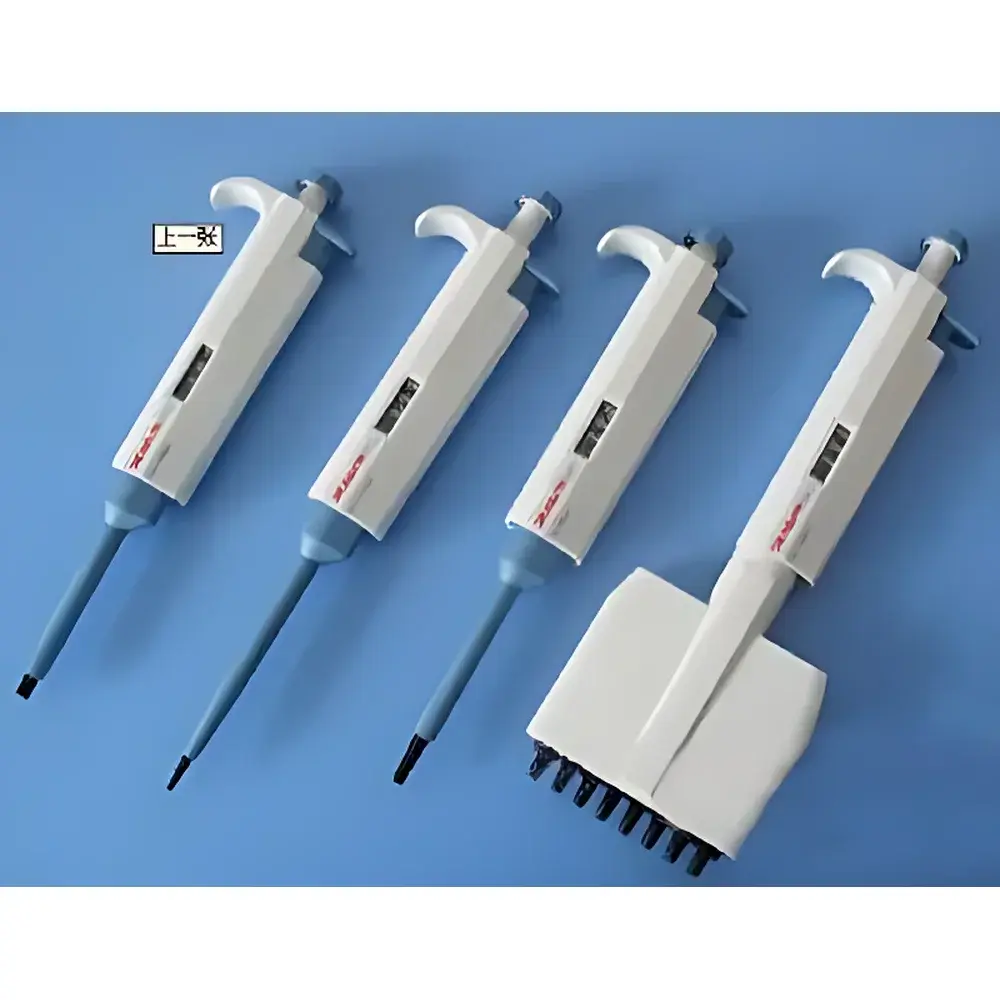
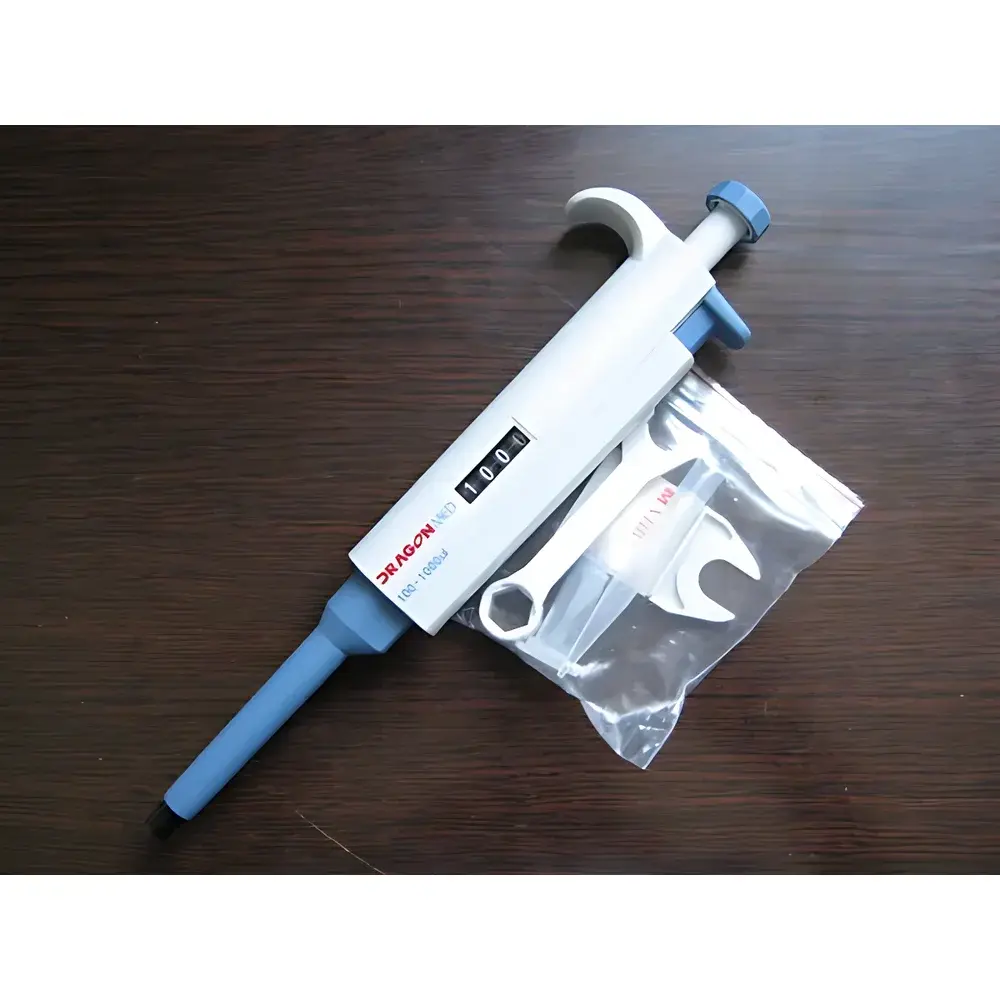
DLAB Toppette Manual Single-Channel Pipette, 100–1000 µL
| Brand | DLAB |
|---|---|
| Origin | Beijing, China |
| Pipette Type | Manual Single-Channel |
| Volume Range | 100–1000 µL |
| Maximum Capacity | 1000 µL |
| Accuracy | ±6 µL (±0.6%) |
| Precision | ±0.2% |
| Tip Compatibility | Standard Conical 1000 µL Tips |
| Sterilization | Autoclavable (121 °C, 20 min) |
| Adjustable Volume | Yes |
| Volume Lock | Integrated |
| Weight | <120 g |
| Material | Chemically Resistant Polypropylene & Stainless Steel Components |
Overview
The DLAB Toppette Manual Single-Channel Pipette (100–1000 µL) is a precision-engineered liquid handling instrument designed for routine and high-frequency pipetting tasks in academic, clinical, and industrial laboratories. Based on positive displacement air-cushion mechanics, it delivers reproducible volumetric delivery across its full range through calibrated spring-loaded piston actuation and consistent plunger travel. Unlike electronic or motorized systems, this manual pipette prioritizes mechanical reliability, tactile feedback, and long-term calibration stability—making it ideal for applications where simplicity, serviceability, and compliance with GLP/GMP workflows are essential. Its lightweight construction (<120 g), ergonomic grip geometry, and low actuation force reduce operator fatigue during extended use—critical for QC labs performing hundreds of transfers per shift.
Key Features
- Ergonomic, two-tone gray-and-blue housing engineered to align with natural hand contours—minimizing grip strain and improving control during repetitive operations.
- Digital volume window with high-contrast numerals enables rapid, unambiguous verification of setpoint without repositioning the pipette.
- Integrated volume lock prevents accidental adjustment during transport or storage—ensuring traceability between calibration events.
- Detachable tip cone assembly fabricated from autoclavable, chemically resistant polypropylene and stainless steel; validated for ≥20 cycles at 121 °C / 103 kPa for sterility assurance.
- Replaceable hydrophobic filter barrier within the tip cone protects internal mechanisms from aerosol contamination and sample carryover—reducing cross-contamination risk in molecular biology and diagnostic workflows.
- Tool-free disassembly design supports field-level maintenance: O-rings, seals, and piston components are accessible using standard DLAB service tools (included).
- Quick-release ejector mechanism reduces thumb pressure by >40% compared to legacy designs—validated via ISO 8549-1 anthropometric testing protocols.
Sample Compatibility & Compliance
The Toppette 100–1000 µL pipette accommodates all industry-standard conical 1000 µL tips meeting ISO 8655-2 dimensional tolerances. It maintains accuracy and precision when dispensing aqueous solutions (e.g., PBS, Tris-HCl), viscous buffers (≤50 cP), and ethanol/water mixtures (up to 70% v/v). Performance conforms to ISO 8655-1 (General Requirements) and ISO 8655-6 (Test Methods for Piston-Operated Volumetric Apparatus), with certified uncertainty budgets traceable to NIM (National Institute of Metrology, China). Calibration certificates include as-found/as-left data, temperature/humidity metadata, and compliance statements aligned with ISO/IEC 17025 requirements. The device supports audit-ready documentation for FDA 21 CFR Part 11–governed environments when paired with DLAB’s optional calibration logbook templates.
Software & Data Management
As a manually operated instrument, the Toppette requires no embedded firmware or connectivity. However, its calibration history, maintenance logs, and user-defined SOPs integrate seamlessly into laboratory information management systems (LIMS) via standardized CSV export from DLAB’s free PipetteLog desktop application (Windows/macOS). This tool enables version-controlled recordkeeping, scheduled recalibration alerts, and deviation reporting aligned with ALCOA+ principles (Attributable, Legible, Contemporaneous, Original, Accurate). All calibration events generate PDF reports compliant with ISO/IEC 17025 clause 7.8.2, including measurement uncertainty calculations per GUM (JCGM 100:2008).
Applications
This pipette is routinely deployed in applications demanding repeatable mid-volume transfer: preparation of ELISA assay plates, serial dilution of reference standards in environmental testing, cell culture media supplementation, PCR master mix assembly, and QC sampling for pharmaceutical excipient analysis. Its robustness under high-throughput conditions makes it suitable for ISO 17025-accredited testing labs performing ASTM D1193 (reagent water) or USP analytical instrument qualification. The autoclavable tip cone ensures compatibility with sterile technique requirements in microbiology and bioprocessing environments—particularly where laminar flow hood integration and frequent decontamination cycles are mandated.
FAQ
Is the Toppette 100–1000 µL pipette certified for ISO 8655 compliance?
Yes—each unit ships with a factory calibration certificate referencing ISO 8655-6 test methodology and includes uncertainty values derived from NIM-traceable standards.
Can this pipette be sterilized in an autoclave without compromising accuracy?
Yes—the tip cone and lower body components are rated for 20 autoclave cycles at 121 °C / 103 kPa; post-sterilization verification recommends checking accuracy at 100 µL and 1000 µL using gravimetric method per ISO 8655-6 Annex B.
What is the recommended recalibration interval under GLP conditions?
DLAB recommends quarterly calibration for daily use; semiannual intervals are acceptable for intermittent use (<50 operations/week), provided usage logs and performance verification checks (e.g., daily 1000 µL water delivery test) are maintained.
Does the pipette support third-party tip brands?
It is fully compatible with any ISO 8655-compliant 1000 µL conical tip; however, DLAB-certified tips guarantee optimal seal integrity and error minimization across the full volume range.
How is traceability maintained during field servicing?
All replacement parts (pistons, O-rings, filters) carry unique batch IDs and material certifications; service records must document part numbers, installation dates, and post-service verification results per ISO/IEC 17025 clause 6.4.10.
Related Products



