
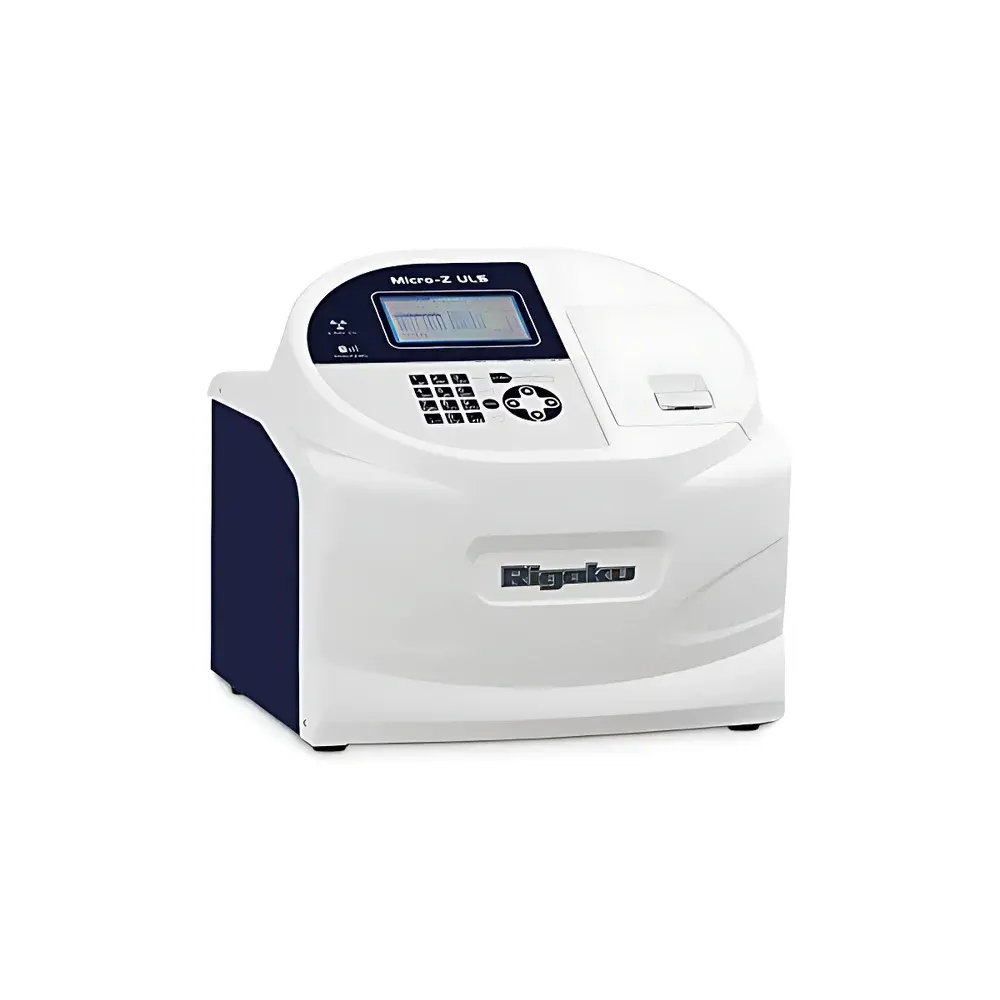
Rigaku Micro-Z Cl Single-Wavelength Wavelength Dispersive X-Ray Fluorescence (WDXRF) Analyzer for Ultra-Low Chlorine Analysis
| Brand | Rigaku |
|---|---|
| Origin | Japan |
| Model | Micro-Z Cl |
| Instrument Type | Benchtop |
| Excitation Mode | Single-Wavelength |
| Analyte | Total Chlorine |
| X-ray Tube Power | 80 W |
| Detection Limit | 0.11 ppm |
| Quantification Range | 0–5 wt% |
| Analysis Time | 300 s |
| Vacuum Requirement | Yes (gas-free operation) |
| Compliance | SH/T 0977, ASTM D7536 |
| Operating Environment | 10–40 °C, <80% RH |
| Dimensions (W×D×H) | 45 × 41 × 43 cm |
| Weight | 40 kg |
| Power Supply | AC 200–240 V |
Overview
The Rigaku Micro-Z Cl is a benchtop single-wavelength wavelength dispersive X-ray fluorescence (WDXRF) spectrometer engineered specifically for ultra-low-level total chlorine quantification in hydrocarbon matrices. Unlike energy-dispersive (EDXRF) systems, the Micro-Z Cl employs high-resolution Bragg diffraction using a fixed-analyzer crystal to isolate the Cl Kα emission line (2.622 keV) with exceptional spectral selectivity—minimizing interferences from sulfur, silicon, and transition metals commonly present in refined fuels and crude oils. Its monochromatic excitation design utilizes a focused, high-intensity X-ray beam generated by an 80 W sealed-tube source, optimized to maximize signal-to-background ratio for chlorine without requiring helium purge or reactive gas flow. This architecture enables reliable detection down to 0.11 ppm (mass basis) in accordance with SH/T 0977 and ASTM D7536 protocols—making it suitable for refinery process control, custody transfer verification, and regulatory compliance testing under ISO 8217, ASTM D4294, and UOP 477 frameworks.
Key Features
- Single-wavelength WDXRF architecture delivering superior spectral resolution and chlorine-specific sensitivity
- Gas-free operation enabled by integrated vacuum system—eliminates argon/helium consumption and associated infrastructure costs
- Benchtop footprint (45 × 41 × 43 cm) designed for seamless integration into QC laboratories, blending portability with analytical robustness
- Stable calibration performance: certified drift correction supports annual recalibration intervals per SH/T 0977 requirements
- Non-contact sample measurement using disposable polypropylene or Mylar-backed sample cups—no solvent extraction, no membrane cutting, no cross-contamination risk
- Integrated high-voltage power supply and X-ray tube with field-serviceable modules; critical components (X-ray source, HV generator) support on-site replacement by authorized Rigaku service engineers in mainland China
Sample Compatibility & Compliance
The Micro-Z Cl is validated for direct analysis of liquid hydrocarbon samples including gasoline, diesel fuel, jet fuel (Jet A/A-1), naphtha, crude oil, and lubricant base stocks. Sample introduction requires minimal preparation: 2–3 mL transferred into standardized 32-mm-diameter sample cups sealed with low-chlorine polymer film. No digestion, dilution, or chemical derivatization is necessary. The instrument meets full technical equivalence to SH/T 0977 (Chinese petroleum industry standard) and ASTM D7536 (Standard Test Method for Chlorine in Hydrocarbons by Wavelength Dispersive X-ray Fluorescence Spectrometry). Data integrity complies with GLP and GMP principles; audit trails, user access logs, and electronic signature support are configurable to align with FDA 21 CFR Part 11 readiness requirements.
Software & Data Management
Operation is managed via Rigaku’s proprietary ClQuant software, built on a Windows 10 IoT Enterprise platform. The interface provides guided workflow navigation—from sample registration and method selection to real-time spectrum visualization and automated peak integration. Calibration curves are stored with metadata (date, operator, reference standards used), and all raw spectra are archived in vendor-neutral .rxf format. Data export supports CSV, PDF report generation, and direct LIMS integration via ASTM E1384-compliant HL7 or ODBC drivers. Software validation documentation (IQ/OQ/PQ templates) and change control records are provided to support regulated laboratory implementation.
Applications
- Monitoring chlorine ingress in refinery feedstocks to prevent catalyst poisoning in hydrotreating and FCC units
- Verifying chlorine content in aviation turbine fuels against ASTM D1655 and DEF STAN 91-91 specifications (max 1 ppm)
- Supporting ISO 8217 Annex B compliance for residual and distillate marine fuels
- Quality assurance of petrochemical intermediates such as chlorinated solvents and alkyl chloride derivatives
- Investigating chloride-induced stress corrosion cracking (CISC) risks in pipeline transport systems
FAQ
Does the Micro-Z Cl require external cooling water or compressed air?
No. The instrument operates with passive thermal management and does not require auxiliary utilities beyond standard AC power and vacuum pump exhaust ventilation.
Can the system analyze solid or viscous samples such as bitumen or heavy fuel oil?
It is optimized for low-viscosity liquids; high-boiling or asphaltic samples require dilution with xylene or toluene to ensure homogeneous film formation and avoid sedimentation artifacts.
Is method transfer possible between different Micro-Z Cl units?
Yes—cross-instrument reproducibility is maintained within ±5% RSD at 1 ppm Cl level when using identical calibration standards and cup geometry, per ASTM D7536 Section 11.1.
What maintenance is required beyond annual calibration?
Routine tasks include vacuum pump oil replacement every 6 months, optical path inspection quarterly, and periodic verification of X-ray tube output stability using certified check standards.
How is data security enforced during remote diagnostics?
Remote support sessions initiate only upon explicit user authorization and employ TLS 1.2 encrypted tunnels; no persistent remote access credentials are stored on the instrument.





