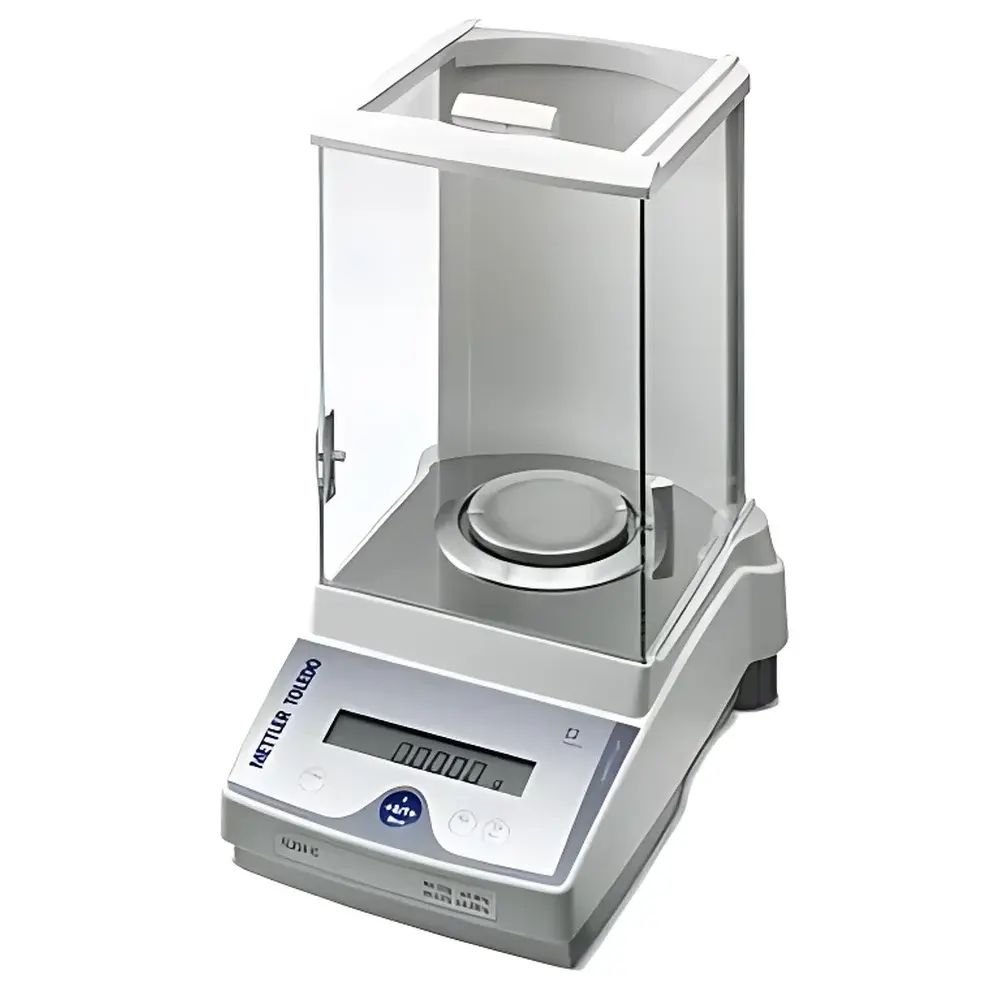
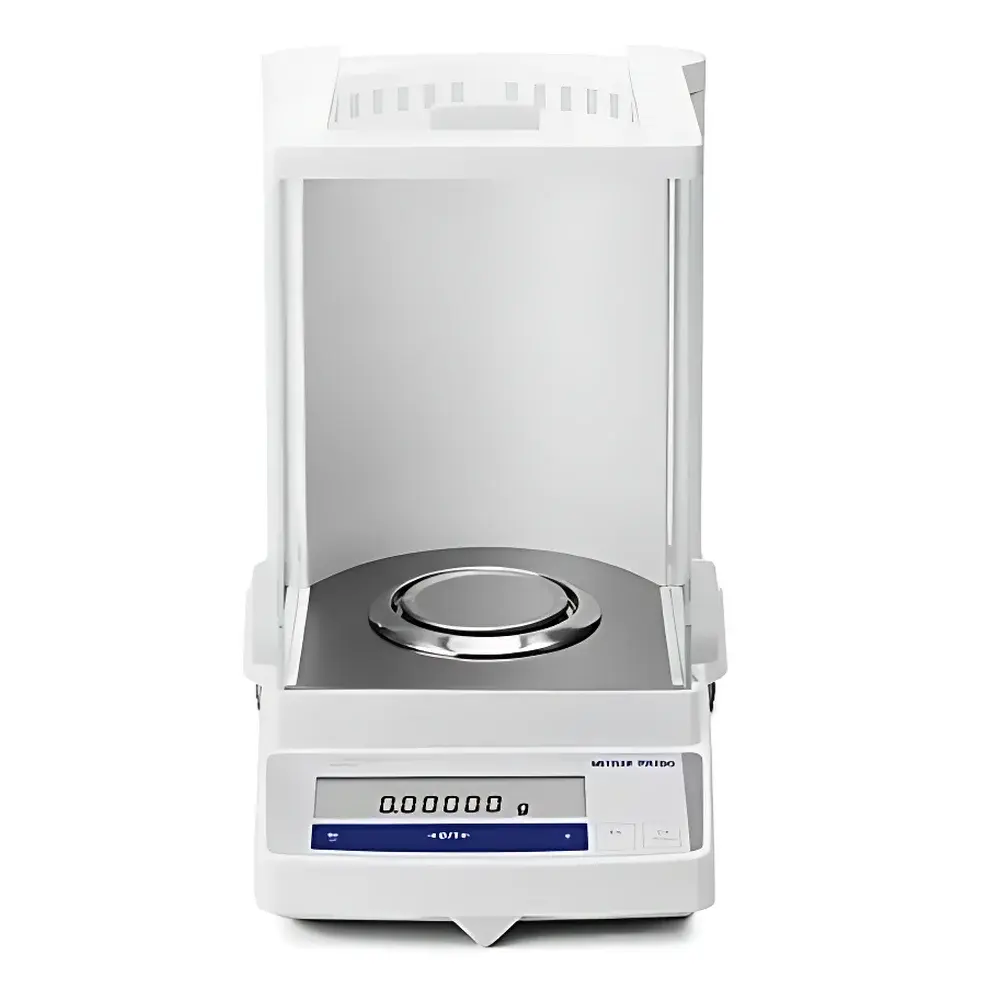
METTLER TOLEDO AL204 Analytical Balance
| Brand | METTLER TOLEDO |
|---|---|
| Origin | USA |
| Model | AL204 |
| Readability | 0.1 mg |
| Max Capacity | 210 g |
| Repeatability | 0.1 mg |
| Linearity Error | 0.3 mg |
| Calibration | External 200 g weight |
| Pan Diameter | 90 mm |
| Draft Shield Height | 220 mm |
| Dimensions (W×D×H) | 238 × 335 × 364 mm |
| Interface | RS232 |
| Applications | Simple weighing, percentage weighing, piece counting, dynamic weighing, net/gross/tare operations |
| Compliance | Designed to support GLP/GMP documentation requirements |
Overview
The METTLER TOLEDO AL204 Analytical Balance is a precision laboratory instrument engineered for reliable, high-reproducibility mass measurement in regulated and non-regulated environments. Based on electromagnetic force compensation (EMFC) technology, the AL204 delivers consistent 0.1 mg readability across its 210 g maximum capacity range. Its robust mechanical architecture—featuring a Monobloc® single-module sensor design—ensures long-term stability, minimal drift, and resistance to environmental perturbations such as air currents and vibration. The balance operates within a fully enclosed draft shield (220 mm height) with a 90 mm diameter stainless-steel weighing pan, optimized for routine analytical tasks including sample preparation, reagent dispensing, and quality control testing. As part of the AL Classic series, the AL204 balances cost-efficiency with metrological integrity—making it suitable for academic laboratories, pharmaceutical QC labs, contract testing facilities, and industrial R&D settings where traceable, auditable weighing is required but full regulatory automation is not mandatory.
Key Features
- Electromagnetic force compensation (EMFC) transducer delivering 0.1 mg readability and ≤0.1 mg repeatability (standard deviation under identical conditions)
- Draft shield with fixed-height 220 mm acrylic side panels and sliding front door for rapid access and consistent airflow management
- External calibration capability using a certified 200 g weight; supports periodic verification per ISO/IEC 17025 and ASTM E899 guidelines
- RS232 serial interface compliant with standard laboratory printer and PC protocols; enables direct data export without proprietary drivers
- Integrated In-Use cover (plastic protective shroud) minimizes contamination risk from spilled powders or corrosive solvents
- Intuitive keypad layout with dedicated function keys for tare, print, units, and application mode selection
- Preloaded weighing applications: simple weighing, percentage weighing, piece counting (with user-defined unit weight), dynamic (moving-object) weighing, and add-and-subtract modes
- ABS engineering plastic housing offering chemical resistance, impact resilience, and thermal stability across typical lab ambient conditions (15–30 °C)
Sample Compatibility & Compliance
The AL204 accommodates a broad range of sample types—including powders, granules, liquids in tared vessels, and small solid components—within its 90 mm pan diameter and 220 mm shield clearance. Its open-bottom design facilitates easy cleaning and prevents residue accumulation beneath the pan. While not equipped with internal motorized calibration (i.e., no ProFACT® or FACT® auto-adjustment), the AL204 supports manual external calibration traceable to national standards (e.g., NIST SRM weights). It meets essential performance criteria outlined in USP “Weights and Balances” for Class I analytical balances and aligns with ISO 9001 process control requirements. Though lacking built-in audit trail or electronic signature functionality, its RS232 output allows integration into validated LIMS or ELN systems when paired with compliant data capture software—enabling compliance with FDA 21 CFR Part 11 for record retention where local SOPs permit.
Software & Data Management
The AL204 operates independently without embedded operating system or firmware-based data storage. All measurement data is transmitted in real time via RS232 using ASCII protocol (baud rate configurable up to 9600), supporting seamless integration with third-party laboratory software, spreadsheet applications, or custom-built acquisition tools. No proprietary drivers or cloud services are required. Users may configure print formats (e.g., date/time stamp, gross/net/tare values, unit identifier) directly via front-panel menu. For GLP/GMP environments, laboratories commonly pair the AL204 with validated serial-data logging utilities that generate timestamped, immutable CSV or PDF reports—including operator ID fields when used with external authentication layers.
Applications
- Pharmaceutical formulation: Accurate weighing of active pharmaceutical ingredients (APIs) and excipients during batch preparation and stability study sample setup
- Chemical synthesis: Precise reagent dosing for stoichiometric reactions and catalyst loading in organic and inorganic chemistry labs
- Materials science: Mass determination of thin films, nanoparticles, and composite specimens prior to SEM/TEM analysis or thermal gravimetric characterization
- Food & beverage QA: Verification of ingredient proportions, package fill weight checks, and moisture content calculations via loss-on-drying protocols
- Academic teaching labs: Foundational instruction in metrology principles, uncertainty estimation, and Good Weighing Practice (GWP®) concepts
- Environmental testing: Preparation of standard solutions for ICP-MS, HPLC, or titration workflows requiring sub-milligram accuracy
FAQ
Does the AL204 support internal calibration?
No—the AL204 requires external calibration using a certified 200 g weight. Internal calibration models are designated with “-IC” suffix (e.g., AL204-IC).
Is the RS232 interface compatible with modern Windows/macOS systems?
Yes, when used with a USB-to-RS232 adapter and standard terminal emulation software (e.g., Tera Term, PuTTY) or custom Python/Node.js scripts.
Can the AL204 be used in a fume hood?
It is not recommended due to airflow interference; optimal performance requires stable, draft-free ambient conditions per manufacturer specifications.
What is the warm-up time before first use?
Minimum 30 minutes at stable room temperature (20 ± 2 °C) to achieve thermal equilibrium of the EMFC sensor.
Does the AL204 comply with ISO/IEC 17025 for accredited testing labs?
Yes—as a measurement tool, it supports compliance when operated within defined environmental controls, calibrated per documented procedures, and maintained with traceable records.