
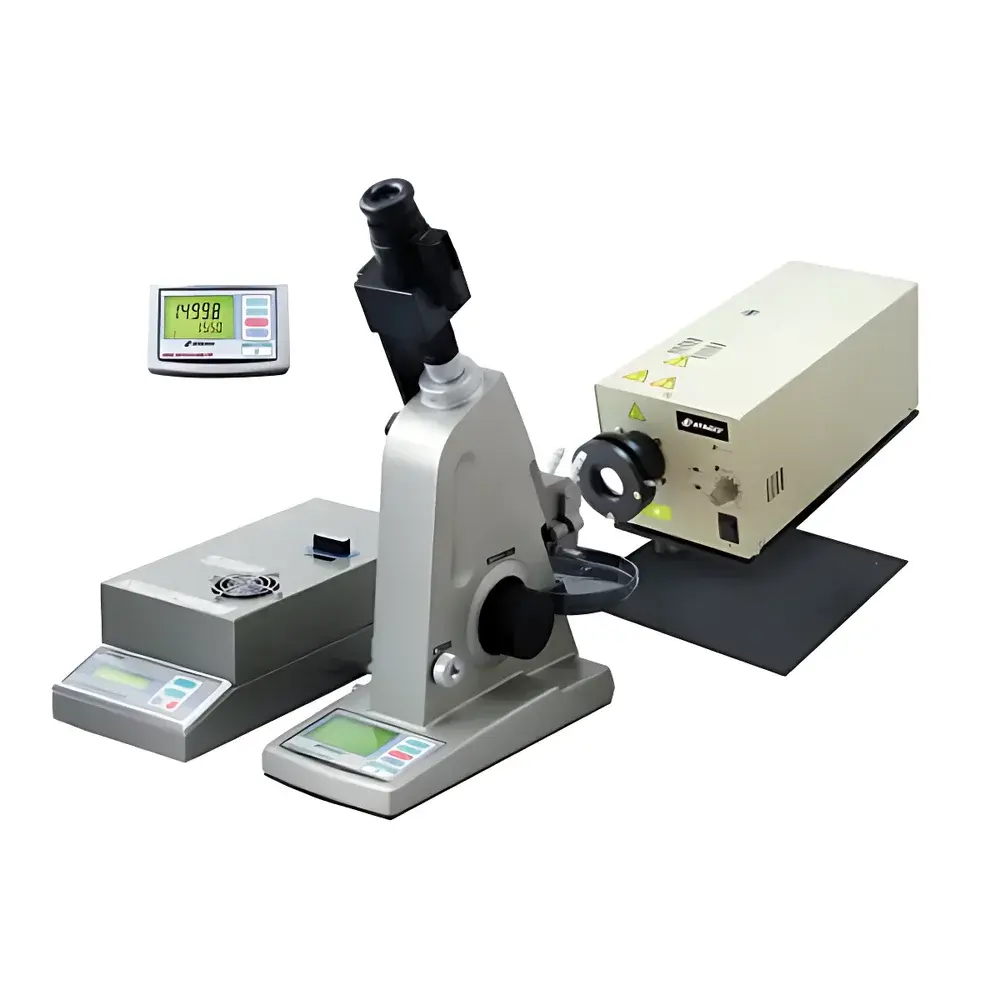
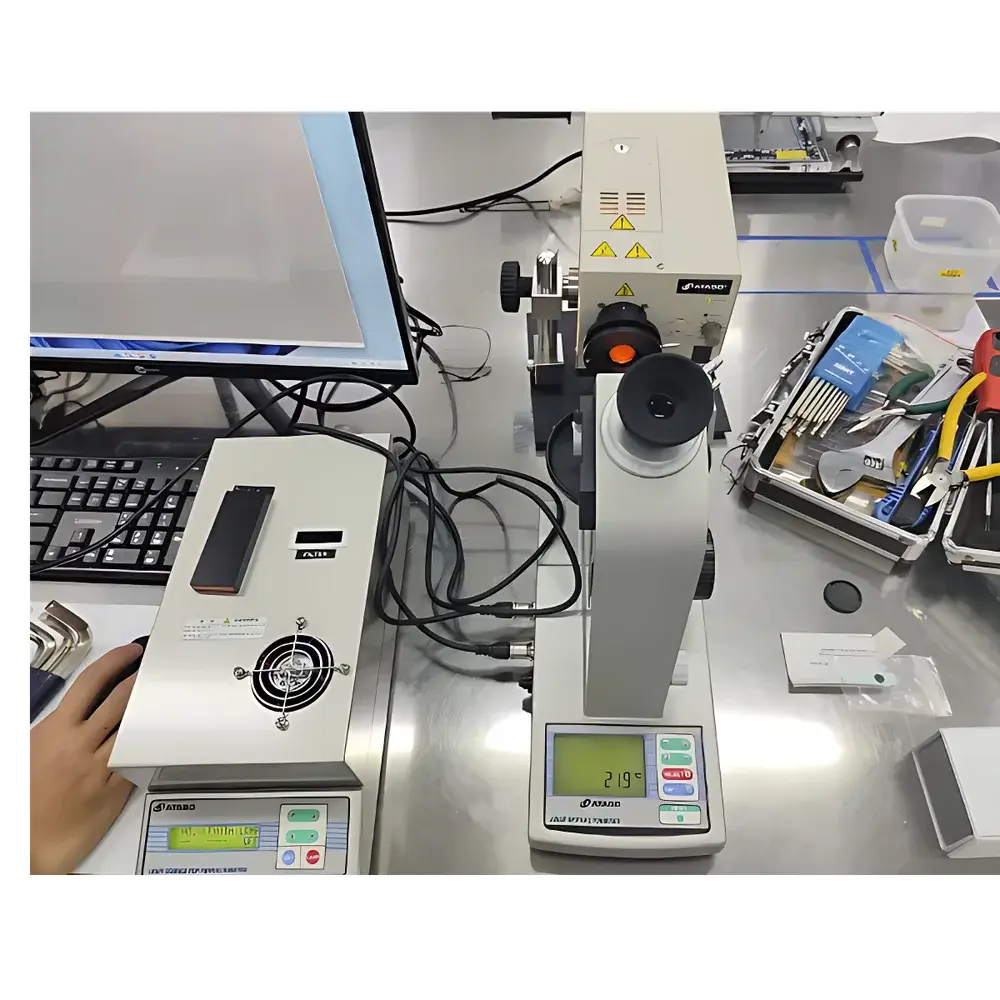
ATAGO DR-M4/1550 Multi-Wavelength Abbe Refractometer
| Brand | ATAGO |
|---|---|
| Origin | Japan |
| Model | DR-M4/1550 |
| Type | Benchtop Abbe Refractometer |
| Temperature Control | Yes |
| Digital Display | Yes |
| Measurement Range | n = 1.5167–1.9166 (450 nm) |
| Accuracy | ±0.0002 (at 589 nm) |
| Wavelength Range | 450–1550 nm (with interchangeable interference filters) |
| Resolution | 0.0001 (refractive index), 0.1 (Abbe number) |
| Operating Temperature | 5–50 °C |
| Power Supply | AC 100–240 V, 50/60 Hz |
| Dimensions (main unit) | 13 × 29 × 31 cm |
| Weight (main unit) | 6.0 kg |
Overview
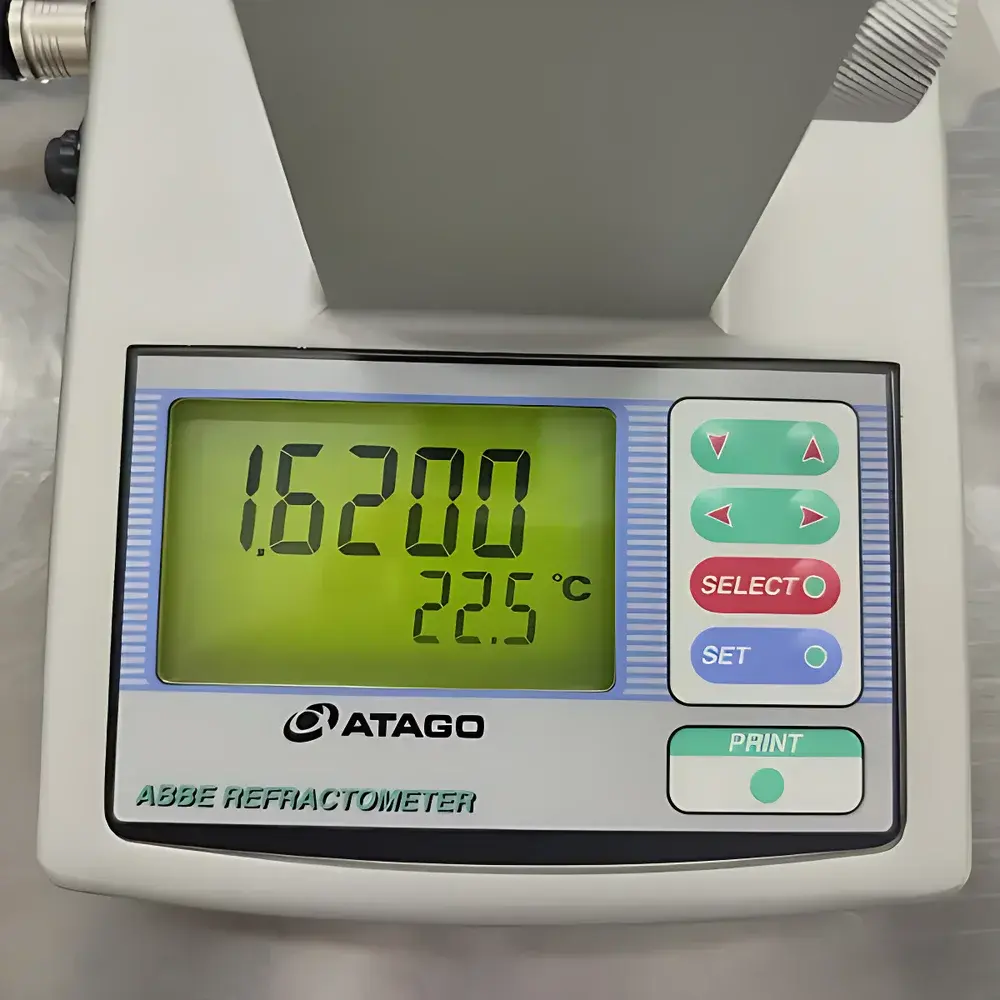
The ATAGO DR-M4/1550 Multi-Wavelength Abbe Refractometer is a precision benchtop instrument engineered for high-accuracy measurement of refractive index (n) and Abbe number (vd or ve) across five discrete spectral wavelengths—450 nm, 589 nm, 680 nm, 1100 nm, and 1550 nm. Based on the classical Abbe refractometer principle, it employs critical-angle measurement via total internal reflection at the prism-sample interface, with optical alignment optimized for collimated halogen lamp illumination and high-contrast boundary line detection. Unlike single-wavelength instruments, the DR-M4/1550 enables direct quantification of chromatic dispersion behavior by acquiring refractive indices at multiple standardized wavelengths—essential for characterizing optical glasses, infrared-transmitting materials (e.g., Ge, ZnSe, chalcogenide glasses), polymer lenses, and specialty coatings where dispersion profiles govern performance in imaging, laser optics, and telecom components. Its dual-scale digital LCD simultaneously displays both n and v values, eliminating manual interpolation and reducing operator-dependent error.
Key Features
- Five-user-selectable wavelength channels (450, 589, 680, 1100, and 1550 nm) using precision interference filters—certified per ISO 10110-2 for spectral bandwidth and center wavelength tolerance.
- High-resolution digital readout: 0.0001 for refractive index and 0.1 for Abbe number, traceable to NIST-traceable calibration standards.
- Integrated Peltier-assisted temperature control (5–50 °C), maintaining sample prism surface stability within ±0.1 °C—critical for minimizing thermal drift during multi-wavelength acquisition.
- Dual-prism optical design with sapphire-coated measuring prism (hardness ≥2000 HV) for extended durability against abrasive or corrosive samples.
- Real-time boundary line detection algorithm with auto-zero compensation, ensuring consistent critical angle identification independent of sample turbidity or minor surface imperfections.
- Compliant with ISO 21348 definitions for spectral irradiance weighting and ASTM E1220-22 for refractometer verification protocols.
Sample Compatibility & Compliance
The DR-M4/1550 accommodates liquid, paste, and low-viscosity semi-solid samples (e.g., optical adhesives, IR lens coatings, germanium wafer cleaning solutions) with minimal volume requirement (≥0.1 mL). Its extended near-infrared capability (up to 1550 nm) supports characterization of telecom-grade silica fibers, quantum dot suspensions, and mid-IR optical polymers. All measurements adhere to ISO 17025-accredited laboratory practices when used with ATAGO-certified calibration oils (e.g., REF-1550-IR series) and documented temperature-controlled validation procedures. The instrument meets CE marking requirements for electromagnetic compatibility (EN 61326-1) and safety (EN 61010-1), and its data output architecture supports audit-ready documentation under FDA 21 CFR Part 11 when paired with compliant printer modules (e.g., DP-AD(B)).
Software & Data Management
While the DR-M4/1550 operates as a standalone instrument, its RS-232C interface enables seamless integration into LIMS or QA/QC workflows. ASCII-formatted output includes timestamp, wavelength ID, measured n value, calculated v number, temperature reading, and filter position status—structured for direct ingestion into statistical process control (SPC) platforms. Optional DP-AD(B) digital printer provides thermally stable, permanent hardcopy records with configurable header fields (operator ID, batch number, SOP reference). All measurement sessions retain full traceability: no data overwrite occurs, and internal memory logs up to 1,000 readings with cycle-accurate metadata.
Applications
- Optical glass certification per ISO 10110-1: Determination of vd and partial dispersion ratios (e.g., Pg,F) for crown/flint classification.
- Infrared material R&D: Dispersion modeling of Ge, Si, CaF2, and AMTIR substrates used in CO2 lasers and thermal imaging systems.
- Pharmaceutical excipient QC: Verification of refractive index homogeneity in polyethylene glycol (PEG) and polysorbate formulations at telecom-relevant wavelengths.
- Telecom component manufacturing: In-process verification of anti-reflective coating uniformity on fused silica collimators operating at 1310/1550 nm bands.
- Academic spectroscopy labs: Empirical validation of Sellmeier equation coefficients for novel nonlinear optical crystals.
FAQ
What calibration standards are recommended for multi-wavelength verification?
ATAGO REF-450, REF-589, REF-1100, and REF-1550 certified reference oils—each traceable to NIST SRM 1484 and characterized at ±0.0001 n accuracy per wavelength.
Can the DR-M4/1550 measure samples with high absorption at 1550 nm?
Yes—its high-sensitivity photodetector array and optimized signal-to-noise ratio (SNR > 85 dB) enable reliable boundary detection even in moderately absorbing media such as doped polymer waveguides.
Is GLP-compliant data archiving supported?
When used with DP-AD(B) printer and ATAGO’s optional Audit Trail Module (P/N: ATM-LOG-DRM4), full electronic records—including operator login, calibration history, and environmental logs—are generated in PDF/A-1b format per ISO 19005-1.
How does temperature stabilization affect multi-wavelength repeatability?
At ±0.1 °C control, inter-wavelength reproducibility improves to ≤±0.00015 n (k=2), meeting ISO 21348 Category B uncertainty requirements for optical metrology.
Are custom filter sets available beyond the standard five wavelengths?
Yes—ATAGO offers OEM filter integration (e.g., 850 nm, 1064 nm) under PN customization agreements, subject to optical path recalibration and factory certification.





