
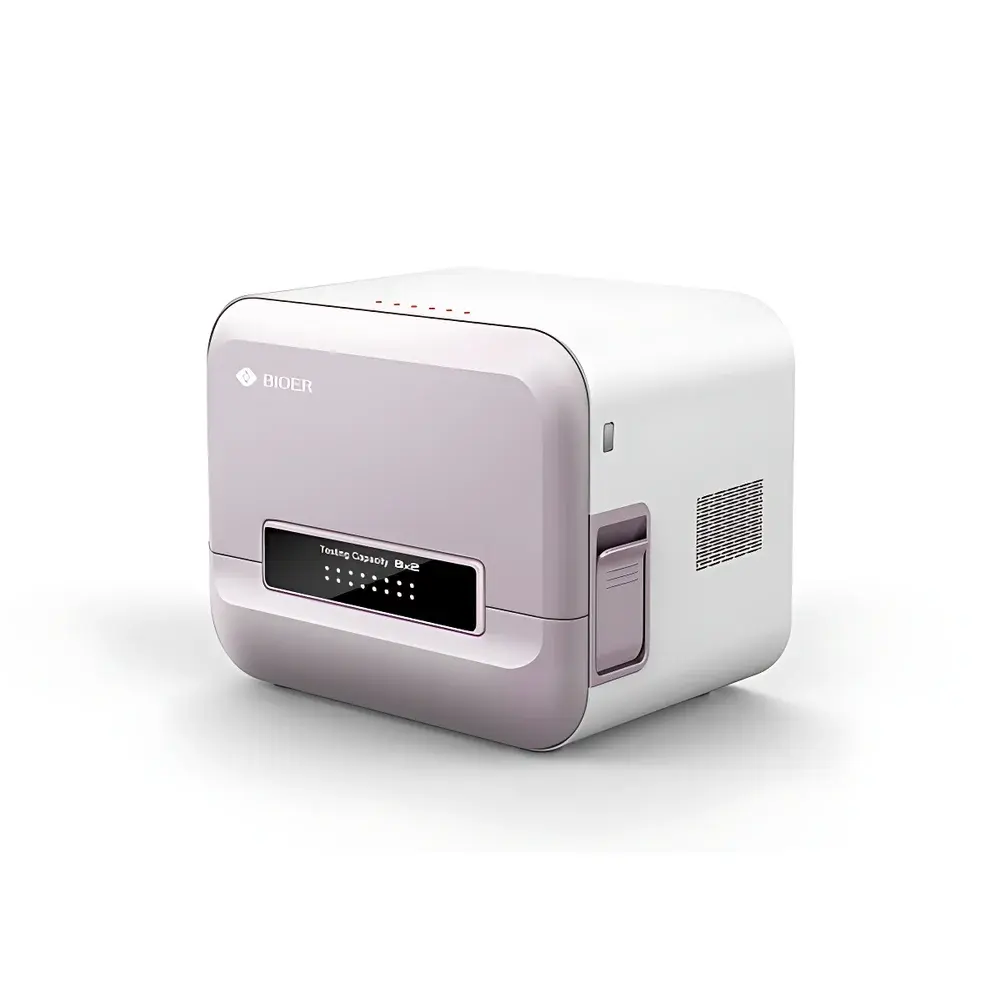
Bioer LineGene Mini Real-Time Fluorescence Quantitative PCR System
| Brand | Bioer |
|---|---|
| Origin | Zhejiang, China |
| Model | FQD-16A (Mini) |
| Instrument Type | Real-Time Fluorescence Quantitative PCR System |
| Sample Throughput | 16-well (single tubes or 8-tube strips) |
| Max Heating Rate | 5.0 °C/s |
| Temperature Accuracy | ≤ ±0.1 °C |
| Well-to-Well Temperature Uniformity | ±0.15 °C |
| Detection Channels | 4 |
| Detection Sensitivity | 1 copy |
| Compatible Consumables | 0.2 mL transparent/white/frosted PCR tubes and 8-tube strips |
| Optical Design | Top-scanning fluorescence detection with optimized light path to minimize stray light |
| Thermal Module | Custom Peltier-based system |
| Power Input | DC 24 V, 180 W |
| Dimensions (L×W×H) | 280 × 240 × 220 mm |
| Net Weight | 6.5 kg |
| Interface | RS232 |
| Operating System | Windows 7 / 8.1 / 10 |
Overview
The Bioer LineGene Mini Real-Time Fluorescence Quantitative PCR System (Model FQD-16A) is a compact, battery-compatible thermal cycler engineered for high-fidelity nucleic acid quantification under field-deployable conditions. It operates on the principle of real-time fluorescence detection during polymerase chain reaction amplification—monitoring accumulation of SYBR Green I, hydrolysis probes (TaqMan), or hybridization probes via four independent optical channels. The system integrates a custom-designed Peltier thermal module with rapid ramping kinetics (up to 5.0 °C/s), precise digital temperature control (≤ ±0.1 °C accuracy), and exceptional well-to-well thermal uniformity (±0.15 °C), enabling reliable quantification across all 16 reaction positions. Its top-scanning optical architecture minimizes stray light interference and enhances signal-to-noise ratio—critical for low-abundance target detection down to single-copy sensitivity. Designed for decentralized molecular testing, the LineGene Mini meets operational requirements in resource-limited or mobile environments without compromising analytical rigor.
Key Features
- 16-well reaction format compatible with both individual 0.2 mL PCR tubes and 8-tube strips—including transparent, white, and frosted configurations for optimal fluorescence coupling
- Four-channel fluorescence detection supporting multiplex assays with spectral separation for FAM, HEX/VIC, ROX, and Cy5 dyes
- High-speed thermal cycling enabled by an advanced Peltier module with active heat dissipation design, ensuring reproducible ramp rates and minimal overshoot
- Top-scanning excitation/emission optics with calibrated LED sources and precision bandpass filters, delivering stable photometric performance across instrument lifetime
- Onboard analysis suite supporting qualitative detection, absolute quantification, standard curve generation, melting curve analysis, SNP genotyping, relative quantification (ΔΔCt), and isothermal amplification monitoring
- Embedded Windows-based control interface with full Chinese-language support and intuitive workflow navigation—no external PC required for basic operation
- DC 24 V power architecture enabling integration with portable power banks or vehicle batteries for extended off-grid deployment
Sample Compatibility & Compliance
The LineGene Mini accepts standard 0.2 mL thin-wall PCR consumables without adapter modification, accommodating diverse assay chemistries including SYBR Green I, probe-based (TaqMan, Molecular Beacon), and high-ROX master mixes. Its thermal and optical calibration protocols align with common quality assurance practices used in clinical and environmental molecular laboratories. While not certified under ISO 13485 or FDA 21 CFR Part 11 out-of-the-box, the system supports GLP/GMP-aligned workflows through audit-trail-capable data export (CSV, PDF), timestamped run logs, and user-accessible calibration reports. It is routinely employed in applications governed by national standards for pathogen detection—including GB/T 38519–2020 (HCV RNA quantification), WS/T 684–2020 (TB DNA detection), and NY/T 2727–2015 (foodborne pathogen screening).
Software & Data Management
Control and analysis are performed via the embedded LineGene Mini Software (v3.x), which runs natively on Windows 7/8.1/10 platforms. Raw fluorescence data are stored in proprietary .lgf files with metadata embedding—including operator ID, protocol version, thermal profile parameters, and detector gain settings. Export functions generate compliant reporting formats: Ct values with confidence intervals, amplification plots with baseline correction, melt peak derivatives, and multi-sample comparison tables. All exported datasets include machine-readable timestamps and checksums to support traceability. For laboratory information system (LIS) integration, RS232 serial output enables bidirectional communication with middleware solutions implementing ASTM E1384 or HL7 v2.x message structures.
Applications
- Rapid point-of-need diagnostics for zoonotic and human pathogens—including HBV, HCV, HIV-1, CMV, Mycobacterium tuberculosis, and Enterobacter sakazakii—in veterinary clinics, mobile health units, and disaster response sites
- Environmental surveillance of waterborne bacteria (e.g., total coliform load in dairy supply chains) and food safety testing (Salmonella spp., Listeria monocytogenes)
- Field-based telomerase activity assessment via hTERT mRNA and HTR RNA quantification in agricultural biotechnology research
- Academic and teaching labs requiring transportable instrumentation for hands-on PCR methodology instruction and assay development
- Quality control of lyophilized RT-PCR reagents and master mix stability validation under variable ambient conditions
FAQ
Is the LineGene Mini compliant with FDA 21 CFR Part 11 for electronic records?
The system does not include built-in electronic signature or role-based access control features required for full Part 11 compliance; however, its audit-ready data export and timestamped log files may be incorporated into validated workflows using third-party LIMS or ELN systems.
Can the instrument perform reverse transcription directly onboard?
No—the LineGene Mini is a DNA amplification and detection platform only; RT steps must be performed separately using compatible BioEasy RT reagents prior to loading samples.
What is the recommended maintenance interval for optical calibration?
Bioer recommends annual verification of LED intensity and detector linearity using the supplied reference dye cartridge (Cat. No. CAL-FQD16); no user-serviceable optical alignment is required.
Does the system support external barcode scanning for sample tracking?
Yes—via RS232 connection to industrial-grade USB-to-serial barcode scanners configured as HID-compliant input devices within the OS environment.
Are there validated protocols available for WHO-recommended diagnostic targets?
Bioer provides application notes aligned with WHO priority pathogen targets (e.g., TB, HIV, HBV) using CE-IVD–marked companion reagents; full validation documentation is available under NDA upon request from qualified institutions.






