
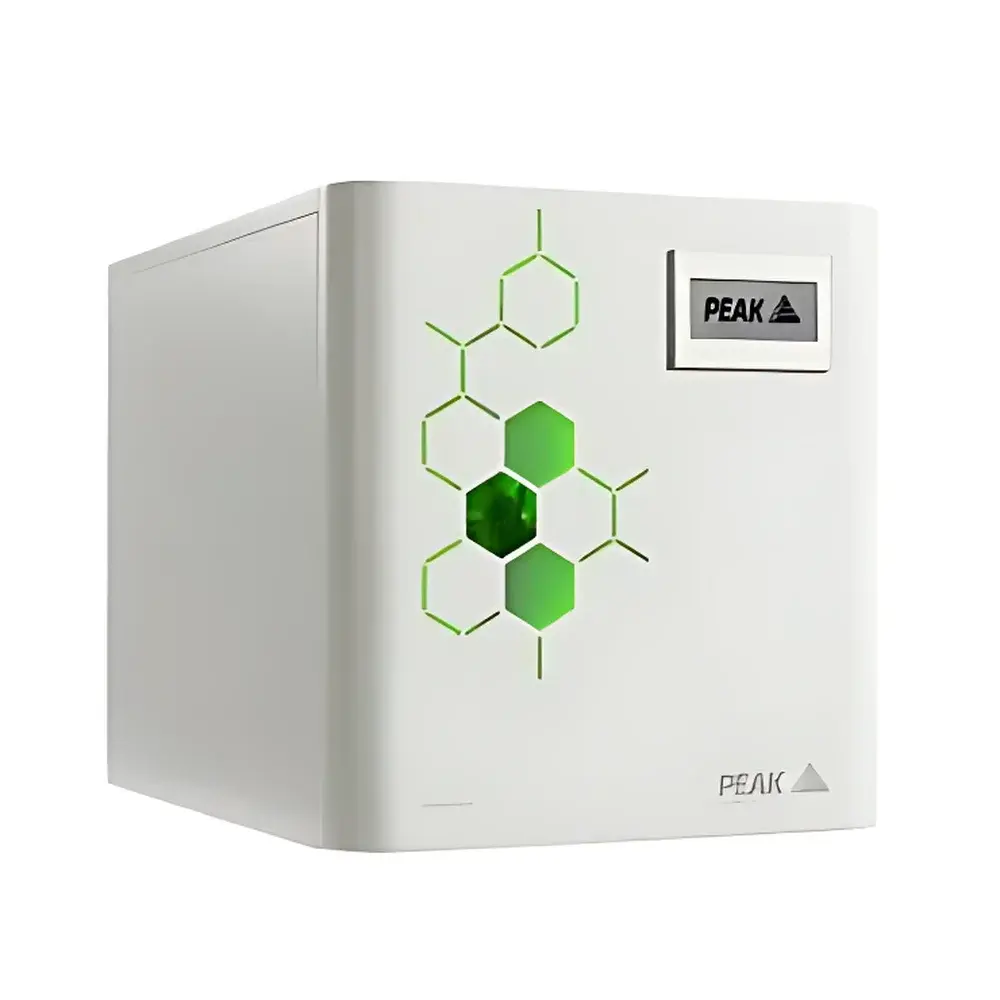
Peak Scientific Precision Hydrogen 450 Hydrogen Generator for GC
| Brand | PEAK |
|---|---|
| Origin | United Kingdom |
| Manufacturer Type | Original Equipment Manufacturer (OEM) |
| Product Category | Imported |
| Model | Precision Hydrogen 450 |
| Hydrogen Generation Principle | Pure Water Electrolysis via Proton Exchange Membrane (PEM) |
| Output Flow Rate | 450 cm³/min |
| Output Pressure | 100 psi (6.9 bar) |
| Hydrogen Purity | 99.9995% |
| Power Consumption | 422 W |
| Warranty | 3-year standard warranty on PEM stack and critical components |
Overview
The Peak Scientific Precision Hydrogen 450 is a laboratory-grade, on-demand hydrogen generator engineered specifically for gas chromatography (GC) systems requiring ultra-high-purity hydrogen as fuel gas—primarily for Flame Ionization Detectors (FID), Flame Photometric Detectors (FPD), and other combustion-based analytical detectors. Unlike conventional compressed gas cylinders, this generator employs proton exchange membrane (PEM) electrolysis of deionized water to produce hydrogen *in situ*, eliminating storage hazards and supply-chain dependencies. The core architecture integrates a high-efficiency PEM cell, integrated desiccant and catalytic purification stages, and real-time pressure/flow regulation—ensuring consistent delivery of 99.9995% pure H₂ at up to 450 cm³/min and 100 psi. Its design complies with IEC 61010-1 safety standards for laboratory equipment and incorporates fail-safe mechanisms including automatic shutdown upon low water level, overpressure, temperature anomaly, or gas purity deviation—making it suitable for unattended operation in regulated environments.
Key Features
- Proton Exchange Membrane (PEM) electrolysis technology ensures zero hydrocarbon contamination and eliminates the need for metal hydride or alkaline electrolyte maintenance.
- Integrated dual-stage purification: catalytic recombination of residual oxygen followed by molecular sieve drying delivers hydrogen meeting ASTM D7528 and ISO 8573-1 Class 1 (oil-free, particle-free, dew point ≤ –40 °C).
- Digital flow and pressure control with ±1% setpoint accuracy across the full 0–450 cm³/min range; programmable ramping for detector startup sequences.
- Modular, space-efficient footprint (W × D × H: 240 × 420 × 450 mm) designed for benchtop integration beneath or adjacent to GC instruments.
- Intelligent diagnostics with onboard LCD interface displaying real-time status of water level, PEM temperature, outlet pressure, flow rate, and system health indicators.
- Automatic self-diagnostics at startup and periodic runtime checks; event-logged fault codes support GLP-compliant troubleshooting and audit readiness.
Sample Compatibility & Compliance
The Precision Hydrogen 450 is compatible with all major GC platforms requiring H₂ fuel, including Agilent, Thermo Fisher Scientific, Shimadzu, PerkinElmer, and Waters systems. It meets essential regulatory requirements for analytical laboratories operating under Good Laboratory Practice (GLP) and Good Manufacturing Practice (GMP) frameworks. Its embedded firmware supports 21 CFR Part 11-compliant electronic signatures when integrated with validated LIMS or chromatography data systems (CDS). All internal wetted materials—including stainless steel 316L gas pathways, Nafion™ PEM membranes, and silica gel desiccant—are certified non-reactive with hydrogen and compliant with USP for plastic components. CE marking (EN 61000-6-3, EN 61000-6-4) and UKCA certification confirm electromagnetic compatibility and operational safety.
Software & Data Management
While the Precision Hydrogen 450 operates autonomously via its front-panel interface, optional RS-232 or USB connectivity enables integration with third-party instrument control software (e.g., OpenLab CDS, Chromeleon, Empower). Logged operational data—including cumulative runtime, total H₂ volume generated, maintenance alerts, and calibration history—is exportable as CSV for traceability. Firmware updates are performed via secure USB stick, with version rollback capability and SHA-256 signature verification to ensure integrity. Audit trails record all user-initiated actions (e.g., manual shutdown, flow adjustment), supporting FDA and EMA inspection readiness.
Applications
- Fuel gas supply for FID and FPD detectors in environmental analysis (EPA Method 8260, 8270), petrochemical testing (ASTM D3588), and food safety screening (AOAC 2012.01).
- Hydrogen carrier gas in specialized GC configurations where helium scarcity or cost drives alternative carrier selection (subject to method validation per ISO/IEC 17025).
- On-site generation for mobile GC labs, cleanroom facilities, and ISO 14644-certified environments where cylinder logistics pose contamination or spatial constraints.
- Research applications requiring stable, pulse-free H₂ flow in hyphenated techniques such as GC-MS with hydrogen-compatible ion sources.
FAQ
What feed water quality is required?
Deionized water with resistivity ≥ 15 MΩ·cm and total organic carbon (TOC) < 5 ppb is mandatory. Integrated water quality sensor prevents operation if conductivity exceeds 1 µS/cm.
How often must consumables be replaced?
The deionizer cartridge requires replacement every 6–12 months depending on usage; the desiccant column every 18–24 months. Both are field-replaceable without tools.
Can the generator supply multiple GCs simultaneously?
Yes—when paired with a calibrated manifold and pressure-regulated distribution panel, it can serve up to three FID-equipped GCs with independent flow control.
Is remote monitoring supported?
Via optional Ethernet module (sold separately), enabling SNMP-based status polling, email alerts for faults, and integration into building management systems (BMS).
Does it meet explosion-proof requirements for hazardous locations?
No—the Precision Hydrogen 450 is rated for general laboratory use (Class I, Division 2 per NEC Article 500) but is not certified for Zone 1/21 or ATEX Group II environments.



