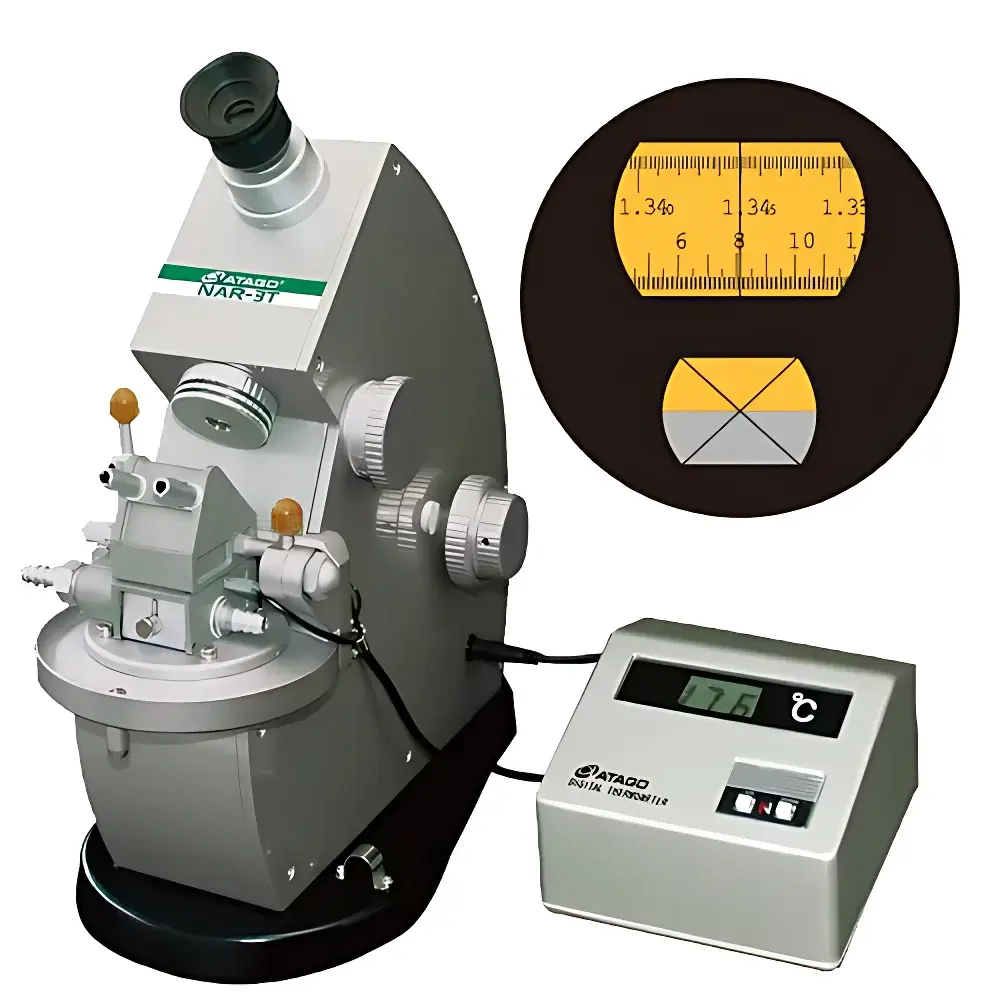
ATAGO NAR-3T High-Precision Abbe Refractometer for Edible Oil Industry
| Brand | ATAGO |
|---|---|
| Origin | Japan |
| Model | NAR-3T |
| Refractive Index Range (nD) | 1.30000–1.71000 |
| Brix Range | 0.00–95.00% |
| nD Resolution | 0.0002 |
| Brix Resolution | 0.1% |
| nD Accuracy | ±0.0001 |
| Brix Accuracy | ±0.05% |
| Temperature Measurement Range | 5–50°C |
| Temperature Display Range | 0.0–50.0°C |
| Temp. Accuracy | ±0.2°C |
| Temp. Resolution | 0.1°C |
| Power Supply | AC 100–240 V, 50/60 Hz |
| Power Consumption | 5 VA |
| Dimensions (Main Unit) | 12 × 31 × 25 cm |
| Weight (Main Unit) | 9.0 kg |
| Dimensions (Temp. Display Unit) | 10 × 11 × 7 cm |
| Weight (Temp. Display Unit) | 0.5 kg |
Overview
The ATAGO NAR-3T High-Precision Abbe Refractometer is a dedicated optical instrument engineered for routine and quality-critical refractive index (nD) and Brix measurements in edible oil production, refining, and quality assurance laboratories. Based on the classical Abbe principle—where light refraction at the sample-prism interface is measured under total internal reflection—the NAR-3T delivers traceable, high-reproducibility results essential for monitoring oil purity, adulteration, hydrolytic degradation (e.g., free fatty acid estimation via correlation), blending consistency, and thermal oxidation status. Its design prioritizes metrological stability in industrial environments: temperature-controlled measurement path, thermally isolated optical train, and dual-scale viewing system optimized for rapid operator alignment and minimal parallax error. Unlike portable or digital handheld units, the NAR-3T maintains full compliance with ISO 2859-1 sampling plans and ASTM D1218 (Standard Test Method for Refractive Index of Hydrocarbon Liquids) when operated within its specified temperature range (5–50°C) and calibrated per ATAGO’s documented procedure.
Key Features
- High-resolution Abbe optical system with dual-control adjustment knobs enabling precise, tactile fine-tuning of the boundary line position—reducing measurement variability across operators.
- Enlarged engraved scale and high-intensity LED illumination ensure clear visual discrimination of the shadow edge, critical for accurate nD reading down to ±0.0001.
- Integrated digital temperature sensor with independent display unit (0.0–50.0°C, ±0.2°C accuracy) enables real-time thermal compensation; temperature data is recorded alongside each refractive index value for audit-ready documentation.
- Wide dynamic range: nD 1.30000–1.71000 and Brix 0.00–95.00%, accommodating undiluted oils, oil-in-water emulsions, and processed lipid fractions without dilution artifacts.
- Robust mechanical architecture: precision-ground stainless steel housing, vibration-damped base, and sealed optical components designed for long-term dimensional stability in factory QC labs.
- Compliance-ready operation: supports GLP-aligned workflows through manual logbook entry protocols and optional traceable calibration with NIST-traceable reference oils (e.g., ATAGO Standard Oil Set).
Sample Compatibility & Compliance
The NAR-3T accepts liquid and semi-liquid edible oil samples—including virgin olive oil, palm olein, soybean oil, sunflower oil, coconut oil, and frying oil residues—without pre-filtration, provided particulates are absent. Sample volume requirement is ≤0.2 mL per measurement. The instrument meets key regulatory expectations for food-grade analytical instrumentation: it operates within the temperature control parameters required by AOAC Official Method 975.05 (Refractometric Determination of Total Solids in Oils), aligns with ISO 5555:2001 (Petroleum products — Sampling), and supports verification against USP (Refractometry) for excipient-grade lipid characterization. While not inherently 21 CFR Part 11 compliant (as it lacks electronic signature functionality), its analog-optical core ensures deterministic, non-software-dependent output—making it suitable for environments where instrument qualification emphasizes physical reproducibility over digital audit trails.
Software & Data Management
The NAR-3T is a benchtop analog-optical instrument with no embedded microprocessor or data logging capability. All measurements are manually read from the ocular scale and recorded externally. This architecture eliminates firmware validation burdens and ensures operational continuity during IT infrastructure updates or cybersecurity audits. Users integrate readings into LIMS or Excel-based QA databases using standardized templates aligned with ISO/IEC 17025 documentation requirements. ATAGO provides a certified calibration certificate (traceable to JCSS standards) with each unit, including uncertainty budgeting per GUM (Guide to the Expression of Uncertainty in Measurement). Optional accessories include temperature-stabilized sample stages and certified reference oils for in-house verification per ISO/IEC 17025 Clause 6.6.
Applications
- Quantitative assessment of oil adulteration (e.g., detection of cheaper vegetable oil blends in premium olive oil via nD deviation from Codex Alimentarius limits).
- Monitoring hydrolytic rancidity progression through correlated Brix shifts in aqueous extracts of degraded oils.
- Batch release testing of refined oils prior to bottling or further processing, per internal SOPs referencing ISO 662:2017 (Animal and vegetable fats and oils — Determination of insoluble impurities).
- Supporting HACCP prerequisite programs by verifying incoming crude oil specifications against supplier certificates of analysis.
- Academic research on lipid phase behavior, including solid fat content estimation via empirical nD/temperature curves.
FAQ
Is the NAR-3T suitable for measuring highly viscous or solidified oils?
Yes—when pre-warmed to ≥35°C to ensure full fluidity, the NAR-3T accommodates high-viscosity oils such as palm stearin or hydrogenated fats without prism coating issues.
Does it require periodic recalibration with certified standards?
Yes. ATAGO recommends daily verification using a reference oil (e.g., nD = 1.47000 at 20°C) before sample analysis, and full recalibration every 6 months by an accredited service provider.
Can ambient lab temperature fluctuations affect measurement accuracy?
The instrument’s built-in temperature sensor compensates only for sample temperature—not ambient drift. Stable lab conditions (20–25°C, ±2°C) are advised to minimize thermal lensing effects in the optical path.
What cleaning protocol is recommended for the prism surface after oil measurement?
Use lint-free wipes moistened with analytical-grade chloroform or hexane, followed by dry air purge. Avoid ethanol or acetone on coated prisms unless specified in the user manual.
Is technical support available for method validation documentation?
Yes. ATAGO’s Application Support Team provides template IQ/OQ protocols, uncertainty calculation worksheets, and ASTM/ISO cross-reference guides upon request for qualified laboratory personnel.