
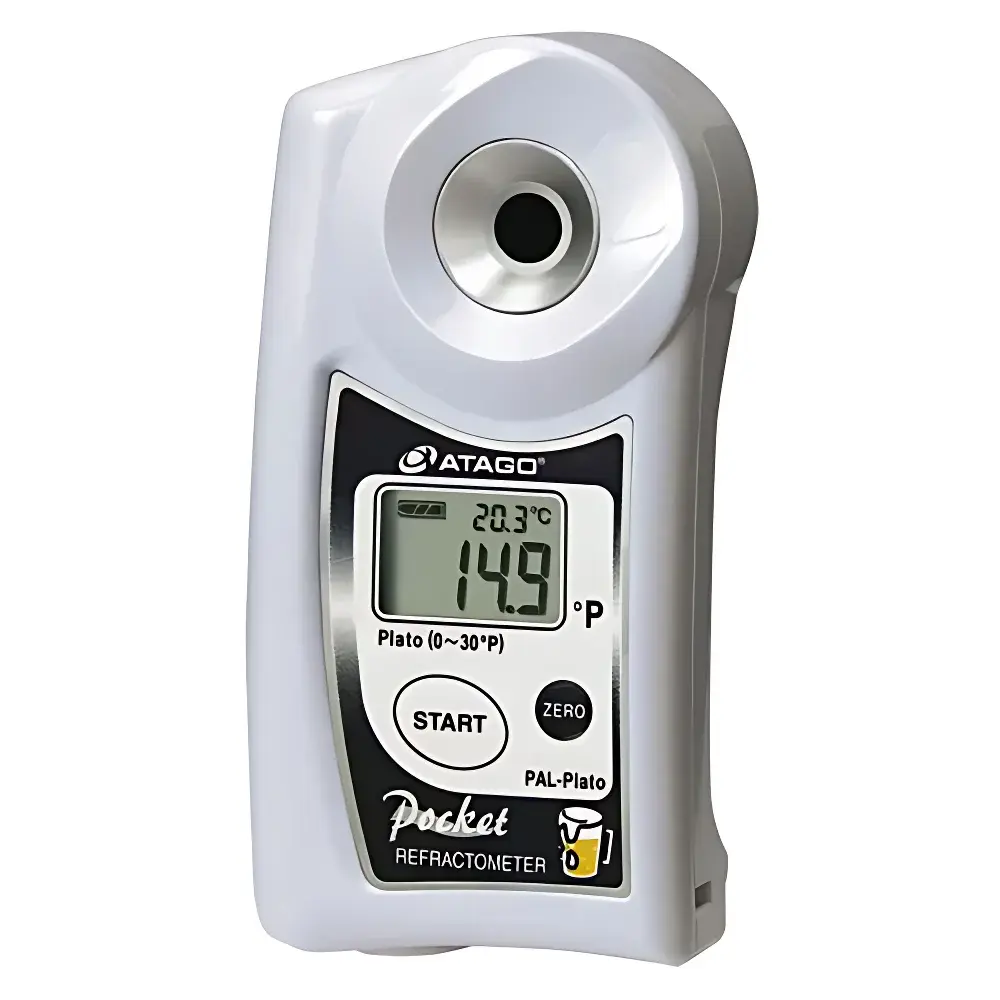
ATAGO PAL-Plato Digital Handheld Refractometer for Wort Concentration Measurement
| Brand | ATAGO |
|---|---|
| Origin | Japan |
| Product Type | Handheld Refractometer |
| Model | PAL-Plato |
| Measuring Range | 0.0–30.0 °P (Plato) |
| Resolution | 0.1 °P |
| Accuracy | ±0.2 °P |
| Automatic Temperature Compensation (ATC) | 10–75 °C |
| Sample Volume | 0.3 mL |
| Measurement Time | 3 seconds |
| Display | Digital LCD |
| IP Rating | IP65 |
| Power Supply | 2 × AAA batteries |
| Dimensions | 55(W) × 31(D) × 109(H) mm |
| Weight | 100 g (instrument only) |
| Operating Ambient Temperature | 10–40 °C |
Overview
The ATAGO PAL-Plato Digital Handheld Refractometer is a precision optical instrument engineered for rapid, reliable quantification of wort concentration in brewing applications. It operates on the principle of refractometry—measuring the refractive index of aqueous sugar solutions—and converts this value directly into degrees Plato (°P), the standard unit for expressing extract concentration in beer production. Unlike hydrometers or pycnometers, which rely on density and require larger sample volumes and temperature equilibrium, the PAL-Plato employs Abbe-type optics with a high-stability prism and embedded thermistor to deliver real-time, temperature-compensated readings across a physiologically relevant range (10–75 °C). Its design conforms to established metrological practices for refractive index-based concentration determination, aligning with methods referenced in ASBC Methods of Analysis (Section 7: Wort and Beer) and ISO 21527-1 for yeast enumeration context where extract consistency is critical.
Key Features
- Direct °P readout calibrated specifically for wort matrices—eliminates manual Brix-to-Plato conversion errors and accounts for non-sugar solutes common in malt extracts.
- Integrated Automatic Temperature Compensation (ATC) spanning 10–75 °C, ensuring measurement integrity during hot wort transfer, kettle sampling, or post-mash lautering.
- Minimal sample requirement of only 0.3 mL—reduces material waste and enables measurement from small-volume pilot batches or inline sampling points.
- Three-second measurement cycle with stable digital LCD display—optimized for high-throughput QC environments without compromising repeatability.
- Rugged, IP65-rated housing resistant to dust ingress and low-pressure water jets—suitable for humid brewhouse floors, packaging lines, and laboratory wet benches.
- Battery-powered operation (2 × AAA) with auto-power-off functionality—enables portability across multiple sampling locations without dependency on fixed power infrastructure.
Sample Compatibility & Compliance
The PAL-Plato is validated for use with clarified or lightly turbid wort samples—including first wort, kettle wort, and cooled pre-fermentation wort—provided particulates are minimized to avoid prism surface interference. It is not intended for fermented beer, high-alcohol distillates, or viscous adjunct slurries. While not a regulated medical device, its performance characteristics support compliance with brewery quality management systems aligned with ISO 9001 and HACCP principles. Measurement traceability is maintained through factory calibration using NIST-traceable sucrose standards; users may perform routine verification with certified 10.00 °P and 20.00 °P reference solutions. The instrument meets CE marking requirements for optical measuring devices under Directive 2014/30/EU (EMC) and 2014/35/EU (LVD).
Software & Data Management
The PAL-Plato is a standalone, firmware-based instrument with no Bluetooth, USB, or cloud connectivity. All data remain on-device only—no internal memory or export capability. This architecture ensures operational simplicity, eliminates cybersecurity exposure, and supports environments where electronic data capture is restricted (e.g., certain GLP-compliant pilot facilities or breweries undergoing FDA 21 CFR Part 11 readiness assessments). For laboratories requiring audit-ready records, users integrate the PAL-Plato into documented SOPs specifying manual transcription protocols, including operator ID, time/date stamp, sample identification, and environmental conditions—all prerequisites for ISO/IEC 17025 accreditation.
Applications
- Real-time wort gravity monitoring during mash-out and lautering to optimize extraction efficiency.
- Pre-boil and post-boil concentration verification for recipe consistency and hop utilization modeling.
- QC release testing of incoming malt extract syrups or liquid adjuncts.
- Educational use in brewing science curricula for demonstrating extract yield calculations and attenuation potential estimation.
- Contract brewing facilities performing multi-client batch validation under shared equipment protocols.
FAQ
Does the PAL-Plato measure Brix or °P directly?
It displays degrees Plato (°P) natively, using a wort-specific algorithm that corrects for nitrogenous compounds and dextrins—not a generic sucrose-based Brix conversion.
Can it be recalibrated by the user?
No. Calibration is performed at the factory using traceable standards; field verification only is recommended via reference solutions.
Is cleaning required between samples?
Yes. A lint-free cloth and distilled water are sufficient; avoid abrasive cleaners or organic solvents that may damage the prism coating.
How does ATC affect accuracy outside the 10–75 °C range?
Measurements below 10 °C or above 75 °C fall outside ATC compensation limits and will produce uncorrected refractive index values—avoid sampling outside this range.
What is the service life expectancy under typical brewery use?
With proper handling and prism maintenance, the optical path stability exceeds 10 years; battery life averages 12 months under daily use.




