
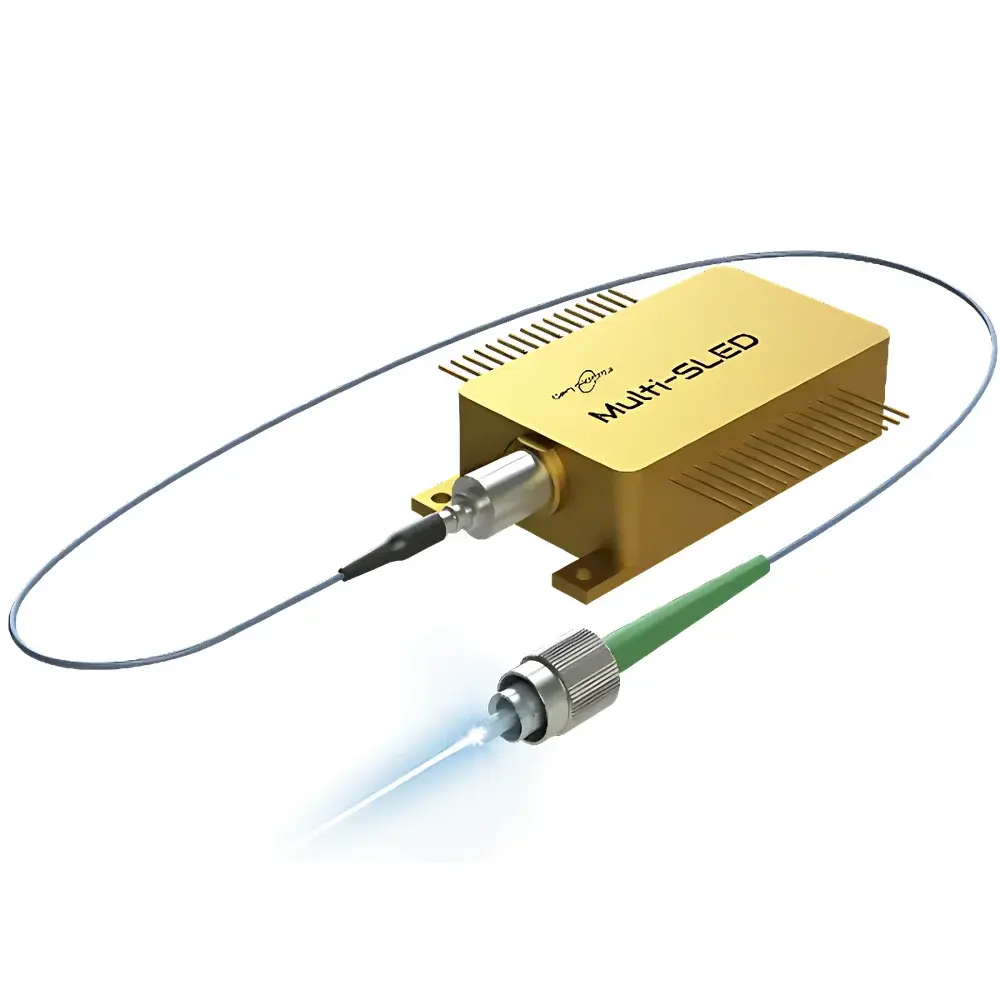
DAYY Photonics Multi-SLED® OSE2 Compact Broadband Superluminescent Diode (SLED) Light Source
| Brand | DAYY Photonics |
|---|---|
| Origin | Canada |
| Model | OSE2 |
| Spectral Range | 770–1680 nm |
| Output Power | Up to 40 mW (fiber-coupled), up to 130 mW (free-space) |
| Spectral Bandwidth (FWHM) | 40–460 nm |
| Package | 32-pin butterfly with integrated TEC, optical isolator, and spectral stitching architecture |
| SLED Channels | Configurable 2–6 per unit |
| Monitoring | Individual photodiode per SLED |
| Polarization | High polarization extinction ratio (PER) |
| Fiber Interface | FC/APC or SMA (optional) |
| Compliance | RoHS-compliant, CE-marked for laboratory use |
Overview
The DAYY Photonics Multi-SLED® OSE2 is an engineered broadband light source designed for demanding near-infrared (NIR) applications requiring high spectral coverage, low temporal coherence, and stable radiometric performance. Unlike conventional laser or LED sources, the OSE2 leverages superluminescent diode (SLED) technology—operating in amplified spontaneous emission (ASE) regime—to deliver spatially coherent, spectrally broad output without interference fringes. Its core innovation lies in DAYY’s proprietary spectral stitching architecture: multiple discrete SLED emitters (2–6 channels), each independently biased and monitored, are combined into a single collimated or fiber-coupled beam with seamless spectral overlap. This architecture enables continuous spectral coverage from 770 nm to 1680 nm—spanning the O-, E-, S-, C-, L-, and U-bands—while maintaining sub-nanometer wavelength stability and <±0.02 nm/h drift under constant thermal control. The device integrates a thermoelectric cooler (TEC), high-extinction-ratio polarization-maintaining (PM) fiber coupling options, and an internal optical isolator to suppress back reflections—critical for interferometric and OCT-grade systems.
Key Features
- Modular multi-SLED architecture: Configurable 2–6 individually addressable SLED channels within a single 32-pin butterfly package.
- Real-time power stabilization: Each SLED incorporates an integrated monitoring photodiode enabling closed-loop current control for long-term power stability (<±0.5% over 8 hours).
- Thermally managed operation: Single shared TEC maintains junction temperature within ±0.1 °C across all channels, ensuring reproducible center wavelength and spectral shape.
- Optimized spectral continuity: Spectral stitching minimizes gaps between adjacent SLED bands, achieving effective bandwidths up to 460 nm FWHM (e.g., ASM000008, ASM000108, ASM000208).
- Flexible output formats: Available in polarization-maintaining (PM) fiber (FC/APC or SMA), single-mode (SM) fiber, or free-space collimated variants—with free-space models delivering up to 130 mW total optical power.
- Ruggedized packaging: Hermetically sealed butterfly housing with industry-standard pinout supports integration into OEM instruments and automated test platforms.
Sample Compatibility & Compliance
The OSE2 is compatible with standard PMF-1550, SMF-28, and HI1060 fibers depending on wavelength band selection. All fiber-coupled variants meet IEC 61300-2-4 (vibration), IEC 61300-2-1 (impact), and Telcordia GR-1209-CORE reliability requirements. The device complies with RoHS Directive 2011/65/EU and carries CE marking for electromagnetic compatibility (EN 61326-1) and safety (EN 61010-1). For regulated environments—including medical device manufacturing and GLP-compliant optical testing—the OSE2 supports traceable calibration documentation and can be supplied with factory-measured spectral power density (SPD) reports referenced to NIST-traceable standards. While not intrinsically FDA 21 CFR Part 11 compliant, its stable output characteristics and hardware-level monitoring make it suitable for use in systems implementing audit trail and electronic signature controls.
Software & Data Management
The OSE2 operates as a stand-alone analog-controlled source but is fully compatible with DAYY’s optional USB-based digital controller (DC-1000 series), enabling RS-232/USB communication for remote channel enable/disable, current ramping, and real-time photodiode feedback logging. Firmware supports SCPI command sets for integration into LabVIEW, Python (PyVISA), and MATLAB automation frameworks. Spectral characterization data—including measured SPD curves, center wavelength, FWHM, and polarization extinction ratio—is delivered in CSV and HDF5 formats for post-processing and metrological traceability. All units ship with a calibration certificate specifying spectral coverage, output power at reference conditions (25 °C, 100 mA drive current), and thermal coefficient of wavelength shift (typically <0.01 nm/°C).
Applications
- Optical Coherence Tomography (OCT): Provides broadband illumination for axial resolution enhancement in ophthalmic, dermatological, and endoscopic OCT systems—particularly where >5 µm axial resolution in tissue is required.
- Fiber-optic component testing: Characterizes insertion loss, polarization-dependent loss (PDL), and group delay ripple in WDM filters, circulators, isolators, and FBGs across C+L bands.
- Interferometric sensing: Serves as low-coherence source in white-light interferometry, fiber Bragg grating (FBG) interrogation, and distributed acoustic sensing (DAS) systems.
- Spectroscopic calibration: Functions as transfer standard for NIR spectrometer validation, particularly in pharmaceutical raw material identification (USP ) and process analytical technology (PAT) workflows.
- Biomedical imaging system development: Enables prototyping of diffuse optical tomography (DOT) and photoacoustic imaging (PAI) platforms requiring tunable, high-power NIR illumination.
FAQ
What is the difference between a SLED and a laser diode?
SLEDs operate below lasing threshold and emit amplified spontaneous emission—producing broadband, low-coherence light ideal for interferometry and OCT. Laser diodes produce narrow-linewidth, highly coherent output unsuitable for applications requiring coherence gating.
Can the OSE2 be used in swept-source OCT?
No—the OSE2 is a static broadband source. It is optimized for spectral-domain OCT (SD-OCT) and time-domain OCT (TD-OCT), not swept-source configurations requiring rapid wavelength tuning.
Is spectral stitching visible as intensity dips in the combined output?
No—DAYY’s stitching algorithm ensures ≥15 nm spectral overlap between adjacent SLEDs and applies gain compensation during assembly to maintain flatness within ±1.5 dB across the stitched band.
How is thermal management implemented across multiple SLEDs?
A single high-efficiency TEC cools the entire semiconductor submount, while individual SLED drive currents are dynamically adjusted based on real-time photodiode feedback to compensate for thermal cross-talk.
Do you offer custom spectral configurations outside the listed ASM part numbers?
Yes—DAYY Photonics provides full spectral design services, including non-standard center wavelengths, asymmetric bandwidths, and hybrid visible-NIR combinations upon request and NDA.





