
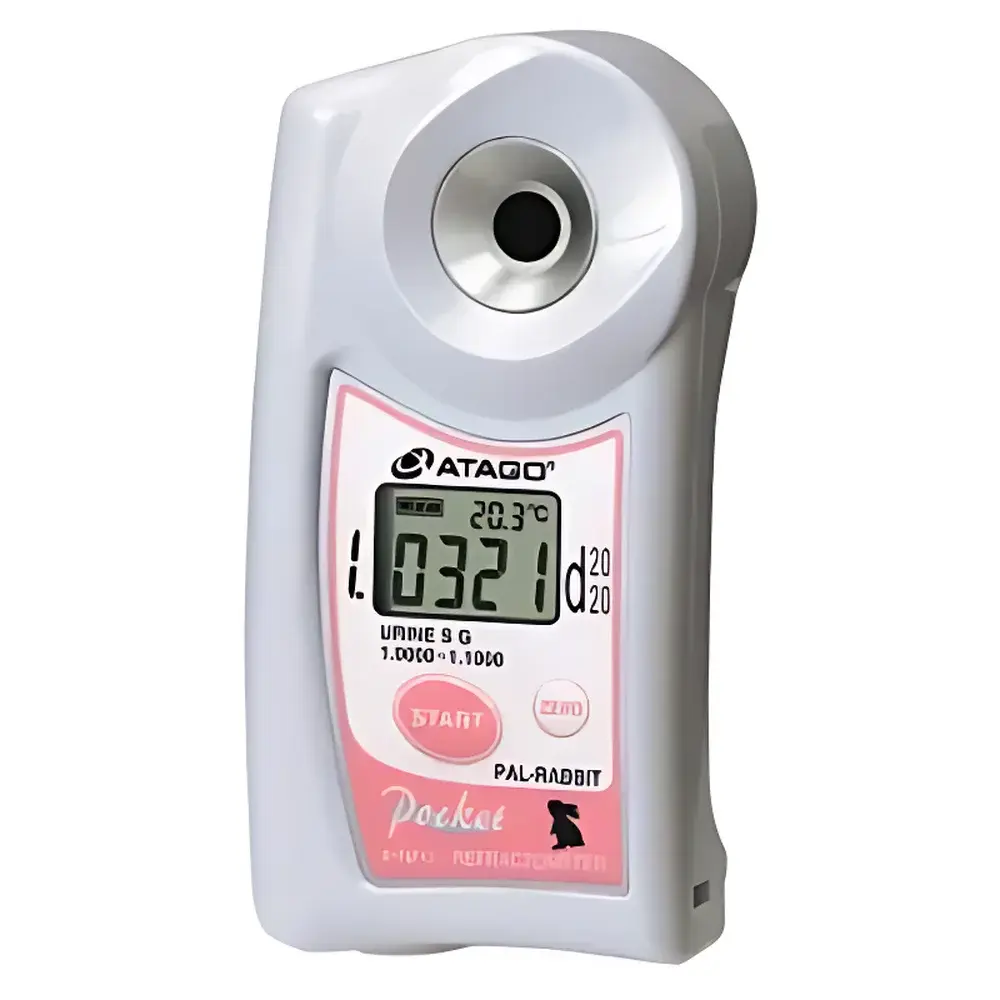
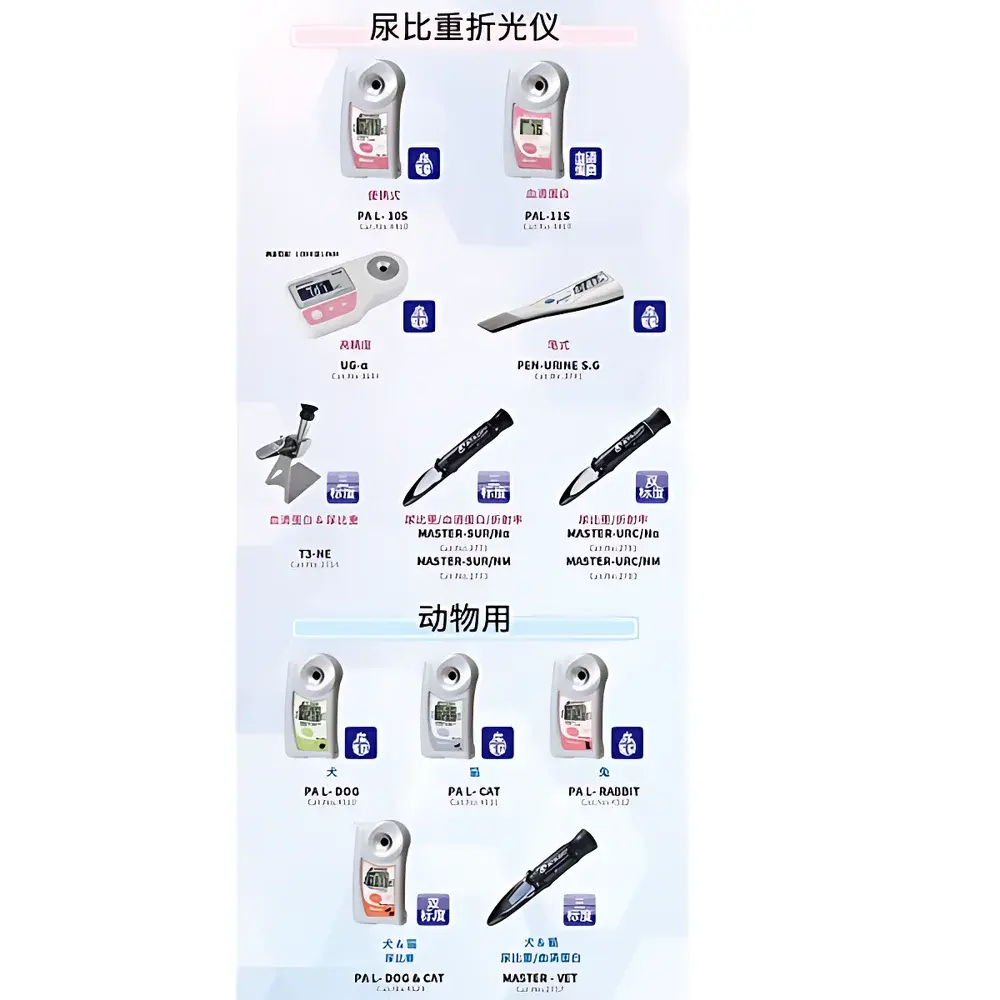
ATAGO PAL-RABBIT Rabbit Urine Specific Gravity Refractometer
| Brand | ATAGO |
|---|---|
| Origin | Japan |
| Model | PAL-RABBIT |
| Catalog No. | 4512 |
| Measurement Range | 1.0000–1.1000 |
| Accuracy | ±0.002 |
| Temperature Compensation | 10–35°C (ATC) |
| Resolution | 0.0001 |
| Power | 2×AAA batteries |
| IP Rating | IP65 |
| Dimensions | 5.5×3.1×10.9 cm |
| Weight | 100 g (instrument only) |
Overview
The ATAGO PAL-RABBIT Rabbit Urine Specific Gravity Refractometer is a handheld, temperature-compensated optical instrument engineered specifically for the rapid, non-invasive quantification of urine specific gravity (USG) in domestic and laboratory rabbits (Oryctolagus cuniculus). It operates on the principle of critical-angle refractometry: light passing through a small urine sample undergoes refraction at the prism-sample interface; the resulting critical angle correlates directly with solute concentration, enabling precise determination of USG without dilution or chemical reagents. Unlike general-purpose clinical refractometers, the PAL-RABBIT features a custom-calibrated scale optimized for the physiological USG range of rabbits (1.0000–1.1000), where subtle deviations—such as elevation above 1.030 or depression below 1.005—may indicate early-stage renal insufficiency, dehydration, diabetes insipidus, or dietary-induced metabolic stress. Its compact form factor and robust optical architecture make it suitable for point-of-care use in veterinary clinics, vivariums, and field-based rabbit husbandry operations.
Key Features
- Species-specific calibration: Scale precisely aligned to rabbit urinary physiology, minimizing interpretation error versus generic USG scales.
- Automatic Temperature Compensation (ATC): Compensates for sample temperature fluctuations between 10°C and 35°C using a built-in bimetallic thermal element, eliminating manual correction tables and ensuring measurement consistency across ambient conditions.
- High-resolution digital display: 0.0001 resolution enables detection of minute USG shifts—critical for longitudinal monitoring of chronic kidney disease progression or response to fluid therapy.
- Dust- and water-resistant housing (IP65 rated): Withstands routine disinfection protocols (e.g., 70% ethanol wipe-downs) and incidental splashes in clinical or biocontainment environments.
- Battery-operated portability: Powered by two standard AAA batteries (included), supporting >5,000 measurements per set; no external power source or warm-up time required.
- Minimal sample volume: Requires only 0.3 mL of fresh, uncentrifuged urine—ideal for small-volume collections from restrained or stressed rabbits.
Sample Compatibility & Compliance
The PAL-RABBIT is validated for use with native, unpreserved rabbit urine samples collected via manual expression, cystocentesis, or metabolism cage collection. It is not intended for use with highly viscous, hemolyzed, or heavily contaminated specimens, which may scatter incident light and compromise accuracy. While the device itself does not require regulatory certification for veterinary diagnostic use in most jurisdictions, its measurement methodology aligns with principles referenced in veterinary clinical pathology guidelines (e.g., ASVCP Veterinary Clinical Pathology Guidelines). Data generated supports Good Laboratory Practice (GLP)-compliant animal health monitoring when integrated into documented observational protocols. The instrument complies with IEC 60529 (IP65) for ingress protection and meets RoHS Directive 2011/65/EU requirements for hazardous substance restriction.
Software & Data Management
The PAL-RABBIT is a standalone analog-digital hybrid instrument with no onboard data logging, Bluetooth, or USB connectivity. All measurements are displayed in real time on a high-contrast LCD screen and must be manually recorded. This design prioritizes operational simplicity, battery longevity, and electromagnetic compatibility in electromagnetically noisy environments (e.g., near MRI suites or surgical equipment). For institutions requiring traceable records, integration with electronic lab notebooks (ELNs) or veterinary practice management systems (e.g., Cornerstone, eVetPractice) is achieved via manual entry or optional third-party barcode-scanning peripherals. Though not FDA 21 CFR Part 11 compliant out-of-the-box, audit trails can be maintained externally through standardized SOP documentation of operator ID, date/time stamp, animal ID, and measured USG value per observation event.
Applications
- Early detection of prerenal azotemia in geriatric or postoperative rabbits exhibiting reduced water intake.
- Monitoring hydration status during antibiotic therapy or NSAID administration, both associated with nephrotoxic risk in lagomorphs.
- Assessing renal concentrating ability in breeding colonies to identify subclinical chronic kidney disease affecting reproductive performance.
- Supporting welfare assessments under EU Directive 2010/63/EU and AAALAC International standards by providing objective biomarkers of physiological stress.
- Validating efficacy of dietary interventions (e.g., increased fiber or sodium restriction) on urinary solute excretion patterns.
- Training veterinary students and technicians in species-specific urinalysis fundamentals without reliance on centrifugation or dipstick interpretation subjectivity.
FAQ
Can the PAL-RABBIT be used for other small mammals such as guinea pigs or chinchillas?
No—it is calibrated exclusively for rabbit urine density characteristics. Other lagomorphs or rodents exhibit different baseline USG distributions and osmolar profiles; cross-species use introduces systematic bias.
Does the instrument require periodic recalibration?
ATAGO recommends annual verification using certified reference standards (e.g., NIST-traceable sucrose solutions at 1.0100 and 1.0400); field recalibration is not user-serviceable.
Is cleaning solution compatibility documented?
Yes: 70% isopropyl alcohol or 0.5% sodium hypochlorite solution is approved for prism and housing surface decontamination; avoid acetone, chloroform, or abrasive cloths.
How does ATC function without a digital temperature sensor?
It employs a passive bimetallic strip integrated into the prism mount, mechanically adjusting optical path length in response to thermal expansion—no firmware or battery-dependent electronics involved.
What is the expected service life under typical veterinary clinic usage?
With proper handling and storage (in supplied protective case, away from UV exposure), optical performance remains stable for ≥8 years based on ATAGO’s accelerated aging validation data.




