
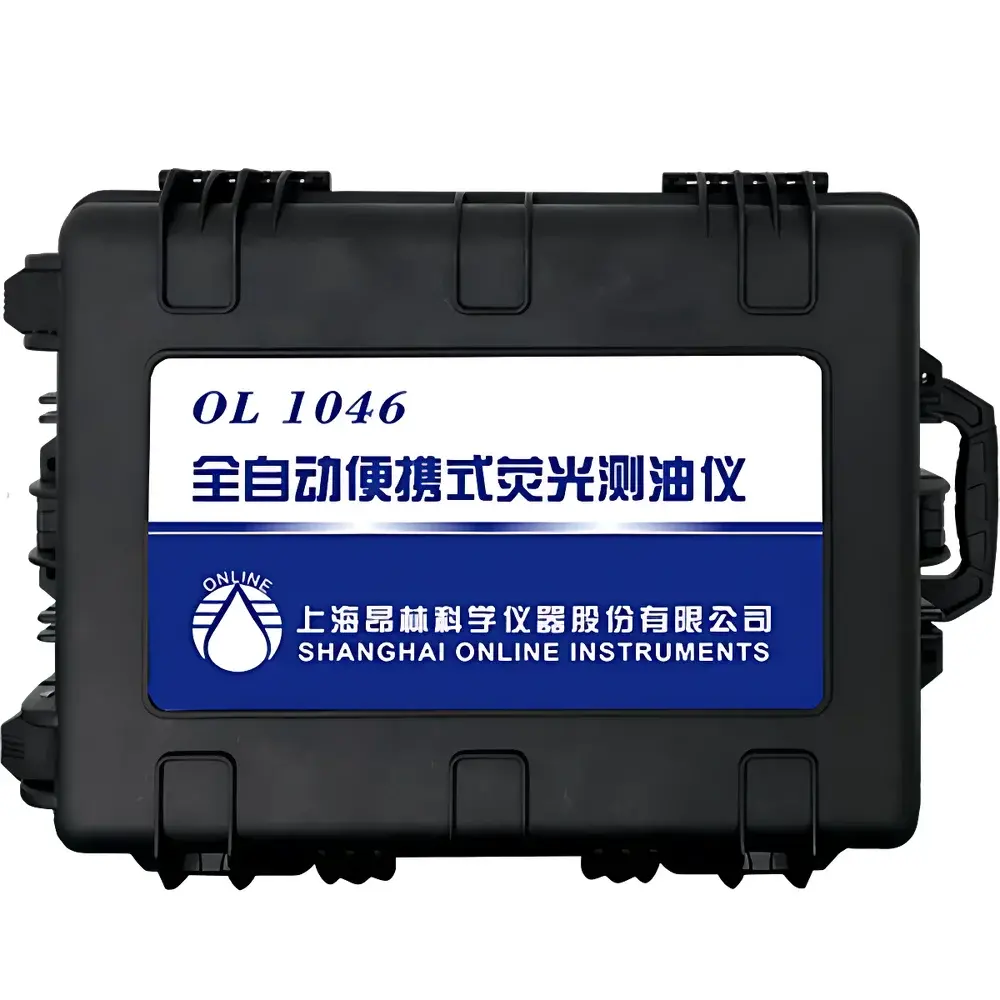
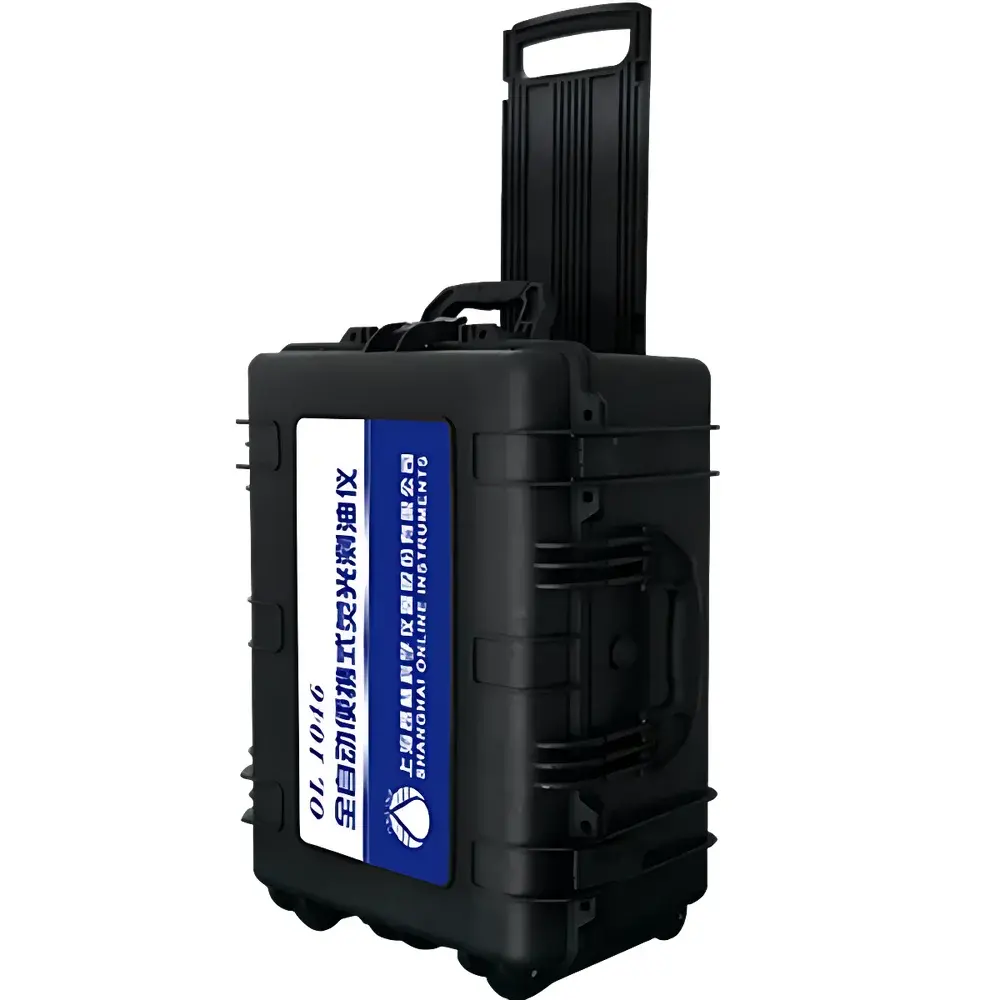
Online Instrument OL1046 Portable Automated Fluorescence Oil-in-Water Analyzer
| Brand | Online Instrument |
|---|---|
| Origin | Shanghai, China |
| Manufacturer Type | Direct Manufacturer |
| Region of Origin | Domestic (China) |
| Model | OL1046 |
| Instrument Type | Portable |
| Measurement Principle | Fluorescence Spectrophotometry |
| Measurement Range | 0–5 mg/L |
| Detection Limit | 0.0010 mg/L |
| Accuracy | ±2% |
| Resolution | 0.001 mg/L |
| Analysis Cycle Time | 9 minutes |
Overview
The Online Instrument OL1046 Portable Automated Fluorescence Oil-in-Water Analyzer is an integrated field-deployable instrument engineered for rapid, accurate quantification of petroleum hydrocarbons in aqueous matrices using fluorescence spectrophotometry. Based on the principle that polycyclic aromatic hydrocarbons (PAHs) in petroleum compounds exhibit characteristic native fluorescence when excited at specific UV wavelengths (typically 365 nm), the OL1046 measures emitted fluorescence intensity—linearly proportional to oil concentration within the validated range of 0–5 mg/L. Its design complies with core methodological foundations of national standard GB/T 16488–1996 (Determination of Petroleum Hydrocarbons in Water by Fluorescence Method) and aligns with international technical expectations for field-ready oil-in-water analysis, including ASTM D7678–21 (Standard Test Method for Determination of Oil and Grease in Water by Solvent Extraction and Infrared Spectrophotometry) in measurement intent, though optimized for fluorescence-based field deployment rather than IR.
Key Features
- Fully integrated portable architecture: Combines solvent extraction module, fluorescence detection unit, reagent reservoir, waste collection chamber, and sample bottle holder within a single ruggedized enclosure—enabling operation inside moving environmental monitoring vehicles without signal drift or mechanical misalignment.
- Opto-mechanical stability: Features vibration-damped optical path design and solid-state excitation/detection optics, ensuring consistent photometric performance under dynamic transport conditions.
- True walk-away automation: One-touch initiation executes the entire analytical sequence—including non-contact water volume measurement (error <2%), precise petroleum ether dosing via calibrated syringe pump, mechanical agitation-assisted liquid-liquid extraction, three-stage phase separation (extraction tube + hydrophobic membrane + gravity settling), organic phase transfer, and fluorescence measurement—without manual intervention.
- Non-contact volumetric sensing: Employs ultrasonic or capacitive sensing (configurable per calibration protocol) to determine sample volume prior to reagent addition, eliminating pipetting errors and cross-contamination risks associated with manual transfer.
- Trace-level sensitivity: Achieves a method detection limit (MDL) of 0.0010 mg/L with 0.001 mg/L digital resolution, supporting compliance with stringent regulatory thresholds for surface water and drinking water source monitoring.
Sample Compatibility & Compliance
The OL1046 is validated for use with 500 mL narrow-mouth borosilicate glass sampling bottles as specified in GB/T 16488–1996, minimizing adsorption losses and preserving sample integrity during transport. It accommodates turbid, colored, or suspended-solid-laden water samples common in estuarine, coastal, and riverine environments—provided particulate load does not exceed 50 mg/L (pre-filtration recommended above this threshold). The instrument’s operational workflow supports GLP-aligned data integrity requirements: all critical parameters (sample ID, volume, reagent lot, timestamp, operator ID, and raw fluorescence counts) are automatically logged. Audit trails meet foundational expectations for environmental field instrumentation used in regulatory reporting contexts, and optional firmware upgrades support 21 CFR Part 11-compliant electronic signatures and secure user access control.
Software & Data Management
Controlled via an embedded industrial-grade touchscreen PC running Linux-based firmware, the OL1046 provides intuitive graphical interface navigation and real-time status visualization. Measurement data—including raw fluorescence intensity, calculated concentration (mg/L), calibration curve metadata (R² ≥ 0.999), and process diagnostics—are exported in CSV or PDF formats via USB or Wi-Fi. Internal storage retains ≥10,000 test records with time/date stamping and GPS-tagged location metadata (when external GNSS module is connected). Firmware supports user-defined calibration curves (multi-point linear or quadratic), QC check standards verification, and automated pass/fail flagging against preset action limits.
Applications
- Field-based pollution source identification: Rapid screening of discharge points, stormwater outfalls, and marina runoff for petroleum hydrocarbon leakage.
- Emergency response monitoring: On-site assessment during oil spill incidents in marine, estuarine, or freshwater systems—delivering quantitative results within 9 minutes per sample.
- Regulatory compliance verification: Supporting routine surveillance programs for wastewater treatment plant effluents, industrial discharge permits, and ambient water quality assessments per local environmental protection bureau mandates.
- Research-grade environmental forensics: Enabling high-temporal-resolution spatial mapping of hydrocarbon gradients in dynamic coastal zones and river plumes.
FAQ
What solvent is required for extraction?
Petroleum ether (boiling point 60–90 °C) is the designated extraction solvent, pre-qualified for minimal auto-fluorescence and optimal PAH solubility.
Is the instrument suitable for seawater analysis?
Yes—the system compensates for salinity-induced matrix effects via built-in blank correction and has been verified for accuracy in 0–35 ppt NaCl solutions.
Can calibration curves be imported from external labs?
Yes—CSV-formatted calibration data (concentration vs. fluorescence units) can be uploaded and applied to subsequent measurements.
What maintenance is required between analyses?
No consumable parts require replacement per run; only periodic cleaning of the extraction tube and optical cuvette with solvent is recommended after every 20 samples.
Does the OL1046 support remote diagnostics or firmware updates?
Yes—via secure HTTPS-enabled web interface accessible through local network or cellular hotspot, enabling over-the-air firmware patches and diagnostic log retrieval.
Related Products







