
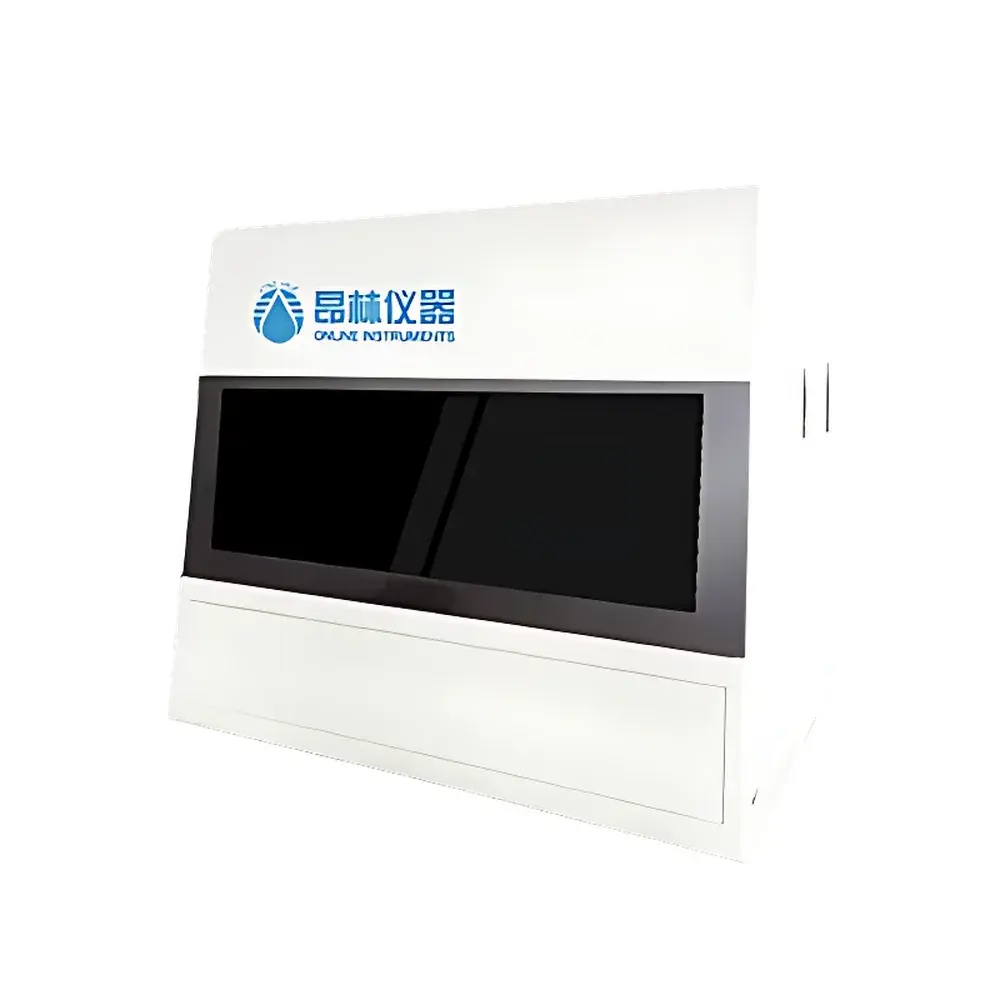
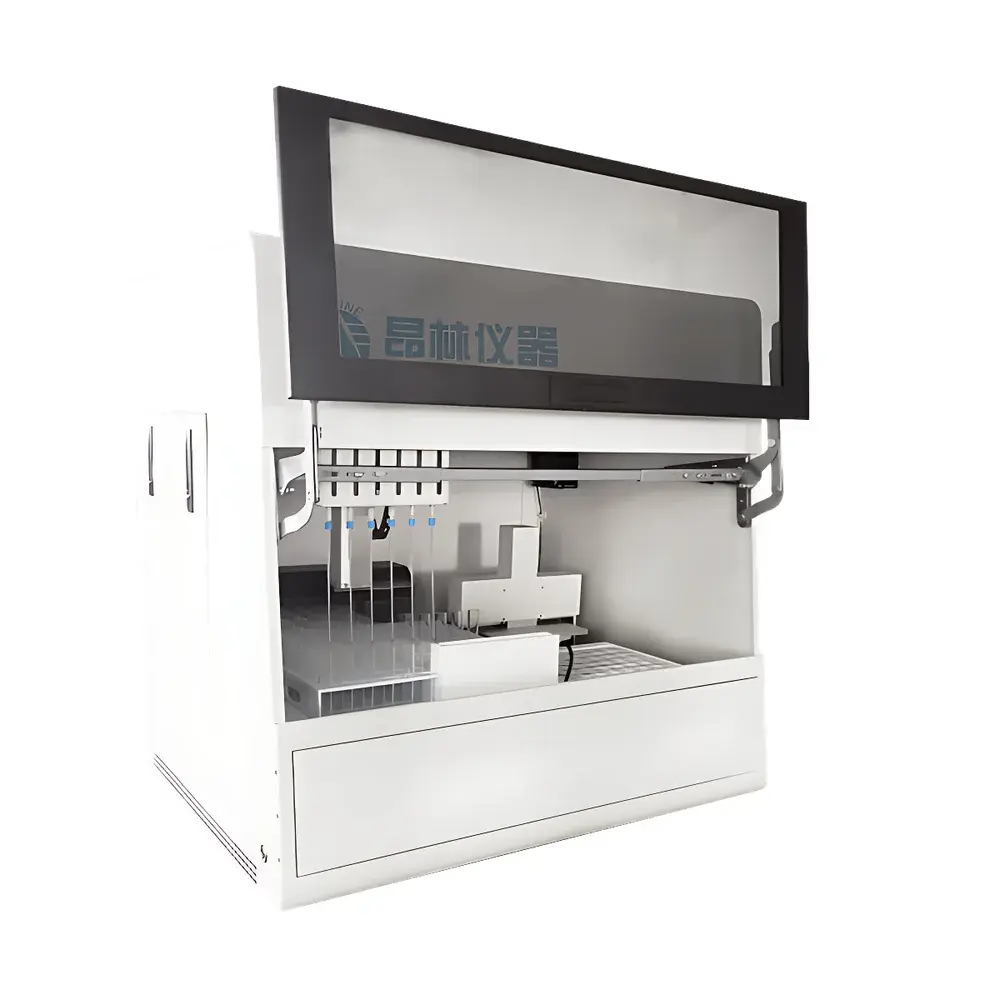
Online Instrument OL3236 Automated COD Analyzer
| Brand | Online Instrument |
|---|---|
| Origin | Shanghai, China |
| Manufacturer Type | Direct Manufacturer |
| Instrument Type | Laboratory-Based |
| Model | OL3236 |
| Measurement Principle | Rapid Digestion Spectrophotometry |
| Wavelengths | 600 nm ± 20 nm and 440 nm ± 20 nm |
| Measurement Range | 15–1000 mg/L COD |
| Accuracy | ±5% of reading |
| Repeatability | RSD ≤ 2% |
| Limit of Detection | 4 mg/L |
| Cycle Time | 40 minutes per batch of 36 samples |
| Batch Capacity | 108 sample positions |
| Digestion Capacity | 36 simultaneous digestion units |
| Photometric Measurement Channels | 6 parallel optical cells |
Overview
The Online Instrument OL3236 Automated COD Analyzer is a laboratory-grade spectrophotometric system engineered for high-throughput, unattended determination of Chemical Oxygen Demand (COD) in aqueous matrices. It implements the standardized rapid digestion method—compliant with ISO 15705:2002 and APHA Standard Methods 5220 D—wherein water samples are oxidized under acidic, high-temperature conditions (165 °C for 15 min) using potassium dichromate as the oxidant. The resulting colorimetric change, proportional to the consumed oxygen equivalent, is quantified at dual wavelengths (600 nm and 440 nm) to correct for turbidity and interferences. Unlike manual or semi-automated benchtop systems, the OL3236 integrates fluidic handling, thermal control, optical detection, and data reporting into a single platform, eliminating operator-dependent variability and enabling full walk-away operation across multi-day sequences.
Key Features
- Fully automated workflow: Sequential execution of sample aspiration, reagent dosing (including sulfuric acid, silver sulfate catalyst, and potassium dichromate), sealed digestion, cooling, photometric measurement, and report generation—all without manual intervention.
- Intelligent dual-wavelength photometry: Simultaneous absorbance acquisition at 600 nm (primary COD-sensitive band) and 440 nm (turbidity correction band), minimizing matrix-induced bias in colored or suspended-solid-rich samples.
- Adaptive range switching: Automatic dilution and re-measurement when sample COD exceeds the upper limit of the current calibration segment (e.g., >1000 mg/L), ensuring traceability and linearity without manual reconfiguration.
- Integrated thermal management: PID-controlled heating block maintains precise 165 °C ± 1 °C during digestion; all reaction vessels remain sealed to prevent vapor loss and cross-contamination.
- Comprehensive system hygiene: Post-analysis automatic rinsing of all fluidic paths—including sampling probes, reagent lines, digestion tubes, and optical cuvettes—with deionized water and air purge cycles to eliminate carryover between samples.
- Embedded industrial tablet interface: Local HMI with intuitive touch-based navigation, real-time status dashboard, and on-device method editing—no external PC required for routine operation.
Sample Compatibility & Compliance
The OL3236 supports direct analysis of raw and filtered surface water, groundwater, domestic wastewater, and pre-treated industrial effluents. It accommodates sample volumes from 2.0 to 5.0 mL and tolerates total suspended solids (TSS) up to 100 mg/L without filtration. All digestion and measurement protocols align with ISO 15705:2002, EPA Method 410.4 (modified), and China’s HJ 828–2017 standard. The instrument architecture meets IEC 61000-6-2/6-3 for electromagnetic compatibility and is designed for GLP-compliant environments: audit trails log all user actions, method changes, calibration events, and error conditions with timestamp and operator ID. Optional 21 CFR Part 11 compliance package enables electronic signatures, role-based access control, and immutable data archiving.
Software & Data Management
The embedded firmware supports method storage, calibration curve management (up to 12-point polynomial or linear fits), and QC flagging (e.g., blank drift >5%, recovery outside 85–115%). Data export is available in CSV, PDF, and XML formats, with configurable metadata fields (sample ID, location, analyst, instrument ID). LIMS integration is achieved via HL7 v2.x or ASTM E1384-compliant RESTful API, enabling bidirectional synchronization of sample batches, results, and instrument status. Remote access is secured via TLS 1.2–encrypted web interface accessible from iOS, Android, or desktop browsers—supporting live video feed of the digestion chamber, real-time absorbance plots, and remote start/stop/pause commands.
Applications
- Regulatory wastewater discharge monitoring for municipal treatment plants (daily compliance reporting per local environmental authority requirements).
- Industrial process control in chemical, pharmaceutical, food & beverage, and pulp & paper sectors where COD serves as a surrogate for organic load in influent/effluent streams.
- Research laboratories conducting kinetic studies of biodegradation, inhibitor screening, or oxidation efficiency comparisons across catalyst formulations.
- Environmental testing service providers performing batched client submissions under ISO/IEC 17025-accredited scopes.
- Educational institutions utilizing the system for teaching analytical method validation, QA/QC principles, and automated instrumentation design.
FAQ
What digestion temperature and duration does the OL3236 use, and how is temperature stability ensured?
The system maintains a constant 165 °C ± 1 °C for exactly 15 minutes per digestion cycle using a calibrated, PID-regulated aluminum heating block with integrated thermocouple feedback and over-temperature cut-off.
Can the OL3236 handle highly turbid or saline wastewater samples?
Yes—dual-wavelength correction at 440 nm compensates for light scattering, and the sealed digestion protocol minimizes chloride interference; for chloride concentrations exceeding 2000 mg/L, optional mercury-free AgNO₃ pretreatment modules are available.
Is method validation documentation provided for regulatory submission?
Yes—the factory acceptance test (FAT) report includes precision (RSD ≤ 2%), accuracy (±5% vs. certified reference materials), LOD (4 mg/L), and linearity (r² ≥ 0.999 over 15–1000 mg/L) data per ISO/IEC 17025 Annex A.3 guidelines.
How is reagent waste managed during automated operation?
All post-digestion liquid waste is pneumatically transferred to a dedicated, sealed 5-L HDPE collection reservoir with level sensor and leak-proof quick-connect fittings—compatible with on-site hazardous waste disposal protocols.
Does the system support custom calibration curves or user-defined calculation formulas?
Yes—through the embedded method editor, users may define multi-point calibrations, apply correction factors (e.g., for chloride masking), and embed proprietary algorithms using Lua scripting within the firmware sandbox environment.
Related Products







