
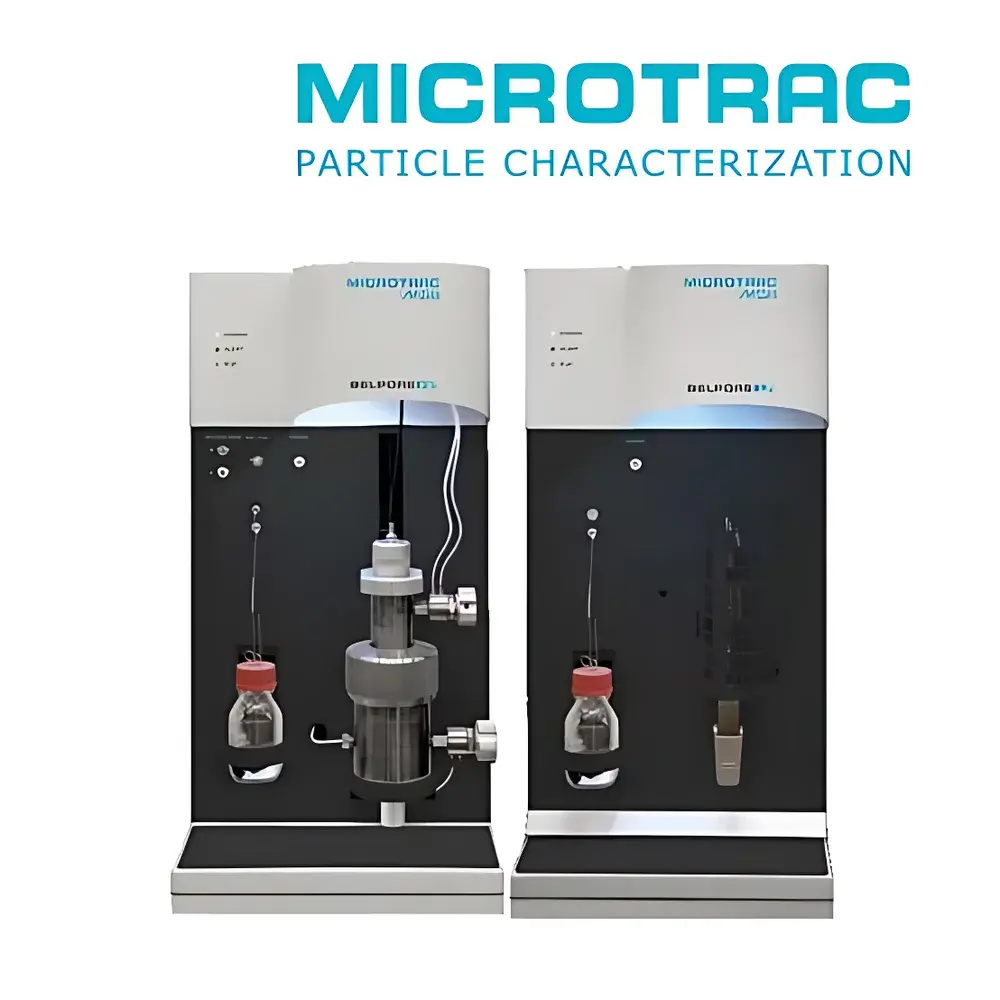
Microtrac BELPORE Series Automated Mercury Intrusion Porosimeter
| Brand | Microtrac |
|---|---|
| Origin | Italy |
| Model | BELPORE Series |
| Measurement Volume Range | 0.5–2 cm³ |
| Pressure Range | Vacuum to 414 MPa |
| Volume Measurement Accuracy | Better than 1% F.S. |
| Pressure Measurement Accuracy | Better than 0.1% F.S. |
| Maximum Data Points | 10,000 (intrusion) + 10,000 (extrusion) |
| Certified | CE, ISO 9001 |
Overview
The Microtrac BELPORE Series Automated Mercury Intrusion Porosimeter is a high-precision instrument engineered for the quantitative characterization of pore structure in rigid, non-collapsible porous solids. Based on the fundamental principle of mercury intrusion porosimetry (MIP), it exploits the non-wetting nature of mercury and its predictable capillary behavior under controlled pressure, governed by the Washburn equation. As pressure increases, mercury is forced into progressively smaller pores; the corresponding intrusion volume at each pressure step yields a complete pore size distribution (PSD) across the measurable range—from macropores down to mesopores and fine micropores. The BELPORE platform extends this classical technique with vertical intruder geometry, fully automated pressure control, and integrated vacuum management—enabling reliable analysis from 1 mm down to 3.6 nm pore diameters, covering all three operational variants: LP (low-pressure), MP (medium-pressure), and HP (high-pressure).
Key Features
- Vertical mercury intruder design ensures gravitational safety, eliminates mercury column instability, and enables precise volumetric displacement measurement without external gas or cryogenic support.
- P.A.S.C.A.L. (Pressurization by Automatic Speed-up and Continuous Adjustment Logic): A proprietary real-time pressure regulation algorithm that dynamically adjusts pressurization rate based on actual sample response—reducing total analysis time while preserving thermodynamic equilibrium at each data point.
- High-resolution acquisition: Up to 20,000 total data points per run (10,000 intrusion + 10,000 extrusion), supporting robust statistical evaluation and detection of subtle pore network features such as bimodality or hysteresis.
- Integrated mercury reclamation system with automatic cleaning cycle—minimizing mercury consumption and operator exposure while maintaining long-term calibration stability.
- Compact footprint and CE/ISO 9001-certified construction meet stringent laboratory space and quality system requirements (e.g., GLP-compliant environments).
- Three modular configurations: BELPORE LP (1,000–3.25 µm), BELPORE MP (15–0.0065 µm), and BELPORE HP (15–0.0036 µm), enabling application-specific optimization without hardware duplication.
Sample Compatibility & Compliance
The BELPORE Series accommodates a broad spectrum of inorganic and organic rigid materials—including ceramics, catalysts, cements, carbons, metal oxides, and geological samples—without requiring pre-drying when using the LP variant’s vertical degassing mode. This capability allows moisture-sensitive specimens (e.g., hydrated concrete, solvent-containing green bodies) to be analyzed in their native state, avoiding structural collapse or pore closure artifacts. All instruments comply with EU Machinery Directive 2006/42/EC and Electromagnetic Compatibility Directive 2014/30/EU. CE marking confirms conformity with essential health and safety requirements. ISO 9001 certification validates consistent manufacturing and service processes. While MIP itself is not standardized under a single ISO document, BELPORE workflows align with ASTM D4404 (Standard Test Method for Determination of Pore Size Distributions of Catalyst Substrates and Supports by Mercury Intrusion Porosimetry) and ISO 15901-1 (Porous materials — Mercury porosimetry and gas adsorption — Part 1: Mercury porosimetry).
Software & Data Management
PoreInspect software serves as the central interface for instrument control, data acquisition, and advanced post-processing. It supports simultaneous monitoring and independent operation of up to four BELPORE units via LAN connection, facilitating multi-instrument labs and method harmonization. Key analytical functions include automated blank correction, compressibility assessment and compensation, fractal dimension calculation, tortuosity estimation, and permeability modeling. Users may select among multiple pore geometry models (cylindrical, slit, ink-bottle) and export results in CSV, PDF, or XML formats. All raw pressure-volume datasets are stored with full metadata (timestamp, operator ID, method version, calibration logs), satisfying audit-trail requirements under FDA 21 CFR Part 11 when deployed with appropriate IT validation protocols. Method libraries enable SOP-driven operation, ensuring inter-laboratory reproducibility.
Applications
- Quality control of ceramic filters and membrane substrates in filtration and separation industries.
- Pore structure optimization of battery electrode materials (e.g., LiFePO₄ cathodes, silicon anodes) for ion transport efficiency.
- Characterization of catalyst supports (γ-Al₂O₃, zeolites) to correlate surface accessibility with reaction kinetics.
- Hydration monitoring in cementitious systems through comparative LP-MIP analysis of samples at different curing ages.
- Validation of additive manufacturing (AM) powder bed sintering density and interparticle pore network evolution.
- Geological core analysis for reservoir rock classification in oil & gas exploration (porosity, permeability, pore throat size distribution).
FAQ
What pore size range can the BELPORE HP model resolve?
The BELPORE HP configuration achieves resolution down to 3.6 nm (0.0036 µm) at maximum pressure (414 MPa), suitable for fine mesoporous and upper-microporous materials.
Does the system require liquid nitrogen or auxiliary gases for operation?
No—BELPORE operates without liquid nitrogen, helium, or compressed air. Vacuum generation and mercury displacement are fully self-contained via integrated mechanical pumps and vertical intruder mechanics.
How does P.A.S.C.A.L. improve measurement accuracy compared to conventional ramp-based pressure control?
P.A.S.C.A.L. continuously monitors intrusion rate and adjusts pressure incrementally to maintain near-equilibrium conditions—avoiding kinetic overshoot and ensuring each data point reflects true capillary equilibrium, critical for accurate PSD deconvolution.
Can wet or hydrated samples be measured without drying artifacts?
Yes—the BELPORE LP variant supports vertical degassing at adjustable low vacuum levels (<10 mbar), enabling mercury intrusion into moisture-retaining matrices like fresh concrete or solvent-saturated MOFs without structural alteration.
Is PoreInspect compliant with regulatory data integrity standards?
When deployed with validated user access controls, electronic signatures, and audit-trail logging enabled, PoreInspect meets ALCOA+ principles and supports compliance with FDA 21 CFR Part 11 and EU Annex 11 for regulated laboratories.
Related Products



