
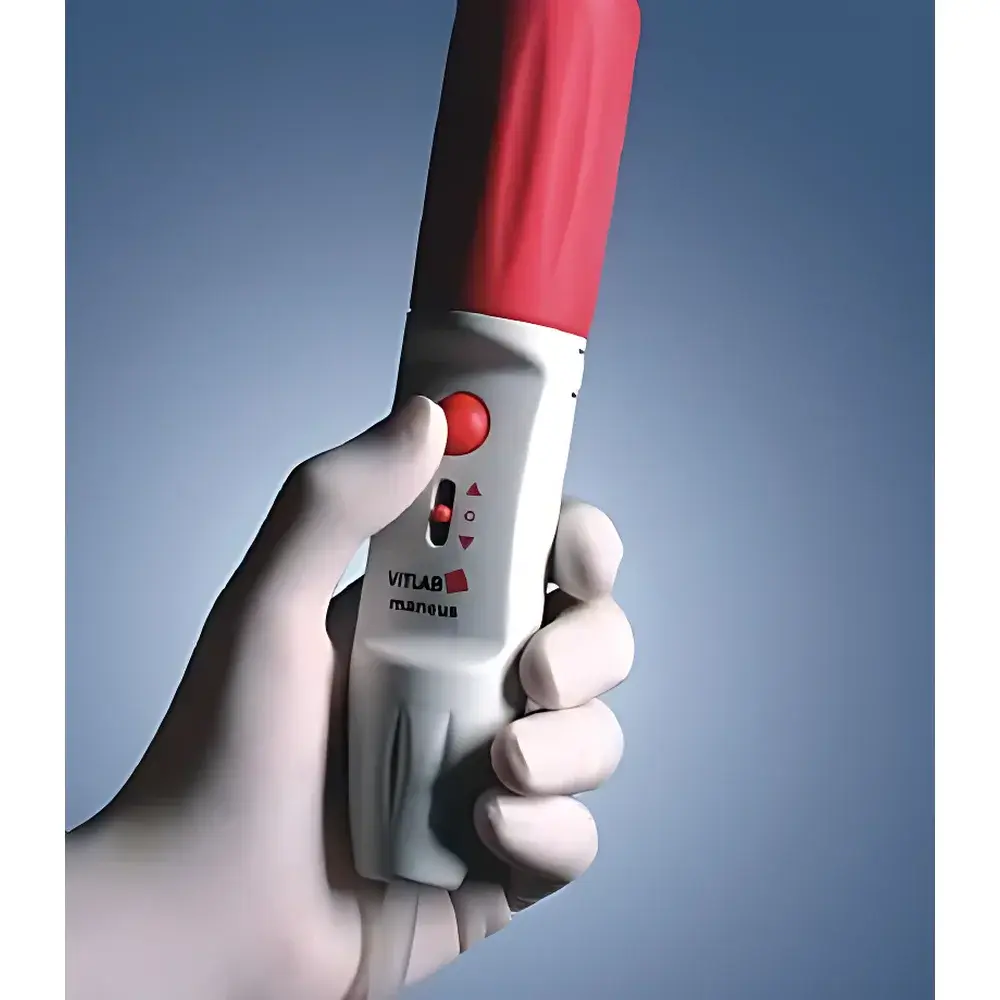
VITLAB maneus Manual Pipette Controller
| Brand | VITLAB |
|---|---|
| Origin | Germany |
| Model | maneus |
| Pipette Type | Single-Channel Manual Pipette Controller |
| Volume Range | 0.1–100 mL |
| Valve System | Ergonomic Dual-Action Airflow Valve |
| Operation | One-Handed Control |
| Liquid Level Control | Precision Meniscus Adjustment Lever |
| Integrated Hydrophobic Filter | Yes |
| Compliance | ISO 8655-2 (Pipette Controllers), CE Marked |
| Construction | Chemically Resistant Polymer Housing with Soft-Grip Ergonomic Design |
Overview
The VITLAB maneus Manual Pipette Controller is a precision-engineered liquid handling instrument designed for reliable, repeatable, and ergonomic manual pipetting across a broad volume range (0.1–100 mL). Unlike electronic or motorized alternatives, the maneus operates on a purely mechanical airflow principle—leveraging a dual-action valve system to regulate aspiration and dispensing without batteries or external power. Its core mechanism follows the fundamental physics of controlled air displacement: pressing the control lever opens a calibrated airflow path, drawing liquid into the pipette tip via negative pressure; releasing or adjusting the lever modulates flow rate and enables fine-tuned meniscus positioning. This passive, analog design ensures intrinsic stability, zero drift, and immunity to electromagnetic interference—critical attributes in regulated analytical laboratories, QC environments, and teaching labs where operational transparency and long-term calibration integrity are prioritized.
Key Features
- Ergonomic one-handed operation enabled by a balanced center-of-gravity housing and low-actuation-force dual-lever valve system
- Precision meniscus adjustment lever allows real-time visual alignment of liquid level within glass or plastic volumetric pipettes—essential for Class A compliance verification and gravimetric calibration
- Integrated hydrophobic PTFE filter (0.2 µm pore size) positioned upstream of the valve chamber prevents aerosol ingress and protects internal components from corrosive or volatile solvents
- Chemically resistant polymer construction (FDA-compliant polypropylene and thermoplastic elastomer) withstands repeated exposure to alcohols, acetone, dilute acids/bases, and common laboratory disinfectants
- No electronics, no firmware, no battery dependency—eliminates validation overhead associated with software-based controllers under GLP/GMP or ISO/IEC 17025 requirements
- Modular design supports rapid field replacement of filter cartridges and O-rings using standard service kits (VITLAB part no. 1630501)
Sample Compatibility & Compliance
The maneus controller is compatible with all standard Class A and Class B volumetric pipettes (ISO 648, ISO 1042) ranging from 0.1 mL to 100 mL, including borosilicate glass, polystyrene, and polypropylene formats. It does not interface with positive-displacement or electronic pipettes. All materials in contact with airflow pathways comply with USP and cytotoxicity and systemic injection testing. The device bears CE marking per Directive 2014/30/EU (EMC) and 2014/31/EU (Measuring Instruments), and conforms to ISO 8655-2:2022 for manual pipette controllers—including mechanical durability (≥100,000 actuation cycles), leakage rate (<1.0 µL/min at 100 kPa), and volume repeatability (CV ≤ 0.5% at mid-range volumes).
Software & Data Management
The VITLAB maneus is a standalone mechanical instrument with no embedded software, firmware, or digital connectivity. As such, it requires no computer interface, driver installation, or cybersecurity configuration. This architecture inherently satisfies FDA 21 CFR Part 11 requirements for systems exempt from electronic record/recordkeeping provisions—making it suitable for use in validated workflows where audit trails, user authentication, or electronic signatures are not applicable. Calibration records (e.g., gravimetric verification per ISO 8655-6) are maintained manually in laboratory notebooks or LIMS-integrated spreadsheets, consistent with traditional wet-lab documentation practices.
Applications
- Gravimetric preparation of standard solutions and reference materials in metrology labs
- Manual titration setup requiring precise delivery of titrant into burettes or flasks
- Cell culture media preparation where sterility and solvent compatibility (e.g., DMSO, ethanol) are critical
- Environmental testing labs performing EPA Method 300.0–300.1 anion analysis via ion chromatography sample dilution
- Pharmaceutical QC labs conducting USP volumetric apparatus calibration
- Undergraduate and graduate teaching laboratories emphasizing foundational pipetting technique and error source identification
FAQ
Is the maneus compatible with serological pipettes?
Yes—it supports both TC (to contain) and TD (to deliver) serological pipettes meeting ISO 648 specifications, provided they feature standardized conical tips (DIN 12751).
Can it be used with organic solvents like chloroform or ether?
The hydrophobic PTFE filter and chemically resistant housing allow intermittent use with low-boiling-point organics; however, prolonged exposure to highly aggressive solvents (e.g., THF, DMF) is not recommended without prior compatibility testing.
Does VITLAB provide a calibration certificate with purchase?
No factory-issued calibration certificate is included; users must perform initial gravimetric verification per ISO 8655-6 and document results internally. Traceable calibration services are available through authorized VITLAB service centers (certificate option code: CAL-MAN-01).
What maintenance intervals are recommended?
Filter replacement every 6 months under routine use or immediately after visible contamination; full service inspection (valve seal integrity, lever spring tension) every 12 months or after 50,000 actuations.
Is the maneus suitable for ISO/IEC 17025-accredited testing laboratories?
Yes—its mechanical simplicity, documented conformity to ISO 8655-2, and absence of software dependencies align with ILAC-G8:2023 guidance for equipment used in accredited testing where measurement uncertainty contributions are well-characterized and stable.
Related Products



