
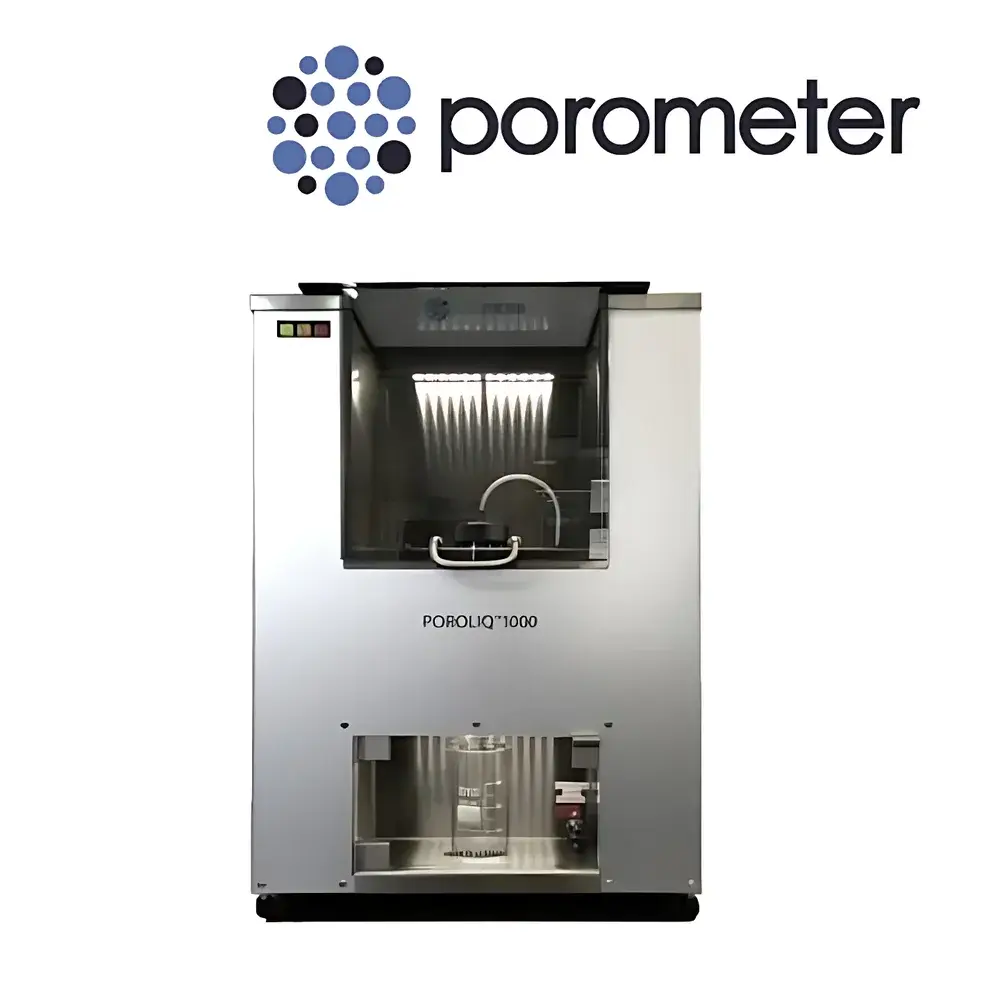
Porometer POROLIQ Liquid-Liquid Pore Size Analyzer
| Brand | Porometer |
|---|---|
| Model | POROLIQ |
| Origin | Germany |
| Technology | Liquid-Liquid Displacement (LLP) |
| Measurement Principle | Capillary Flow Porometry via Immiscible Liquid Pair (e.g., Isopropanol/Water) |
| Minimum Detectable Pore Diameter | 2 nm |
| Data Acquisition Mode | Stepwise Pressure Ramp with Equilibrium Validation Algorithm |
| Compliance Framework | ASTM F316-22, ISO 15901-1, USP <801>, GLP/GMP-ready audit trail support |
Overview
The Porometer POROLIQ is a high-precision liquid-liquid displacement (LLP) pore size and porosity analyzer engineered for the quantitative characterization of through-pores in delicate, low-pressure-sensitive membranes and porous media. Unlike traditional gas-liquid capillary flow porometers, the POROLIQ employs an immiscible liquid pair—typically isopropanol as the wetting phase and water or silicone oil as the non-wetting phase—to eliminate compressibility artifacts, surface tension hysteresis, and evaporation-related drift. This enables stable, reproducible measurement of pores down to 2 nm in diameter under near-ambient pressure conditions. The instrument operates on the fundamental principle of Washburn’s equation modified for liquid-liquid systems, where pore entry pressure is directly related to interfacial tension, contact angle, and pore geometry. Its stepwise pressure ramp protocol incorporates real-time flow stability validation: each data point is accepted only when both differential pressure and volumetric flow rate remain within user-defined convergence thresholds for a configurable dwell time—ensuring metrological rigor over speed.
Key Features
- Liquid-liquid displacement methodology eliminates vapor-phase interference and enables true low-pressure pore penetration without membrane compaction or drying artifacts.
- Sub-2 nm resolution capability validated per ISO 15901-1 Annex C for nanoporous polymer films and asymmetric ultrafiltration membranes.
- Integrated dual-sensor pressure control system with piezoresistive transducers (0.01% FS accuracy) and mass flow meters traceable to NIST standards.
- Automated wetting/non-wetting fluid selection with programmable solvent exchange sequences to accommodate chemically diverse substrates (e.g., fluorinated PVDF, hydrophilic cellulose acetate).
- Modular sample holder design supporting flat-sheet membranes (up to 50 mm diameter), hollow-fiber modules (up to 20 fibers, 1.2 mm OD), and rigid discs (ceramic/metal sintered media, 25–47 mm).
- Compliance-ready firmware with 21 CFR Part 11–enabled electronic signatures, audit trail logging, and user role-based access control (Operator, Supervisor, Administrator).
Sample Compatibility & Compliance
The POROLIQ accommodates a broad spectrum of industrially relevant porous materials without requiring pre-drying, critical-point drying, or conductive coating. It is routinely deployed for quality assurance of polymeric flat-sheet and hollow-fiber membranes used in pharmaceutical sterile filtration (per USP ), ceramic microfiltration elements in food processing, sintered stainless steel frits in bioreactor spargers, and electrospun nanofiber nonwovens for battery separators. All measurement protocols adhere to ASTM F316-22 (Standard Test Methods for Pore Size Characteristics of Membrane Filters by Bubble Point and Mean Flow Pore Test) and ISO 15901-1 (Porous materials — Mercury porosimetry and gas adsorption — Part 1: Determination of pore size distributions), with documented equivalence for liquid-liquid variants. Full traceability is maintained through calibration certificate linkage, raw data archiving (HDF5 format), and metadata tagging per GLP Annex 11 requirements.
Software & Data Management
POROLIQ Control Suite v4.x is a Windows-based application built on .NET Framework with deterministic real-time acquisition scheduling. It provides synchronized visualization of pressure ramp profiles, real-time flow vs. pressure curves, and automatic derivation of bubble point, mean flow pore diameter (MFPD), and pore size distribution (PSD) histograms using kernel density estimation. Export options include CSV (ASTM-compliant column headers), PDF reports with embedded digital signatures, and direct SQL Server database ingestion for LIMS integration. Raw datasets retain full timestamped sensor readings at 100 Hz sampling, enabling retrospective reprocessing with updated calibration coefficients or alternative PSD algorithms (e.g., regularization-based inversion).
Applications
- R&D of next-generation hemodialysis membranes requiring precise 5–20 nm pore cutoff validation.
- Batch release testing of sterilizing-grade polyethersulfone (PES) filters per FDA guidance on integrity testing.
- Failure analysis of fouled ceramic membrane tubes via comparative pre-/post-cleaning pore distribution overlays.
- Development of gradient-pore scaffolds for tissue engineering, where hierarchical porosity (macro/meso/micro) must be quantified across three orders of magnitude.
- Supplier qualification of metal fiber sintered disks used in aerospace hydraulic filtration, where pore tortuosity and throat-to-throat connectivity impact beta-ratio performance.
FAQ
How does liquid-liquid displacement differ from gas-liquid porometry in practice?
Liquid-liquid methods avoid gas compression effects and allow measurements at pressures below 10 mbar—critical for fragile asymmetric membranes that deform under gas pressure.
Can POROLIQ measure blind pores or surface porosity?
No—it measures only through-pores (i.e., interconnected channels spanning the full thickness); blind or dead-end pores require complementary techniques such as mercury intrusion porosimetry or SEM cross-sectioning.
Is method validation support available for regulated environments?
Yes—Porometer provides IQ/OQ documentation templates, third-party calibration certificates (DAkkS-accredited labs), and on-site PQ protocol development aligned with ISO/IEC 17025.
What maintenance intervals are recommended for routine operation?
Fluid reservoirs require replacement every 90 days; pressure transducers are factory-calibrated annually; no consumable parts beyond standard HPLC-grade solvents and filter cartridges.
Does the system support automated multi-sample unattended operation?
Yes—optional carousel sample changer (up to 12 positions) with barcode-triggered method recall and auto-zero sequence between runs.



