
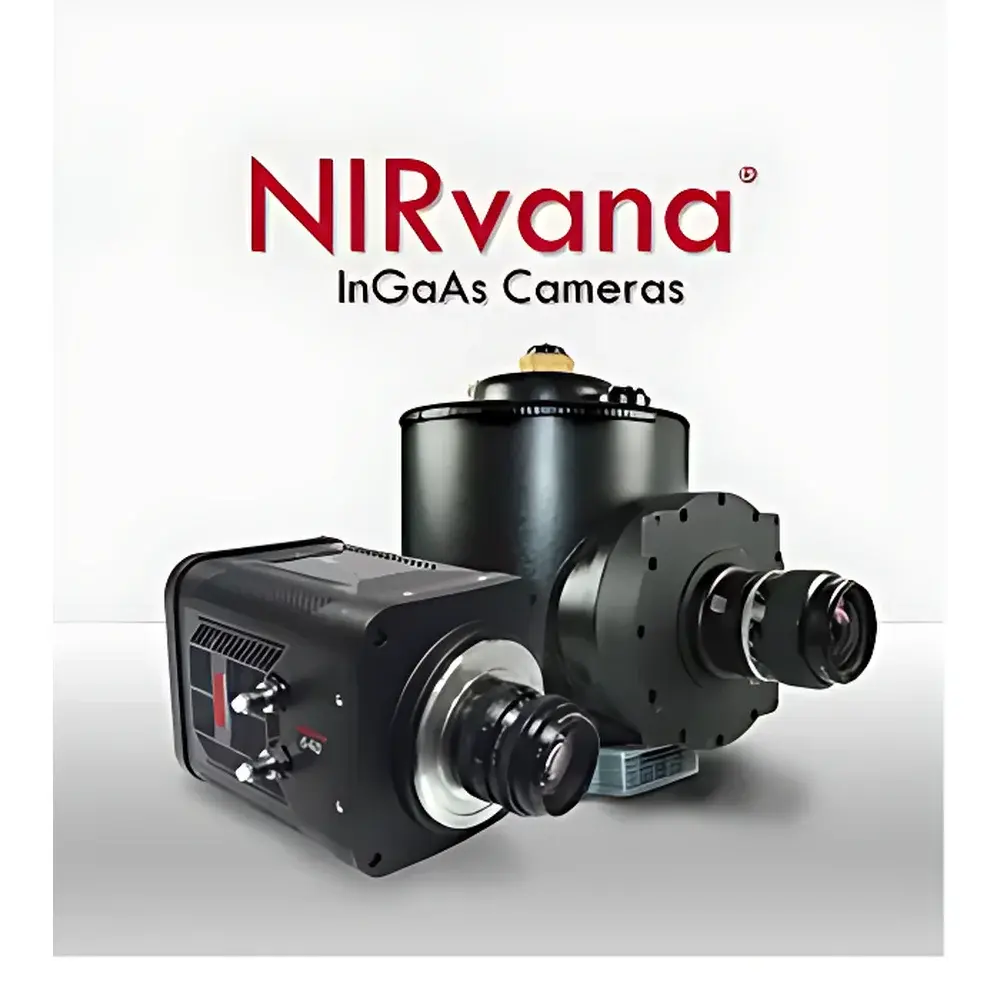
Teledyne Princeton Instruments NIRvana LN/640/640ST Scientific-Grade InGaAs Short-Wave Infrared (SWIR) Camera
| Brand | Teledyne Princeton Instruments |
|---|---|
| Origin | USA |
| Model | NIRvana: LN / NIRvana: 640 / NIRvana: 640ST |
| Sensor Format | 640 × 512 InGaAs FPA |
| Pixel Size | 20 × 20 µm |
| Spectral Range | 0.9–1.7 µm (NIRvana: 640 & 640ST), 0.9–1.55 µm (NIRvana: LN) |
| Peak Quantum Efficiency | up to 85% (0.95–1.5 µm) |
| Operating Temperature | –190 °C (LN), –85 °C (TE-cooled), –65 °C (ST) |
| Frame Rate | up to 110 fps |
| Interface | GigE Vision compliant |
| Bit Depth | 16-bit digitization |
| Readout Modes | 2 MHz / 5 MHz / 10 MHz |
| Software Platform | LightField 64-bit |
| Compliance | FDA 21 CFR Part 11 ready, GLP/GMP audit trail capable, ASTM E1317-22 compatible for spectral radiometric calibration |
Overview
The Teledyne Princeton Instruments NIRvana series represents the industry’s first fully integrated, scientific-grade short-wave infrared (SWIR) imaging platform engineered specifically for quantitative, low-light, and time-resolved applications in the 0.9–1.7 µm spectral band. Built upon a monolithic 640 × 512 indium gallium arsenide (InGaAs) focal plane array (FPA), the NIRvana camera family leverages decades of cryogenic detector design expertise to deliver sub-electron read noise, ultra-low dark current, and exceptional linearity across its full dynamic range. Unlike commercial SWIR cameras optimized for industrial inspection or surveillance, the NIRvana architecture is grounded in rigorous photon-counting metrology principles—employing vacuum-sealed, thermoelectrically or liquid-nitrogen-cooled sensor housings to suppress thermal generation noise and enable integration times from milliseconds to several minutes without saturation or drift. Its optical design supports both direct imaging and spectroscopic coupling via C-mount, F-mount, and fiber-optic interfaces, making it suitable for benchtop quantum optics, astronomical photometry, and synchrotron-based soft X-ray–SWIR coincidence detection.
Key Features
- Monolithic InGaAs FPA with true 640 × 512 active pixels and uniform 20 × 20 µm pixel pitch, ensuring high spatial fidelity and minimal inter-pixel crosstalk
- Three cooling configurations: NIRvana: LN (liquid nitrogen, –190 °C), NIRvana: 640 (thermoelectric, –85 °C), and NIRvana: 640ST (stabilized thermoelectric, –65 °C), each calibrated for reproducible dark current suppression
- GigE Vision-compliant interface enabling deterministic latency control, packet resend protocols, and plug-and-play integration with standard industrial PCs—no frame grabber required
- True 16-bit digitization with selectable readout speeds (2/5/10 MHz), preserving signal integrity during high-frame-rate acquisition while maintaining >76 dB dynamic range
- Vacuum-integrated cold shield and anti-reflection coated window minimize stray thermal radiation and maximize quantum efficiency (>85% between 0.95–1.5 µm)
- LightField 64-bit software platform with embedded mathematical engine supporting real-time spectral deconvolution, background subtraction, and ROI-based photon flux quantification
Sample Compatibility & Compliance
The NIRvana camera is validated for use with diverse sample types requiring non-destructive, label-free SWIR interrogation—including biological tissues (e.g., murine vasculature in NIR-II window), semiconductor wafers (defect mapping via photoluminescence at 1.3 µm), single-walled carbon nanotubes (exciton emission at 1.0–1.6 µm), and astronomical targets (stellar spectra in J/H/K bands). Its hardware and firmware conform to ISO/IEC 17025 traceability requirements for radiometric calibration, and LightField’s audit-log functionality satisfies FDA 21 CFR Part 11 electronic record and signature compliance for regulated laboratories. All models support NIST-traceable intensity calibration via IntelliCal, and spectral response data are provided per ASTM E1317-22 methodology for instrument characterization reporting.
Software & Data Management
LightField 64-bit serves as the native acquisition and analysis environment, offering deterministic timing control down to 10 µs resolution, multi-camera synchronization over PTP (IEEE 1588), and programmable trigger logic for pump-probe or gated imaging experiments. The platform includes a built-in scripting engine (PICAM API) with native C/C++, Python, MATLAB, LabVIEW, and EPICS bindings—enabling automated experiment orchestration and integration into existing synchrotron or cleanroom control systems. Raw image data are stored in vendor-neutral HDF5 format with embedded metadata (exposure, temperature, gain, wavelength calibration), facilitating long-term archival and cross-platform reprocessing. Export modules support TIFF, FITS, and CSV formats compliant with IVOA and STScI standards.
Applications
- Small-animal NIR-II imaging: Enables high-contrast, deep-tissue vascular visualization using endogenous contrast or SWIR-emitting probes (e.g., Ag₂S QDs), with sub-millimeter spatial resolution at depths exceeding 8 mm
- Astronomical photometry: Supports both long-exposure stellar photometry (integration > 300 s) and high-speed occultation studies (≥100 fps), with linearity maintained to >99.99% across 0–65,535 DN
- Singlet oxygen (¹O₂) luminescence detection: Captures weak 1270 nm phosphorescence with single-photon sensitivity, critical for quantifying photosensitizer efficacy in photodynamic therapy research
- Nanomaterial characterization: Resolves excitonic transitions in chiral semiconducting nanotubes and perovskite nanocrystals via hyperspectral SWIR mapping
- Semiconductor failure analysis: Locates latent defects in SiC and GaN power devices through micro-photoluminescence imaging at 1.1–1.4 µm
FAQ
What distinguishes NIRvana from industrial SWIR cameras?
NIRvana implements scientific-grade calibration workflows—including pixel-level non-uniformity correction, temperature-stabilized dark frame acquisition, and NIST-traceable QE mapping—unavailable in OEM vision systems.
Can NIRvana be synchronized with pulsed lasers or other detectors?
Yes. It supports TTL, LVDS, and optical trigger inputs with <100 ns jitter, and integrates natively with PI-MAX4 ICCD and ProEM EMCCD systems via LightField’s multi-device orchestration layer.
Is spectral calibration included with the system?
Each unit ships with factory-measured spectral responsivity curves and IntelliCal-enabled one-click wavelength/fluence calibration using certified tungsten-halogen and laser line sources.
Does the camera support vacuum or purged enclosures?
The NIRvana: LN and NIRvana: 640 models feature CF-40 vacuum flanges; optional purge ports allow operation under dry nitrogen or argon to eliminate atmospheric water vapor absorption lines near 1.4 µm.
How is data integrity ensured during long-duration acquisitions?
LightField enforces checksum validation on every frame, logs thermal drift compensation parameters in real time, and writes metadata-embedded HDF5 files with automatic versioned backups to network storage.




