
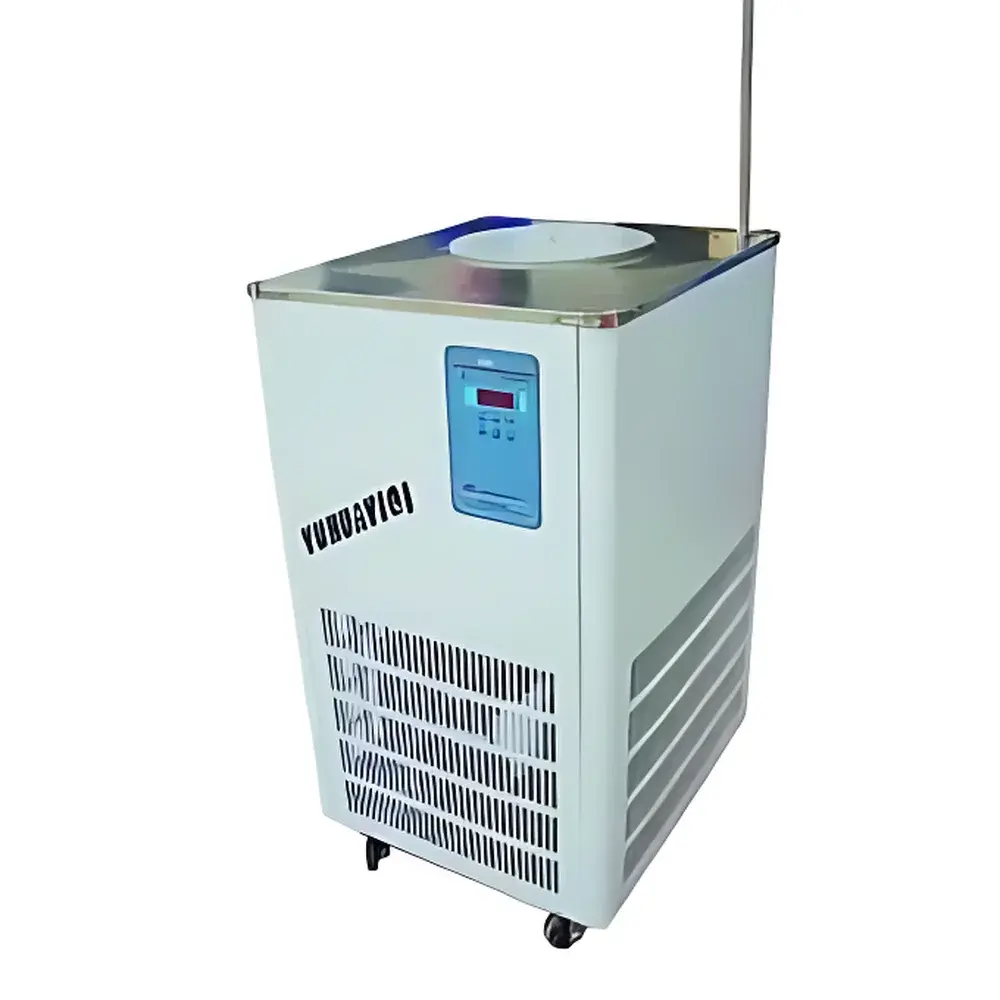
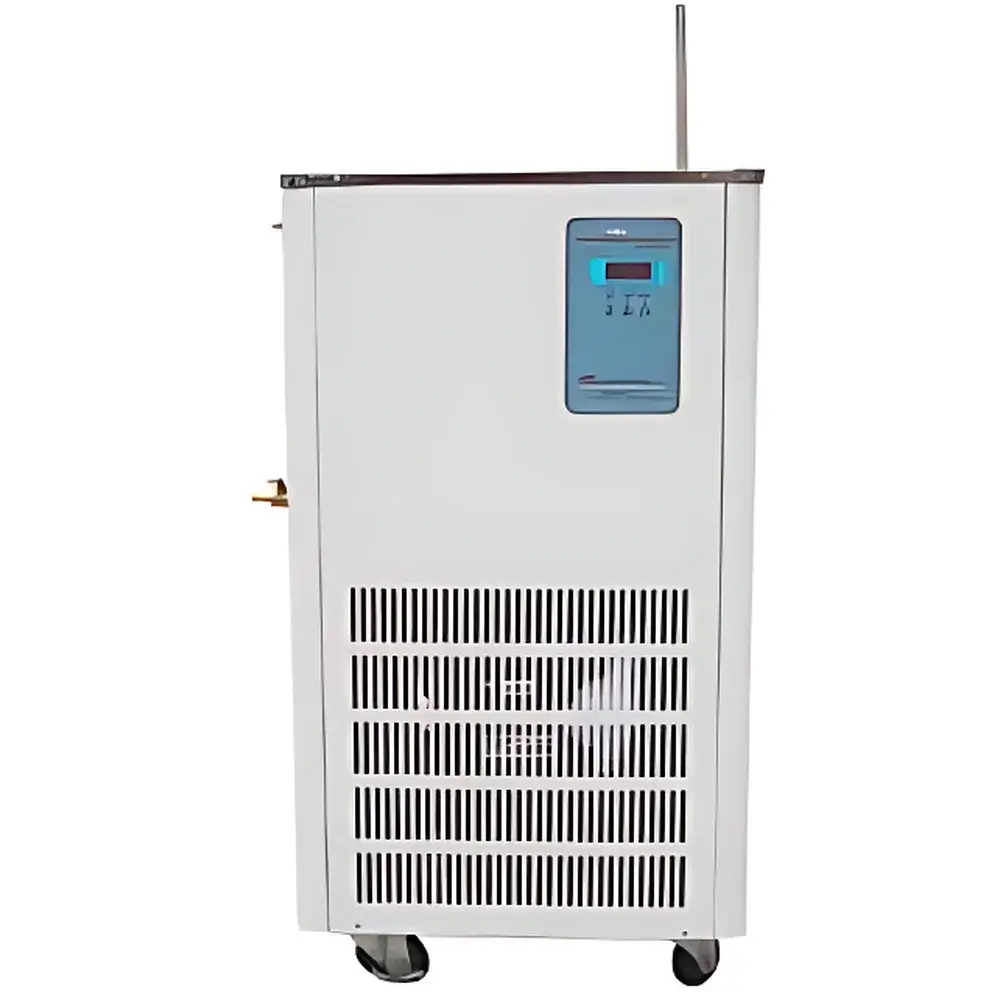
YUHUA DLSB-5/10 Cryogenic Constant-Temperature Circulator
| Brand | YUHUA |
|---|---|
| Model | DLSB-5/10 |
| Reservoir Capacity | 5 L |
| Minimum No-Load Temperature | −15 °C |
| Cooling Capacity | 1328–319 W (at −10 °C) |
| Flow Rate | 20 L/min |
| Head | 4–6 m |
| Temperature Range | Ambient to −10 °C |
| Temperature Stability | ±0.2 °C |
| Power Supply | 220 V, 50 Hz |
| Dimensions (W×D×H) | 500 × 370 × 540 mm |
| Weight | 25 kg |
Overview
The YUHUA DLSB-5/10 Cryogenic Constant-Temperature Circulator is a mechanically refrigerated, closed-loop liquid circulation system engineered for precise thermal management in laboratory and analytical applications. It operates on vapor-compression refrigeration principles—utilizing a hermetically sealed compressor, condenser, expansion valve, and evaporator—to deliver stable, low-temperature coolant to external equipment. Unlike open-bath chillers, this circulator maintains continuous, pressurized flow of heat-transfer fluid (typically ethanol/water or silicone oil mixtures) at user-defined setpoints, enabling active cooling of sensitive instrumentation requiring consistent thermal loading profiles. Its design prioritizes operational continuity, corrosion resistance, and compatibility with vacuum-integrated systems—making it suitable for sustained use in cryochemical synthesis, spectroscopic detector cooling, and low-temperature material characterization.
Key Features
- Hermetically sealed, high-efficiency compressor sourced from internationally recognized manufacturers—ensuring long-term reliability and minimal maintenance intervals.
- Dedicated refrigeration-grade relays, capacitors, and protective circuitry compliant with IEC 60335-1 safety standards for Class II laboratory equipment.
- Microprocessor-based temperature controller with digital LED display, offering intuitive setpoint entry, real-time bath temperature feedback, and auto-tuning PID regulation.
- Corrosion-resistant internal wetted parts—including stainless steel reservoir, fluoropolymer-coated pump housing, and EPDM seals—designed to minimize fluid degradation and metallic ion leaching.
- Integrated centrifugal circulation pump delivering stable 20 L/min flow at 4–6 m head, supporting multi-port distribution manifolds without significant pressure drop.
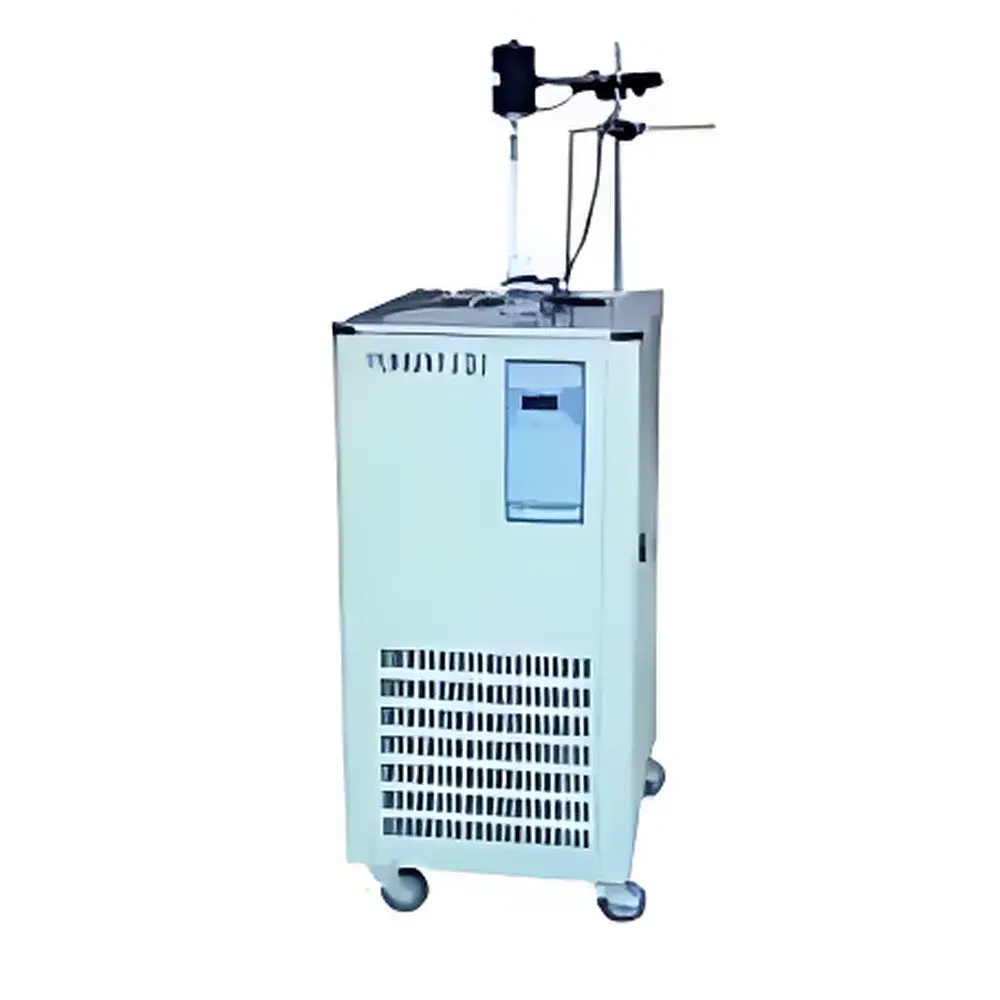
- Onboard electric stirring capability (optional accessory mounting interface), enabling homogeneous temperature distribution within the reservoir during extended static operation.
Sample Compatibility & Compliance
The DLSB-5/10 is compatible with standard laboratory heat-transfer fluids meeting ASTM D1384 (corrosion inhibition) and ISO 6743-20 (classification of synthetic coolants). Its sealed architecture prevents atmospheric contamination, supporting applications requiring Grade 3 or higher water purity per CLSI EP23-A guidelines—particularly relevant for cooling electron microscopy stages, X-ray diffractometers, and laser gain media. The unit conforms to CE marking requirements under Directive 2014/35/EU (Low Voltage Directive) and 2014/30/EU (EMC Directive). While not certified for GMP environments out-of-the-box, its temperature logging capability (via optional RS485 interface) supports 21 CFR Part 11-compliant data integrity when integrated with validated third-party SCADA systems.
Software & Data Management
The DLSB-5/10 features an embedded microcontroller with non-volatile memory storing up to 10 user-defined temperature programs, each configurable with ramp-soak profiles and hold durations. Real-time temperature data can be exported via analog 0–10 V output or Modbus RTU protocol over RS485 for integration into LabVIEW, MATLAB, or enterprise-level LIMS platforms. Optional firmware upgrades enable audit-trail generation (timestamped setpoint changes, alarm events, power cycles), satisfying GLP documentation requirements for method validation records. No proprietary software installation is required—configuration is performed locally via front-panel interface or remotely via ASCII command set.
Applications
- Cooling of rotary evaporators during low-boiling-point solvent removal (e.g., diethyl ether, pentane) to prevent bumping and improve condensation efficiency.
- Thermal stabilization of vacuum freeze-dryers (lyophilizers), ensuring consistent shelf temperature control during primary drying phases.
- Heat rejection for high-power optical components—including Ti:sapphire lasers, Raman spectrometers, and CCD detectors—where thermal drift compromises spectral resolution.
- Temperature-controlled reaction baths for organometallic catalysis, Grignard additions, and cryo-enzymology studies conducted between −10 °C and ambient.
- Secondary cooling loop for ultra-high vacuum (UHV) systems, including sputter deposition chambers and surface analysis tools requiring <1 × 10⁻⁷ mbar base pressure stability.
FAQ
What types of heat-transfer fluids are recommended for use with the DLSB-5/10?
Ethanol/water mixtures (e.g., 30% v/v ethanol) are optimal for operation down to −10 °C; silicone oils (e.g., DC200 series) are required for sub-zero applications below −20 °C. Avoid glycol-based fluids unless specifically formulated for low-temperature viscosity stability.
Can the DLSB-5/10 be integrated into a centralized cooling network?
Yes—the unit supports daisy-chained configurations using insulated, pressure-rated PTFE-lined tubing and quick-connect fittings. Maximum recommended line length is 15 m total equivalent pipe length to maintain flow stability and avoid cavitation.
Is remote monitoring supported without additional hardware?
Basic status signals (run/fault, temperature deviation >±1 °C) are available via dry-contact relay outputs. Full telemetry requires optional RS485 module and host-side protocol implementation.
Does the system include over-temperature or low-flow protection?
Yes—integrated thermistors monitor both reservoir and discharge line temperatures, while flow sensors trigger automatic shutdown if volumetric flow falls below 12 L/min for >30 seconds.
What maintenance schedule is recommended for continuous operation?
Compressor oil and refrigerant charge verification every 24 months; filter-drier replacement every 18 months; annual calibration of temperature sensor against NIST-traceable reference probe.




