
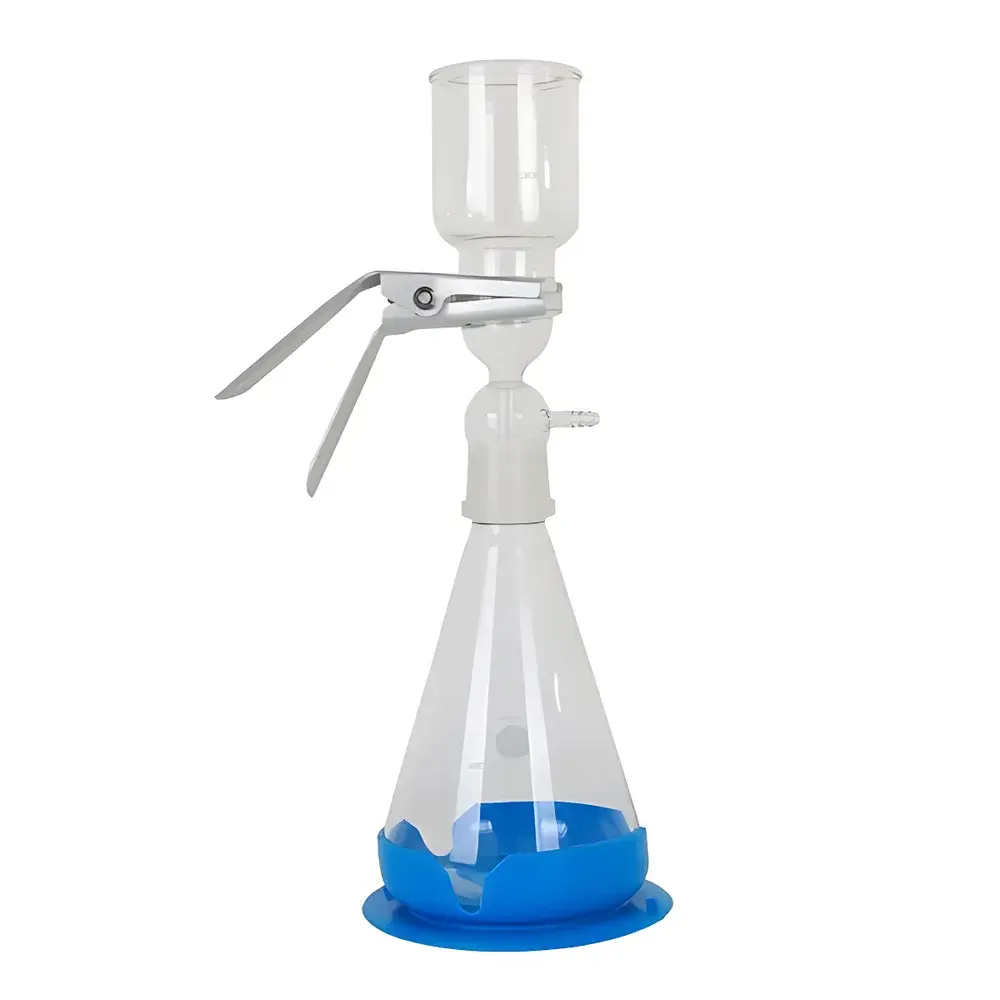
Rocker VF3 Glass Filtration Assembly
| Brand | Rocker |
|---|---|
| Origin | Taiwan |
| Model | VF3 |
| Funnel Capacity | 300 mL |
| Receiving Bottle Capacity | 1000 mL |
| Compatible Membrane Diameter | 47 mm |
| Hose ID | 8 mm |
| Effective Filtration Area | 9.6 cm² |
| Material | Borosilicate Glass (Funnel Body, Base, Ground-Glass Seal, and Bottle) |
| Connection Type | Ground-Glass Joint (No Silicone Stopper Required) |
Overview
The Rocker VF3 Glass Filtration Assembly is a precision-engineered vacuum filtration system designed for laboratory-scale solvent purification and sample preparation in analytical and preparative life science workflows. Built on the principle of gravity-assisted or vacuum-driven pressure differential across a supported membrane, the VF3 assembly enables reliable, contamination-free filtration of aggressive organic solvents and corrosive aqueous solutions—critical for maintaining integrity in high-sensitivity applications such as HPLC mobile phase preparation, GC solvent conditioning, and atomic absorption (AA) spectroscopy sample handling. Its all-borosilicate glass construction—including funnel body, base, ground-glass sealing interface, and rapid-drain receiving bottle—ensures chemical inertness, thermal stability up to 500 °C (short-term), and resistance to thermal shock, alkalis, and most common organic solvents including acetone, acetonitrile, chloroform, THF, and concentrated acids (e.g., ≤30% HNO₃, ≤10% HCl). The ground-glass joint interface eliminates reliance on elastomeric stoppers, removing a major source of extractables, leachables, and seal failure under prolonged vacuum or solvent exposure.
Key Features
- Ground-glass conical joint connection (ISO 2955 standard taper) between funnel and receiver ensures leak-tight, repeatable alignment without silicone or rubber gaskets—reducing risk of cross-contamination and solvent-induced swelling or degradation.
- 300 mL borosilicate glass funnel with integrated 47 mm filter support plate and precision-ground frit surface for uniform membrane seating and optimal flow distribution.
- 1000 mL rapid-drain receiving bottle featuring a wide-mouth, low-profile design with side-port vacuum inlet and bottom outlet valve for efficient solvent recovery and minimized residual hold-up volume.
- Aluminum clamp assembly (anodized grade 6061-T6) provides rigid, corrosion-resistant mechanical support while accommodating thermal expansion differentials between glass components during extended filtration cycles.
- Effective filtration area of 9.6 cm² supports reproducible flux rates across standard 47 mm membranes (cellulose acetate, nylon, PTFE, PVDF) under moderate vacuum (≤0.8 bar).
Sample Compatibility & Compliance
The VF3 system is validated for use with Class I–III solvents per ASTM D4176 and compatible with USP chromatographic solvent purity requirements. Its inert glass architecture meets ISO 15195:2019 criteria for reference material handling in calibration laboratories and aligns with GLP-compliant documentation practices for solvent filtration traceability. No lubricants, adhesives, or polymer seals contact the fluid path—ensuring compliance with FDA 21 CFR Part 11 data integrity expectations when integrated into validated HPLC mobile phase preparation SOPs. The absence of organic gasket materials also satisfies strict extractables testing protocols required by ICH Q5C and EP 2.2.59 for biopharmaceutical process development.
Software & Data Management
As a manually operated, non-electronic filtration assembly, the VF3 requires no embedded firmware, drivers, or software integration. All operational parameters—including vacuum level (monitored externally via gauge), filtration time, membrane lot number, and batch-specific solvent identity—are recorded manually in laboratory notebooks or electronic lab notebooks (ELNs) compliant with ALCOA+ principles (Attributable, Legible, Contemporaneous, Original, Accurate, Complete, Consistent, Enduring, Available). The standardized part numbering (e.g., 167200-03 for full assembly; 167120-30 for funnel) facilitates unambiguous inventory control and audit-ready reagent tracking within LIMS environments.
Applications
- HPLC and UHPLC mobile phase degassing and particulate removal prior to system priming and gradient elution.
- Purification of GC-grade solvents (e.g., hexane, ethyl acetate) to sub-0.22 µm particle specifications for capillary column protection.
- Pre-filtration of acid digestates in AA and ICP-MS sample preparation workflows where fluoride- or chloride-containing matrices demand glass-only contact surfaces.
- Recovery and concentration of heat-labile biomolecules (e.g., plasmid DNA, viral vectors) using low-protein-binding PVDF membranes under gentle vacuum conditions.
- Quality control filtration of cell culture media supplements and sterile-filtered buffers in GMP-aligned upstream bioprocessing labs.
FAQ
Can the VF3 be used with vacuum pumps generating >0.95 bar negative pressure?
Yes—mechanical strength of the borosilicate glass components (DIN ISO 3585) supports continuous operation at ≤0.98 bar vacuum; however, use of a vacuum regulator or safety trap is recommended to prevent sudden implosion during power interruption.
Is the ground-glass joint autoclavable?
The entire assembly may be sterilized via dry heat (160 °C for 2 hours) or ethylene oxide; wet steam autoclaving is not advised due to thermal stress on ground interfaces.
What membrane types are validated for use with the VF3 funnel?
All commercially available 47 mm diameter membranes—including mixed cellulose ester (MCE), polyethersulfone (PES), polytetrafluoroethylene (PTFE), and track-etched polycarbonate—are mechanically and chemically compatible when selected per solvent compatibility charts.
Does Rocker provide a certificate of conformance with each VF3 shipment?
Yes—each unit ships with a manufacturer’s CoC documenting material grade (Duran®-equivalent borosilicate 3.3), dimensional compliance (ISO 1042), and visual inspection results against scratch, chip, and joint tolerance specifications.




