
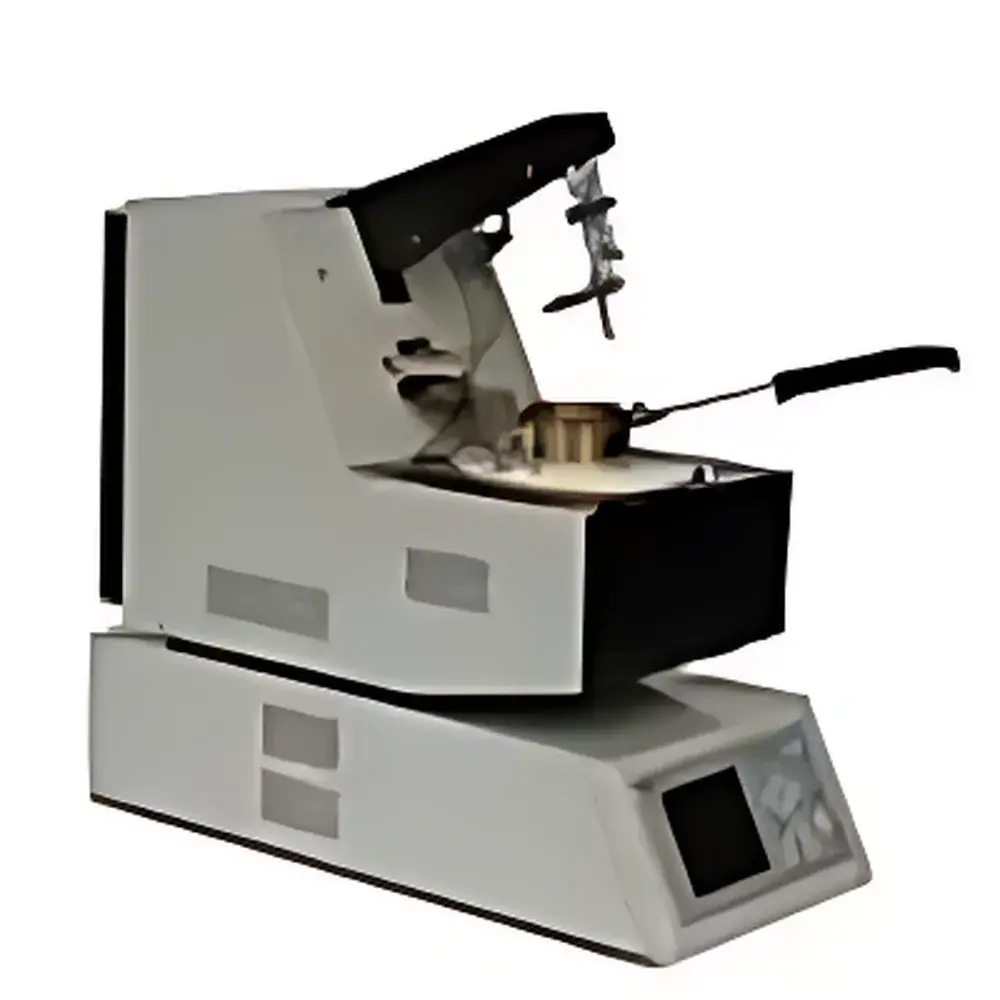
Xufeng FP-C1A Automatic Cleveland Open Cup Flash Point Tester
| Brand | Xufeng |
|---|---|
| Origin | Shanghai, China |
| Model | FP-C1A |
| Temperature Range | 0–400 °C (Typical Test Range: 80–400 °C) |
| Temperature Sensor | Pt100 Platinum Resistance Thermometer |
| Atmospheric Pressure Sensor | Silicon-based Barometric Sensor |
| Flash Detection | Electrode-based Ionization Detector |
| Fire Point Detection | Infrared Sensor |
| Display | LCD Panel |
| Heater Power | 800 W |
| Cooling Method | Forced Air Cooling |
| Ignition Source | Gas-fired (Propane/Butane) |
| Interface | RS-232C Serial Port |
| Weight | 18 kg |
| Dimensions (Test Unit) | 215(W) × 410(D) × 260(H) mm |
| Dimensions (Control Unit) | 215(W) × 480(D) × 110(H) mm |
| Data Storage Capacity | 99 Test Records |
| Compliance | GB/T 3536–2008, ASTM D92–05a, ISO 2592 |
Overview
The Xufeng FP-C1A Automatic Cleveland Open Cup Flash Point Tester is a precision-engineered instrument designed for the standardized determination of flash point and fire point of petroleum products and related hydrocarbon-based liquids in accordance with internationally recognized test methods. It operates on the Cleveland Open Cup (COC) principle—a dynamic, open-vessel heating protocol where the sample is heated at a controlled rate while an ignition source is periodically applied across the surface. Flash point is identified as the lowest temperature at which vapors above the sample ignite momentarily upon exposure to flame; fire point is recorded when sustained combustion (>5 seconds) occurs. This method is widely specified for lubricating oils, fuel oils, bitumens, and heavy distillates where closed-cup techniques (e.g., Pensky-Martens) are unsuitable due to high viscosity or thermal stability limitations.
Key Features
- Triple-test mode selection: dedicated flash point testing, combined flash/fire point testing, and search-mode operation for rapid preliminary estimation.
- Microprocessor-based control architecture with real-time thermal profiling, automatic atmospheric pressure compensation, and algorithmic validation of result consistency per ASTM D92 Annex A and GB/T 3536 Clause 8.3.
- Integrated safety interlocks: auto-shutdown if no flash is detected before reaching the alarm temperature threshold (typically 50 °C below maximum range); inhibition of startup unless mechanical and thermal readiness conditions are confirmed.
- Automated mechanical sequence: motor-driven test arm for precise sample cup positioning; programmable igniter sweep motion; pneumatically actuated safety lid for flame suppression post-detection; and synchronized cooling fan activation upon test completion.
- Comprehensive data management: local storage of up to 99 complete test records with timestamp, ambient pressure, observed flash/fire temperatures, and operator-defined identifiers; statistical evaluation of triplicate runs including mean, min/max deviation, and automatic flagging of outliers exceeding ±10 °C (per ISO 2592 repeatability criteria).
- Modular dual-unit design separates the high-temperature test chamber from the control console—enhancing operator safety, simplifying maintenance access, and minimizing electromagnetic interference with sensitive electronics.
Sample Compatibility & Compliance
The FP-C1A is validated for use with viscous and thermally stable petroleum derivatives including residual fuel oils (ASTM D396), marine fuels (ISO 8217), asphalt binders (ASTM D36), and industrial lubricants (ISO 2909). Its Pt100 sensor ensures traceable temperature measurement calibrated against NIST-traceable reference standards. The instrument conforms to mandatory requirements of GB/T 3536–2008 (Chinese National Standard), ASTM D92–05a (reapproved 2020), and ISO 2592:2022. All firmware logic implements mandatory procedural checks defined in Clause 7.2 of ASTM D92—including minimum heating rate verification (14–17 °C/min during final approach), prescribed flame diameter (3.2–4.8 mm), and dwell time (0.5 ±0.1 s) at each pass. Optional electronic ignition upgrade eliminates external gas supply dependency, supporting GLP-compliant environments where combustible gas infrastructure is restricted.
Software & Data Management
Equipped with an RS-232C serial interface compliant with EIA/TIA-232-F specifications, the FP-C1A supports bidirectional communication with laboratory information management systems (LIMS) or custom PC-based control software. Raw output includes ASCII-formatted strings containing test ID, date/time stamp (RTC-synchronized), barometric pressure (hPa), flash/fire point (°C), heating rate (°C/min), and pass/fail status flags. Data export enables integration into 21 CFR Part 11–compliant audit trails when paired with validated third-party software featuring electronic signatures, user access controls, and immutable record archiving. Firmware supports field-upgradable calibration coefficients and date/time synchronization via host command set.
Applications
- Quality assurance laboratories verifying conformance of refinery outputs to specification limits (e.g., ASTM D975 for diesel fuel flash point ≥52 °C).
- Regulatory compliance testing for transportation and storage classification under UN TDG, IMDG Code, and OSHA HCS hazard communication standards.
- R&D screening of formulated base oils and additive packages where thermal volatility must be characterized prior to oxidation stability assessment (ASTM D2272).
- Contract testing services requiring auditable, repeatable flash point data for ISO/IEC 17025 accreditation.
- Technical service centers performing root-cause analysis of field failures linked to unintended vapor ignition or thermal degradation onset.
FAQ
Does the FP-C1A require external gas supply for ignition?
Yes—the standard configuration uses propane or butane gas delivered via high-pressure tubing (included). An optional electronic spark ignition module is available upon request, eliminating gas dependency.
Can the instrument perform flash point testing only, without fire point determination?
Yes—users may select “Flash Point Only” mode, which terminates testing immediately after first confirmed flash event and suppresses subsequent fire point ramping.
Is atmospheric pressure correction applied automatically during testing?
Yes—the integrated silicon barometric sensor continuously monitors ambient pressure and applies real-time correction to reported flash point values per ASTM D92 Section 10.2.
What is the recommended maintenance interval for the ionization detector?
The electrode-based flash detector requires cleaning with analytical-grade isopropanol every 50 tests or weekly—whichever occurs first—to prevent carbon buildup affecting sensitivity.
How is calibration traceability documented?
Each unit ships with a factory calibration certificate referencing NIST SRM 7462 (melting point standards) and certified barometric references; users may perform field verification using certified thermometer and pressure calibrators per ISO/IEC 17025 Section 6.5.




