
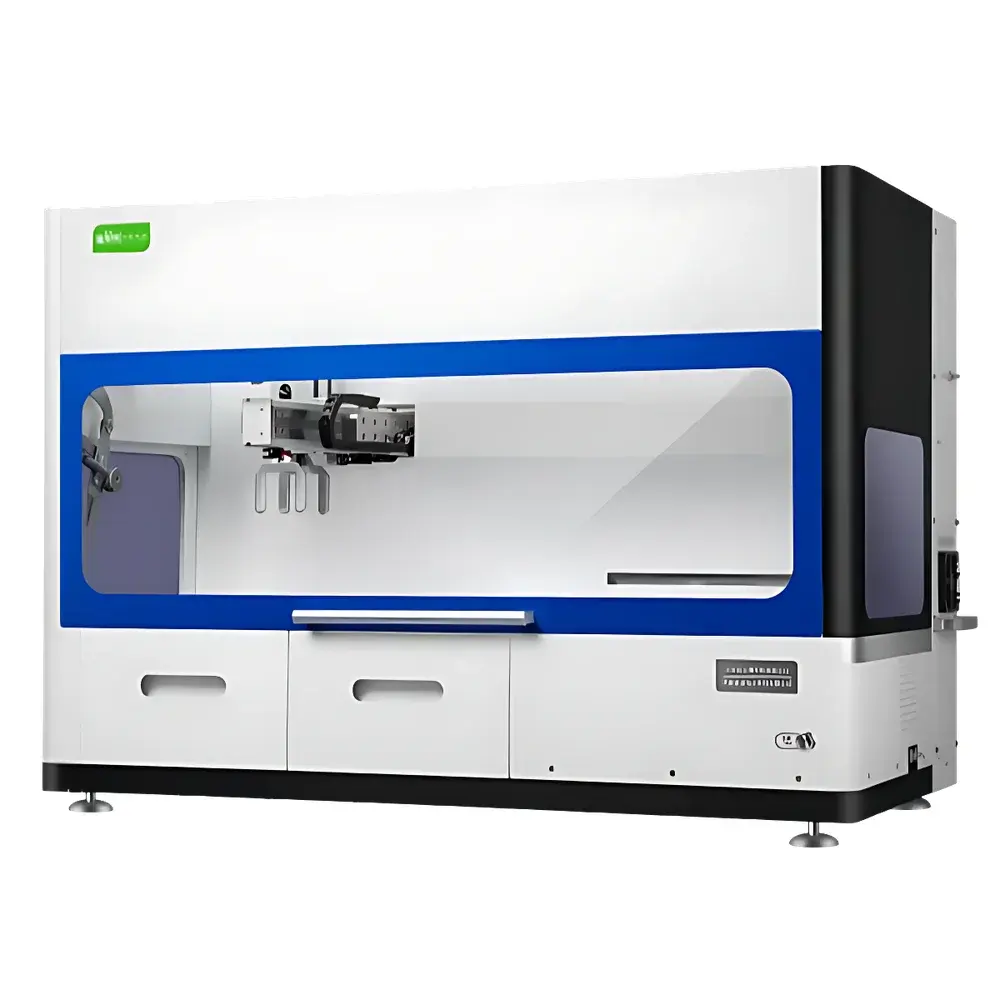
SENTE ST308G Fully Automated Soil Organic Matter Analyzer
| Brand | SENTE |
|---|---|
| Origin | Shandong, China |
| Manufacturer Type | Original Equipment Manufacturer (OEM) |
| Country of Origin | China |
| Model | ST308G |
| Instrument Type | Multi-Parameter Soil Analyzer |
| Compliance | Designed to meet requirements of NY/T 1121.6–2006 (China Agricultural Industry Standard for Soil Organic Matter Determination) |
| Throughput | Up to 40 samples per batch |
| Average Analysis Time | ~6 minutes per sample |
| Digestion Temperature Control Accuracy | ±0.5 °C |
| Titration Resolution | 0.01 mL |
| Automation Level | Full walk-away operation with 3-axis electromechanical robotic arm, integrated digestion and titration modules |
Overview
The SENTE ST308G Fully Automated Soil Organic Matter Analyzer is an engineered solution for high-throughput, standardized quantification of soil organic matter (SOM) in agricultural, environmental, and regulatory laboratories. It implements the wet oxidation principle—specifically the potassium dichromate (K2Cr2O7) digestion method under acidic, heated conditions—followed by redox titration with ferrous ammonium sulfate (FAS), as defined in NY/T 1121.6–2006. This gravimetric-redox methodology remains the reference procedure for SOM determination in Chinese agricultural practice due to its direct correlation with total oxidizable carbon content. Unlike manual or semi-automated systems, the ST308G eliminates operator-dependent variability by integrating precise thermal control, optical endpoint detection, and closed-loop liquid handling—ensuring repeatability across batches and operators while maintaining full traceability to the national standard.
Key Features
- Walk-away automation: Fully unattended operation from sample loading to result export; no manual reagent addition, tube transfer, or endpoint judgment required.
- Integrated digestion-titration architecture: Patented modular design with thermally isolated digestion zone and synchronized titration station, minimizing cross-contamination and thermal drift.
- High-fidelity temperature regulation: PID-controlled heating block with real-time feedback ensures ±0.5 °C stability throughout the 30-minute digestion cycle (typically at 170–180 °C), critical for complete organic carbon oxidation without over-decomposition.
- Optical endpoint recognition: High-sensitivity colorimetric sensor captures dynamic absorbance shifts during FAS titration, detecting the Cr3+/Cr6+ transition with sub-second response time and eliminating subjective visual interpretation.
- 3-axis electromechanical robotic arm: Precision-guided movement enables reliable handling of 15–20 mL digestion vials across sample rack, reagent reservoirs, cooling stage, and titration cuvette—designed for >10,000 cycles without recalibration.
- Chemical safety by design: All digestion and titration steps occur within sealed, vented reaction chambers compliant with ISO 15190:2020 laboratory safety guidelines; acid fumes are actively scrubbed via integrated NaOH trap and HEPA-filtered exhaust.
Sample Compatibility & Compliance
The ST308G accepts standard 15–20 mL borosilicate glass digestion vials containing air-dried, homogenized soil samples (typically 0.5–1.0 g, sieved to ≤2 mm). It supports soils across textural classes (sand, loam, clay) and organic matter ranges (0.2–15% w/w), including calcareous and saline-affected matrices when pre-treated per NY/T 1121.6–2006 Annex B. The system complies with Chinese agricultural industry standards and provides audit-ready digital logs—including timestamps, temperature profiles, titrant volume consumed, and raw absorbance curves—for internal QA/QC and third-party verification. While not certified to ISO/IEC 17025 out-of-the-box, its data structure and metadata tagging align with GLP documentation requirements for method validation studies.
Software & Data Management
Controlled via SENTE Analytical Suite v4.x (Windows-based), the ST308G software provides role-based user access, electronic signature support, and configurable report templates (PDF/CSV/XLSX). All analytical events—including reagent lot tracking, calibration history, maintenance alerts, and failure diagnostics—are stored in a local SQLite database with optional encrypted backup to network drives. Audit trails comply with principles of ALCOA+ (Attributable, Legible, Contemporaneous, Original, Accurate, Complete, Consistent, Enduring, Available) and support retrospective review per FDA 21 CFR Part 11 when deployed with validated IT infrastructure. Raw spectral data and titration curves are exportable for secondary analysis in MATLAB or R environments.
Applications
- Agricultural extension services conducting routine soil fertility mapping and fertilizer recommendation modeling.
- Environmental consultancies performing baseline SOM assessment for land-use change projects (e.g., afforestation, restoration, or urban redevelopment).
- Research institutions studying carbon sequestration dynamics under climate-smart agriculture practices.
- Soil testing laboratories serving certification programs (e.g., organic farming compliance, green procurement schemes) requiring standardized, auditable SOM reporting.
- University teaching labs demonstrating redox chemistry, automated analytical workflows, and method validation principles in environmental science curricula.
FAQ
Does the ST308G support alternative SOM methods such as loss-on-ignition (LOI) or dry combustion?
No—the ST308G is purpose-built for the dichromate oxidation method per NY/T 1121.6–2006. LOI and dry combustion require fundamentally different hardware (e.g., muffle furnaces, elemental analyzers) and are not compatible with its fluidic and thermal architecture.
Can the instrument be integrated into a LIMS environment?
Yes—via configurable ODBC drivers and HL7-compliant result export protocols. Custom API integration is available under SENTE’s Enterprise Connectivity Package.
What maintenance intervals are recommended for long-term operational reliability?
Daily: Cleaning of optical sensor window and titration tip. Quarterly: Calibration of temperature sensors and burette volumetric accuracy. Annually: Full preventive maintenance including robotic arm lubrication and digestion chamber seal inspection.
Is method validation documentation provided with the system?
Yes—each unit ships with a Factory Acceptance Test (FAT) report, IQ/OQ documentation templates, and a pre-validated SOP aligned with NY/T 1121.6–2006, supporting rapid site-specific PQ execution.
How is reagent consumption tracked and managed?
The software monitors real-time reagent levels via weight-based or capacitive level sensors in reservoirs and triggers low-level alerts; usage logs are tied to each sample ID for cost-per-analysis calculation and inventory forecasting.







