
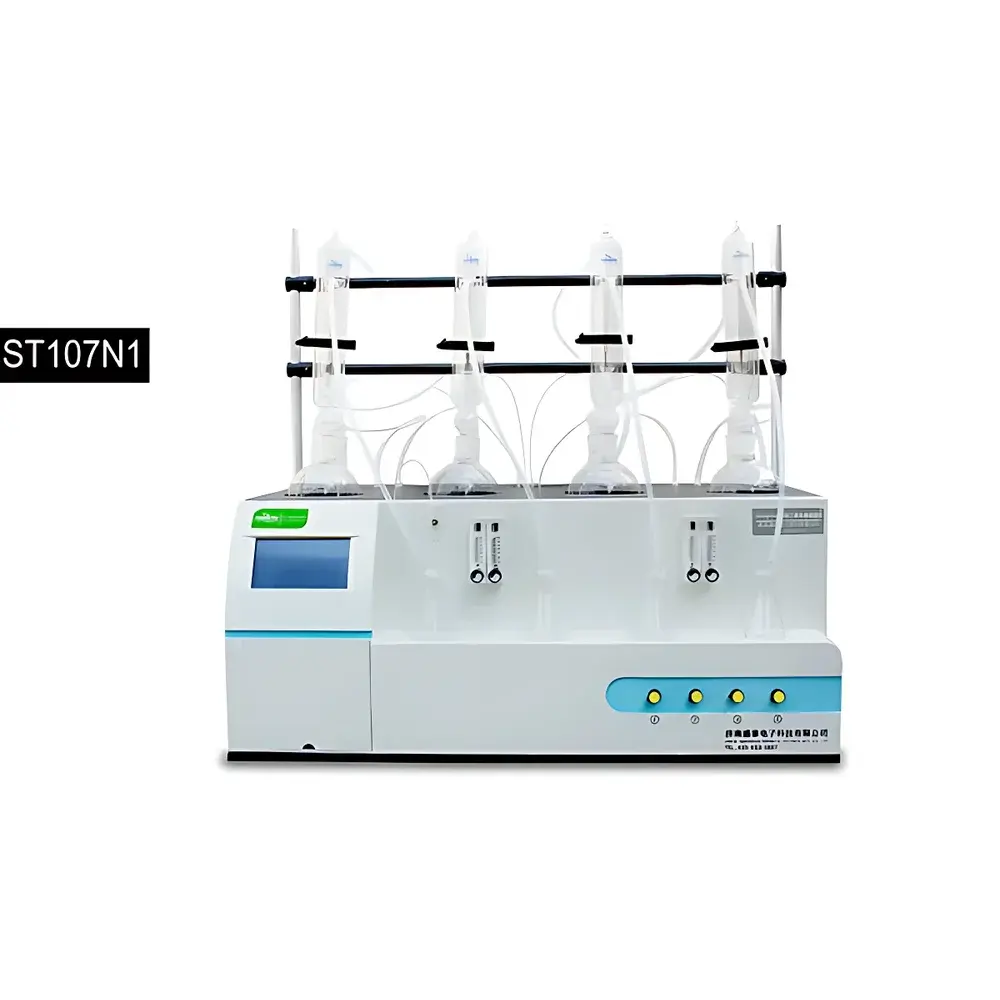
SENTE ST107N1 Automated Sulfur Dioxide Residue Analyzer for Traditional Chinese Medicine
| Brand | SENTE |
|---|---|
| Origin | Shandong, China |
| Manufacturer Type | Direct Manufacturer |
| Product Category | Domestic |
| Model | ST107N1 |
| Price Range | USD 7,000–14,000 (FOB) |
| Type | Intelligent Integrated Analyzer |
| Detection Limit | 5 mg/kg |
| Detection Range | 1–500 mg/kg |
Overview
The SENTE ST107N1 Automated Sulfur Dioxide Residue Analyzer is a fully integrated, regulatory-compliant instrument engineered for precise and reproducible determination of sulfur dioxide (SO₂) residual levels in traditional Chinese medicinal materials and processed herbal slices. It implements the official acid-base titration method specified in the Chinese Pharmacopoeia (2015 Edition), Chapter 2341 “Sulfur Dioxide Residue Determination”, which remains the legally mandated reference procedure for national quality control laboratories and GMP-compliant herbal manufacturing facilities. Unlike high-cost instrumental alternatives—such as gas chromatography (GC) or ion chromatography (IC)—the ST107N1 delivers pharmacopoeial fidelity through automation of all critical manual steps: controlled acid addition, timed distillation under nitrogen purge, condensate cooling, endpoint detection via potentiometric titration, and automatic calculation of SO₂ concentration in mg/kg. Its design eliminates inter-operator variability and system-level inconsistencies commonly observed with custom-assembled glassware setups, ensuring data integrity aligned with GLP and GMP documentation requirements.
Key Features
- Integrated Automation Workflow: Fully automated sequence including sealed acid injection, nitrogen-purged distillation, internal compressor-based coolant circulation, magnetic stirring, and potentiometric titration—executed without manual intervention.
- Far-Infrared Ceramic Heating: Four independent heating zones with adjustable power per position (0–500 W), offering uniform thermal distribution, acid resistance, waterproofing, and energy efficiency compared to conventional electric heating mantles.
- Onboard Nitrogen Flow Control: Four built-in rotameters (60–600 mL/min range per channel), enabling precise, stable, and individually regulated nitrogen purge across up to four samples simultaneously.
- Self-Contained Cooling System: Integrated hermetic compressor chiller (−5 to 15 °C operating range) eliminates dependency on external water sources or chillers—critical for consistent condensation efficiency and method robustness.
- Single-Unit Multi-Sample Capacity: Supports 1–4 parallel determinations with independent parameter control per channel, significantly improving throughput for batch testing of raw herbs, decoction pieces, or processed formulations.
- Regulatory-Ready Interface: Touchscreen HMI with audit-trail-enabled operation logging, user-access levels, and exportable CSV/Excel reports compliant with FDA 21 CFR Part 11 data integrity principles.
Sample Compatibility & Compliance
The ST107N1 is validated for use with solid herbal matrices—including crude roots, barks, flowers, fruits, and processed slices—as defined in the Chinese Pharmacopoeia (2015). It accommodates sample weights from 1.0 to 10.0 g and supports both aqueous and ethanol-water extraction protocols prior to distillation. All wet chemistry components (acid reservoirs, distillation tubes, condensers, titration cells) are constructed from borosilicate glass and PTFE-lined fittings to resist corrosion from hydrochloric acid and sulfur-containing vapors. The instrument meets ISO/IEC 17025 technical competence criteria for testing laboratories and supports validation documentation packages (IQ/OQ/PQ) required by provincial and national drug regulatory authorities. Its operational parameters align with pharmacopoeial acceptance criteria for recovery (85–115%), repeatability (RSD ≤ 5%), and linearity (r² ≥ 0.999) across the 1–500 mg/kg range.
Software & Data Management
The embedded control software provides real-time monitoring of temperature, nitrogen flow rate, distillation time, titrant consumption, and calculated SO₂ concentration per sample. All analytical events—including method start/stop timestamps, reagent lot numbers, operator ID, and calibration records—are stored locally with optional network backup. Data exports include raw titration curves (mV vs. volume), intermediate values (blank correction, acid volume, titrant concentration), and final results traceable to pharmacopoeial formulae. Audit trail functionality logs every user action with timestamp and reason code, satisfying requirements for regulatory inspections under NMPA, WHO-GMP, and USP <1225> verification guidelines.
Applications
This analyzer serves as the primary SO₂ residue testing platform for provincial and municipal Institute for Drug Control (IDC) laboratories, TCM quality assurance departments, contract testing organizations (CTOs), and pharmaceutical manufacturers engaged in herbal product development and release testing. Typical applications include: pre-release screening of sulfur-fumigated Angelica sinensis, Paeonia lactiflora, and Glycyrrhiza uralensis; stability study support for SO₂ degradation kinetics; validation of fumigation mitigation processes; and routine QC of imported herbal raw materials against China’s national safety thresholds (≤150 mg/kg for most herbs; ≤400 mg/kg for certain fruit-based materials). Its reliability has been demonstrated in over 30 provincial IDCs and major TCM enterprises, including China Institute for Food and Drug Control (CIFDC), Shanghai Institute for Food and Drug Control, and华润 Sanjiu Group.
FAQ
Does the ST107N1 comply with the latest Chinese Pharmacopoeia edition?
Yes—it is specifically configured to execute the acid-base titration method described in the Chinese Pharmacopoeia (2020 Edition), Supplement III, which retains identical procedural requirements as the 2015 version.
Can the instrument be validated for GLP/GMP environments?
Yes—full IQ/OQ/PQ documentation templates, calibration certificates, and 21 CFR Part 11-compliant software validation support are provided upon request.
Is external cooling water required?
No—the unit incorporates a sealed refrigeration cycle with programmable setpoint control, eliminating reliance on tap water or auxiliary chillers.
What maintenance is required for long-term operation?
Routine tasks include monthly cleaning of glassware, quarterly verification of nitrogen flow meters, and annual calibration of the titration electrode and temperature sensors using NIST-traceable standards.
How is method transfer supported between labs?
SENTE provides standardized SOPs, training modules, and remote troubleshooting support to ensure consistent implementation across multi-site operations.






