
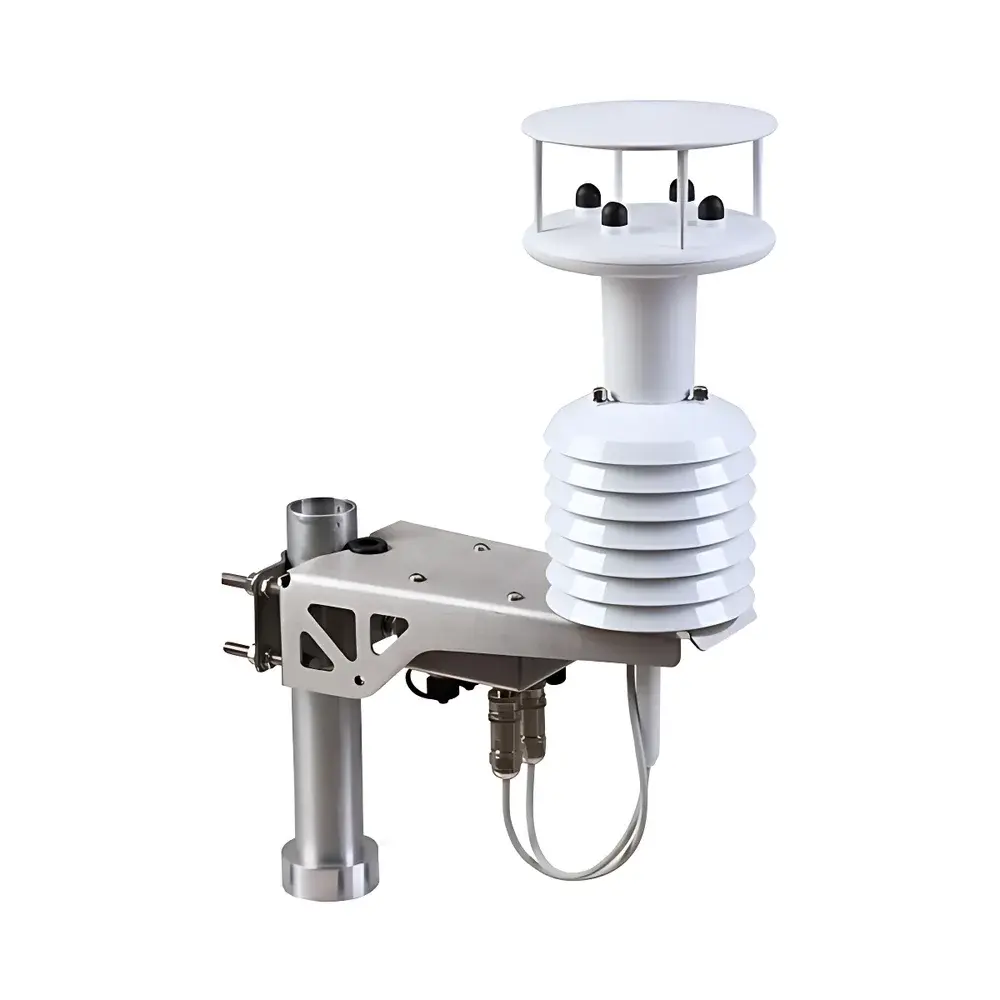
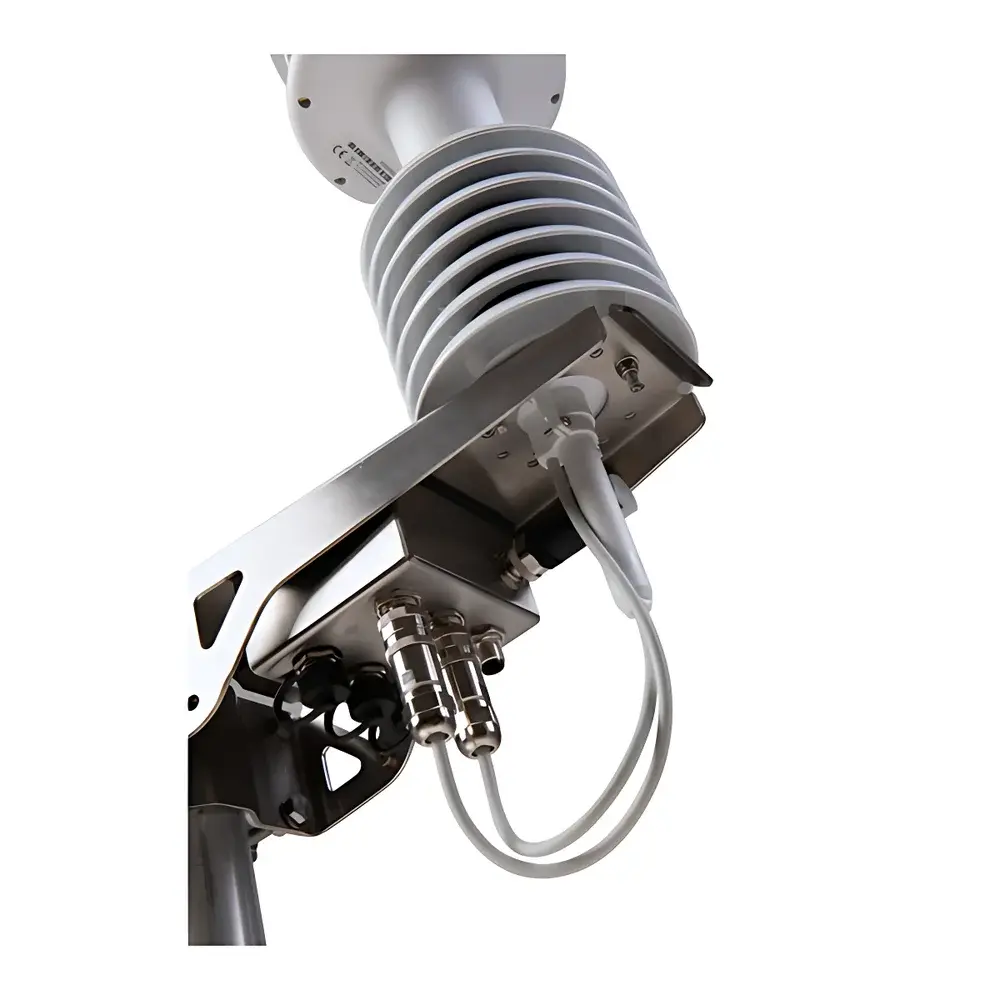
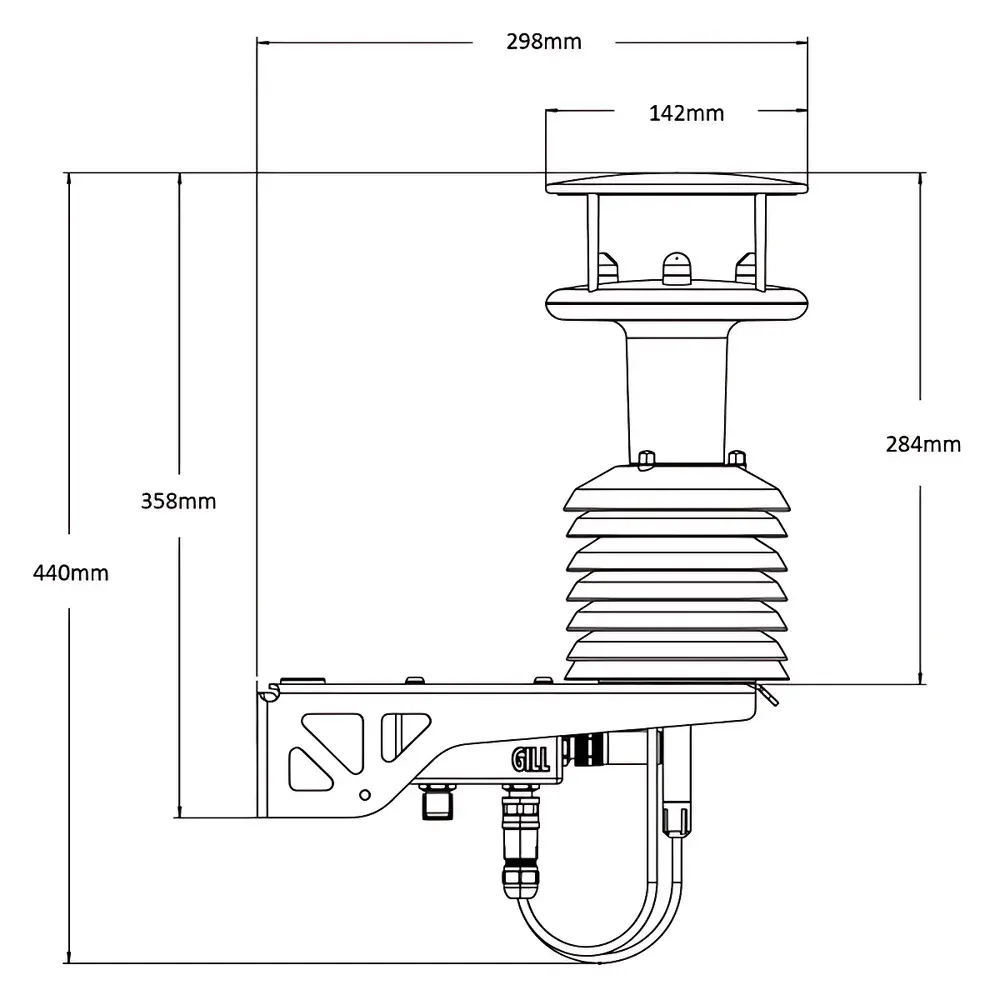
Gill MetConnect One Professional Weather Station
| Brand | Gill |
|---|---|
| Origin | United Kingdom |
| Model | MetConnect One |
| Instrument Type | Portable Weather Station |
| Enclosure Material | 316 Stainless Steel |
| Ingress Protection | IP66/IP67 |
| Sensor Integration | Integrated wind (anemometer & vane), temperature, relative humidity, barometric pressure, rain gauge, PRT input, and two configurable analog inputs |
| Data Output | Time-synchronized, single-string ASCII output with embedded status codes |
| Communication Protocols | RS-232, RS-485, SDI-12, Modbus RTU, NMEA 0183 |
| Software | Free Gill MetView configuration and data visualization software |
| Mounting & Service | Field-replaceable sensors, modular architecture, supported by Gill’s global technical support team |
Overview
The Gill MetConnect One Professional Weather Station is an engineered environmental monitoring solution designed for demanding field deployments where reliability, modularity, and interoperability are critical. Built upon Gill’s decades of expertise in ultrasonic wind sensing and precision meteorological instrumentation, the MetConnect One employs a distributed yet tightly synchronized architecture—combining calibrated, co-located sensors within a single ruggedized 316 stainless steel housing while retaining the flexibility to extend measurement capability via external analog or digital inputs. Its core measurement principles include ultrasonic time-of-flight for wind speed and direction (eliminating mechanical wear), capacitive polymer sensing for relative humidity, thermistor- and PRT-based temperature acquisition, piezoresistive barometry, and tipping-bucket methodology for precipitation quantification. The system outputs time-stamped, protocol-agnostic ASCII strings containing all sensor values alongside diagnostic status flags—enabling immediate validation of data integrity at the acquisition layer. This architecture ensures high reproducibility across installations and supports long-term unattended operation in marine, agricultural, renewable energy, and infrastructure monitoring applications.
Key Features
- Integrated multi-parameter sensing: Ultrasonic wind (speed & direction), Pt1000-grade temperature, capacitive relative humidity, absolute barometric pressure, and tipping-bucket rainfall—all factory-calibrated and thermally compensated.
- Dual analog input channels supporting 4–20 mA or 0–5 V signals from third-party sensors (e.g., pyranometers, soil moisture probes, or gas analyzers), enabling application-specific expansion without gateway hardware.
- Time-synchronized data output across RS-232, RS-485, SDI-12, Modbus RTU, and NMEA 0183 protocols—ensuring seamless integration with SCADA systems, PLCs, dataloggers (e.g., Campbell Scientific CR series), and cloud telemetry platforms.
- IP66/IP67-rated 316 stainless steel enclosure with corrosion-resistant fasteners and UV-stabilized cable glands—validated for continuous operation in coastal, offshore, and industrial environments.
- Field-serviceable design: Individual sensor modules—including wind transducer, rain collector, and humidity/temperature probe—are mechanically and electrically decoupled, allowing replacement without recalibration or system downtime.
- Free Gill MetView software provides intuitive configuration, real-time data visualization, firmware updates, and export to CSV or JSON—fully compatible with Windows and macOS platforms.
Sample Compatibility & Compliance
The MetConnect One is designed for direct deployment in heterogeneous environmental regimes without auxiliary shielding or active ventilation. Its sensor suite meets WMO Guide to Meteorological Instruments and Methods of Observation (CIMO Guide) recommendations for Class II stations. Rainfall measurements comply with ISO 9060:2018 spectral classification for secondary standard pyranometers when paired with optional irradiance sensors. Barometric pressure output is traceable to UKAS-accredited standards, and humidity accuracy adheres to ISO 4677:2022 reference conditions. While not certified to IEC 61000-6-2/6-4 for EMC immunity, the unit incorporates galvanic isolation on all serial interfaces and conforms to EN 61326-1:2013 for laboratory and industrial use. It supports audit-ready data logging when integrated with compliant dataloggers configured for GLP/GMP-aligned metadata tagging (e.g., operator ID, calibration timestamp, location GPS).
Software & Data Management
Gill MetView serves as the primary configuration and diagnostics interface—providing parameter mapping, alarm threshold definition, sampling interval control (1 s to 24 h), and live status monitoring including sensor health indicators and communication error logs. All output strings embed a 2-digit hexadecimal status code per sensor (e.g., “0x00” = nominal, “0x0A” = temperature sensor out-of-range), facilitating automated QA/QC filtering in downstream processing pipelines. Raw ASCII output is natively ingestible by Python (Pandas), MATLAB, or LabVIEW; no proprietary drivers are required. For enterprise deployments, MetConnect One integrates with MQTT brokers and RESTful APIs via compatible edge gateways, supporting structured ingestion into time-series databases (e.g., InfluxDB) and visualization dashboards (e.g., Grafana). Firmware updates preserve user-defined configurations and maintain backward compatibility across minor revisions.
Applications
- Maritime & Port Operations: Real-time wind shear and gust detection for vessel mooring safety; integration with AIS and tidal prediction systems on navigation buoys and harbor master control rooms.
- Solar Farm Performance Monitoring: Correlation of irradiance (via external pyranometer), ambient temperature, wind speed, and soiling rate to model PV panel efficiency degradation and optimize cleaning schedules.
- Agricultural Research: High-resolution microclimate profiling across crop zones—linking rainfall accumulation, leaf wetness duration (derived from RH/temp dew point), and solar insolation to phenological modeling and irrigation scheduling.
- Offshore Wind & Coastal Infrastructure: Structural loading assessment using sustained wind statistics and extreme event flagging; long-term trend analysis aligned with IPCC AR6 regional climate projections.
- Environmental Compliance Monitoring: Baseline meteorological data collection for EIA reporting, stack emission dispersion modeling (e.g., AERMOD inputs), and fugitive dust mitigation verification.
FAQ
Does the MetConnect One require annual recalibration?
No scheduled recalibration is mandated under normal operating conditions. Gill recommends verification against traceable references every 24 months or after physical impact, sensor replacement, or exposure to extreme contamination (e.g., salt crust, volcanic ash). Factory calibration certificates are provided with each unit.
Can the unit operate autonomously on solar power?
Yes—the MetConnect One accepts 9–30 VDC input and draws ≤1.2 W in continuous mode. When paired with a charge controller and ≥20 Ah LiFePO₄ battery, it supports >30 days of operation during low-irradiance periods typical of high-latitude winter deployments.
Is NMEA 0183 output compatible with marine chartplotters?
Yes—output sentences conform to NMEA 0183 v4.10 standards, including $WIMWV (wind), $YXXDR (environmental), and custom $GIMET messages. Baud rate and sentence frequency are configurable via MetView.
How is sensor synchronization achieved across distributed inputs?
All internal sensors share a common 10 MHz oscillator and timestamp engine. External analog inputs are sampled synchronously at 10 Hz and interpolated to the master timebase before inclusion in the output string.
What mounting options are available for mast or pole installation?
Standard U-bolt clamps (30–120 mm diameter), marine-grade stainless steel guy wire kits, and adjustable tilt brackets are offered as accessories. Gill provides detailed wind turbulence correction guidelines for non-ideal mounting heights per IEC 61400-12-1 Annex D.
Related Products







