
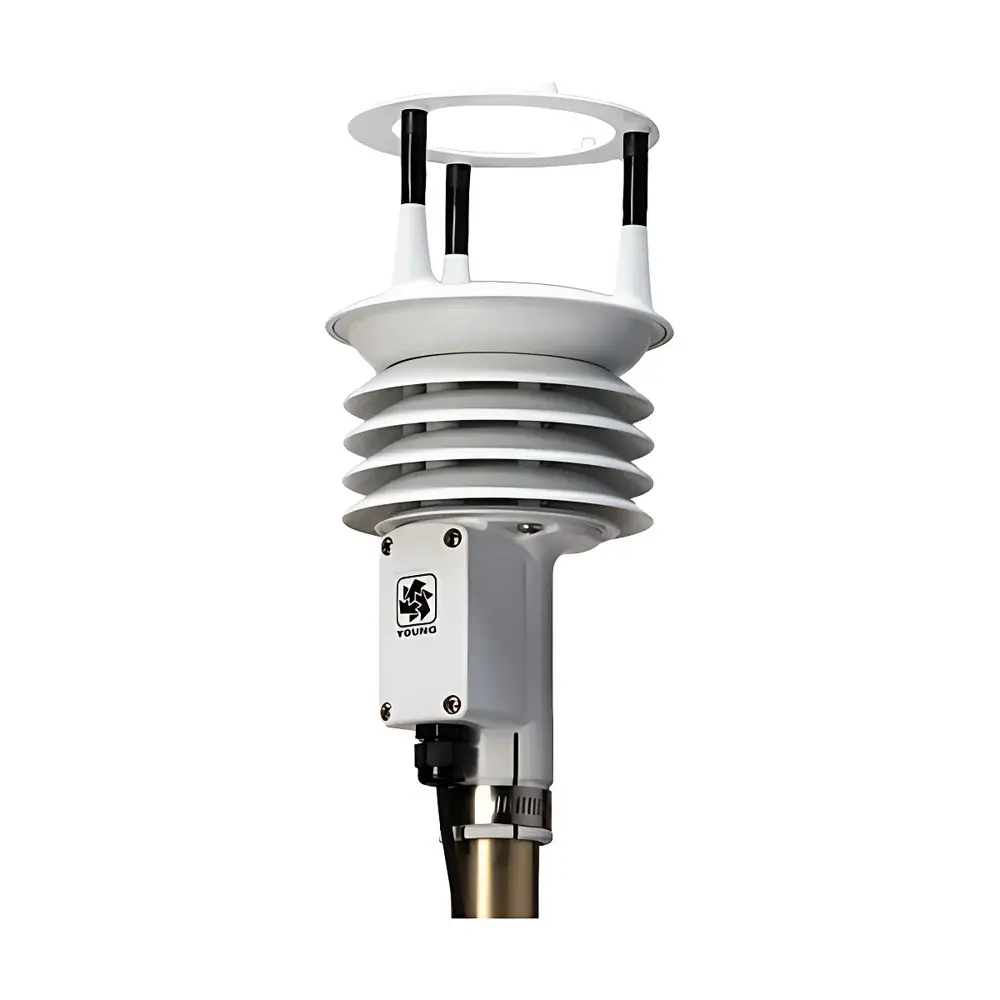
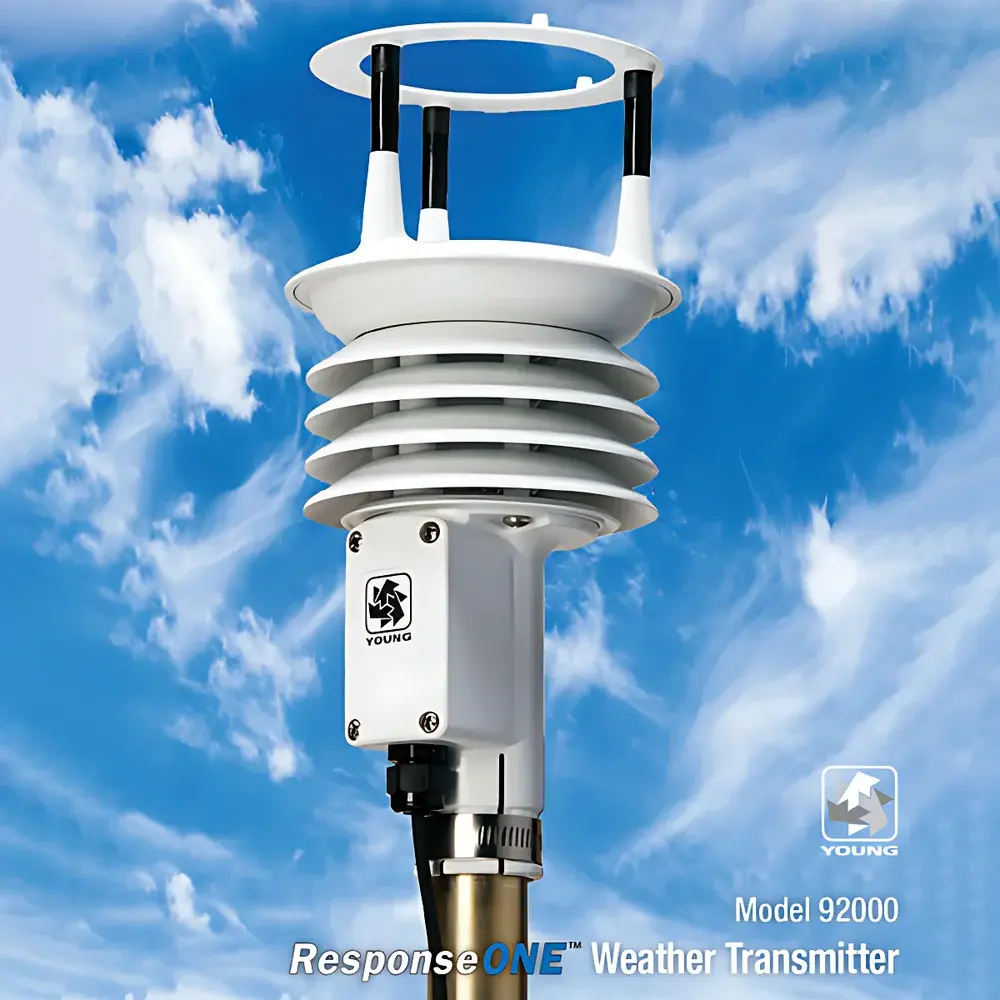
R.M. Young ResponseONE™ 92000 Ultrasonic Weather Sensor
| Brand | R.M. Young |
|---|---|
| Origin | USA |
| Model | 92000 |
| Instrument Type | Portable Weather Station |
| Output Interfaces | SDI-12, NMEA 0183, ASCII Serial |
| Communication Options | RS-232 or RS-485 |
| Mounting | 1-inch IPS pipe thread |
| Housing Material | Corrosion-resistant anodized aluminum |
| Power Supply | 6–24 VDC |
| Operating Temperature | −40 °C to +70 °C |
| IP Rating | IP66 |
Overview
The R.M. Young ResponseONE™ 92000 Ultrasonic Weather Sensor is a fully integrated, compact environmental monitoring instrument engineered for high-fidelity, multi-parameter meteorological measurement in field-deployed applications. Unlike traditional mechanical anemometers and thermohygrometers, the 92000 employs ultrasonic time-of-flight (TOF) technology to measure wind speed and wind direction with no moving parts—eliminating mechanical wear, icing susceptibility, and maintenance intervals associated with cup-and-vane assemblies. Simultaneously, it integrates precision capacitive relative humidity sensing, platinum resistance temperature detection (PT1000-class accuracy), and piezoresistive barometric pressure transduction within a single, aerodynamically optimized housing. This monolithic architecture ensures spatial co-location of all sensors, minimizing microclimate-induced measurement discrepancies common in multi-body weather stations. Designed for continuous outdoor operation across extreme climatic zones—from arctic tundra to tropical coastal environments—the device complies with IEC 60529 (IP66) for dust-tightness and powerful water jet resistance, and meets MIL-STD-810G for shock and vibration resilience.
Key Features
- Ultrasonic wind measurement: 0–60 m/s range, ±0.1 m/s resolution, 1° directional accuracy; immune to icing and bearing degradation
- Integrated environmental sensing: Temperature (−40 to +70 °C, ±0.2 °C typical), Relative Humidity (0–100 %RH, ±2 %RH typical), Barometric Pressure (500–1100 hPa, ±0.5 hPa typical)
- Multi-protocol serial output: Configurable SDI-12 (for low-power datalogger networks), NMEA 0183 (for marine and aviation integration), and ASCII text (for custom SCADA or IoT edge systems)
- Flexible communication: Factory-selectable RS-232 or RS-485 physical layer; supports both polled and continuous transmission modes to optimize power budget in battery-operated deployments
- Robust mechanical design: Anodized aluminum housing with passive thermal management; optimized fin geometry and internal airflow channels reduce solar radiation error on temperature and humidity readings
- Standardized mounting: 1-inch IPS (Iron Pipe Size) male thread enables rapid deployment on standard meteorological masts, tripods, or vessel railings without adapter hardware
- Weatherproof termination: Integrated junction box accepts standard 12–22 AWG shielded twisted-pair cabling; no proprietary connectors required
Sample Compatibility & Compliance
The ResponseONE™ 92000 is validated for use in regulatory-grade environmental monitoring programs requiring traceable, repeatable data. Its sensor calibration protocols align with WMO Guide to Instruments and Methods of Observation (CIMO Guide, Chapter 12) for surface wind and thermodynamic parameters. Humidity and temperature modules are factory-calibrated against NIST-traceable standards, and pressure transducers are compensated for thermal drift across the full operational range. The device meets CE marking requirements under EMC Directive 2014/30/EU and RoHS 2011/65/EU. For deployments supporting ISO/IEC 17025-accredited laboratories or EPA Method-compliant air quality networks, the 92000’s deterministic serial output format and stable timing characteristics support audit-ready data provenance when paired with timestamp-synchronized data loggers (e.g., Campbell Scientific CR6, Onset HOBO RX3000).
Software & Data Management
Each unit ships with Young’s Windows-based ResponseONE Configuration Utility—a lightweight, installer-driven application that enables full parameterization without command-line interaction. Users may configure sampling interval (1 s to 3600 s), output protocol selection, baud rate (up to 115.2 kbps), parity, and data frame structure. The utility also provides real-time telemetry display, firmware update capability, and diagnostic status reporting (e.g., transducer health, signal-to-noise ratio, self-test flags). All configuration changes are stored non-volatilely in onboard EEPROM. When deployed with compliant data acquisition systems, the 92000 supports GLP/GMP-aligned workflows: output strings include UTC timestamps (when synchronized via external GPS or NTP), sensor-specific metadata headers, and CRC-16 checksums for data integrity verification. No cloud dependency or vendor-hosted platform is required—raw ASCII or NMEA streams integrate natively into open-source platforms such as Grafana+InfluxDB or commercial solutions like Campbell Scientific LoggerNet.
Applications
- Automated weather observation networks (AWOS/ASOS) for airports and remote airstrips
- Coastal and offshore buoy systems requiring corrosion resistance and compact form factor
- Environmental impact assessments (EIA) and long-term climate baseline studies per ISO 14064-2
- Agricultural microclimate monitoring for irrigation scheduling and frost prediction models
- Urban heat island (UHI) research using dense sensor arrays with synchronized temporal sampling
- Renewable energy site assessment—including wind resource mapping and turbine control pre-feasibility studies
- Educational meteorology labs where durability, ease of setup, and protocol transparency support curriculum-aligned experimentation
FAQ
Does the 92000 require routine recalibration?
No scheduled recalibration is mandated by the manufacturer under normal operating conditions. However, R.M. Young recommends annual verification against traceable references for applications governed by ISO/IEC 17025 or regulatory reporting frameworks.
Can the 92000 operate on solar-battery power?
Yes—its quiescent current draw is ≤1.2 mA in sleep mode, and active measurement consumes ≤25 mA at 12 VDC. It is routinely deployed with 7 Ah LiFePO₄ batteries and 10 W solar chargers for year-round unattended operation.
Is the RS-485 option suitable for multi-drop networks?
Yes—the RS-485 variant supports up to 32 nodes on a single bus (per EIA-485 standard), with configurable Modbus RTU framing available via software update.
How does the housing mitigate solar radiation error?
The enclosure uses a double-wall, ventilated design with reflective anodized finish and internal thermal mass buffering; wind flow through calibrated vent paths ensures boundary-layer exchange without turbulent perturbation of sensor elements.
What data logger compatibility is verified?
Officially supported platforms include Campbell Scientific CR1000X/CR6, Onset HOBO RX3000/WiFi, Delta-T Devices DL2e, and Decagon EM50G; generic ASCII/NMEA parsing is compatible with any system supporting serial TTL/RS-232/RS-485 input.







