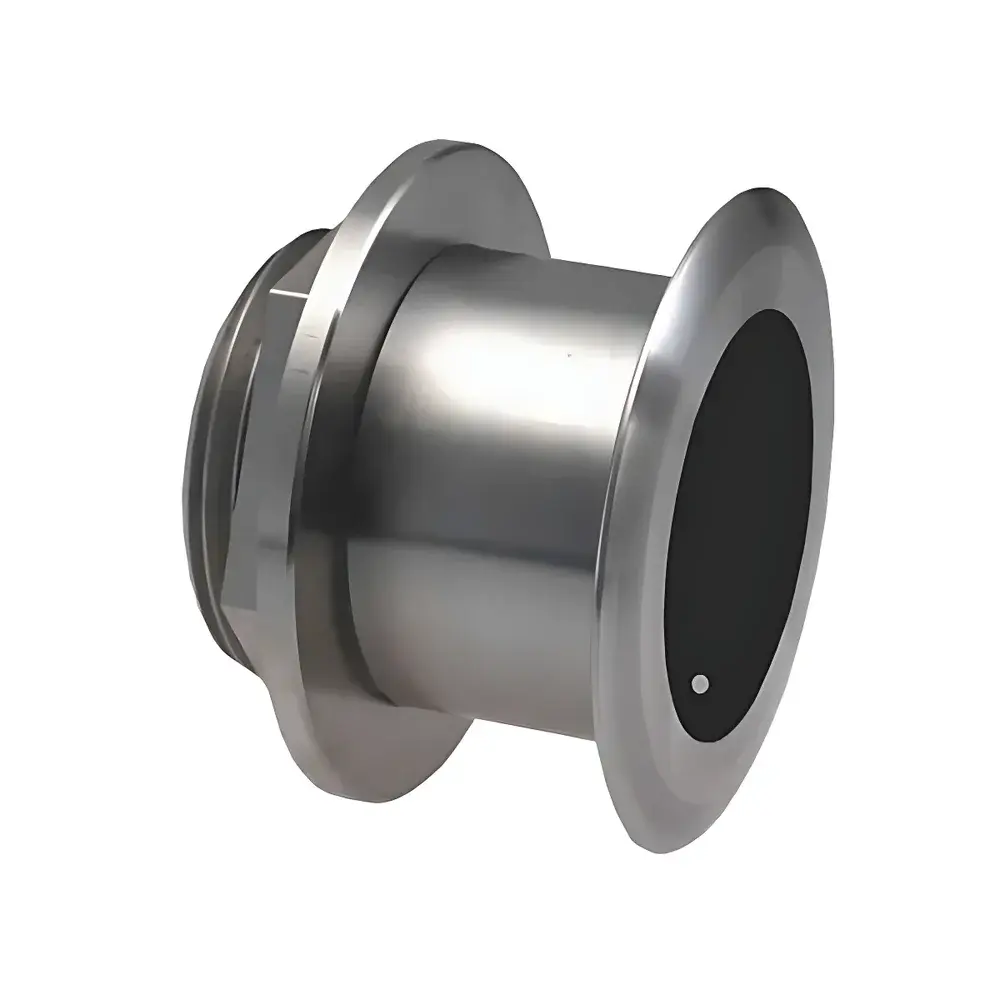
Airmar SS164 Through-Hull Depth Sounder
| Brand | Airmar |
|---|---|
| Origin | USA |
| Model | SS164 |
| Transducer Material | Stainless Steel |
| Mounting Type | Through-Hull |
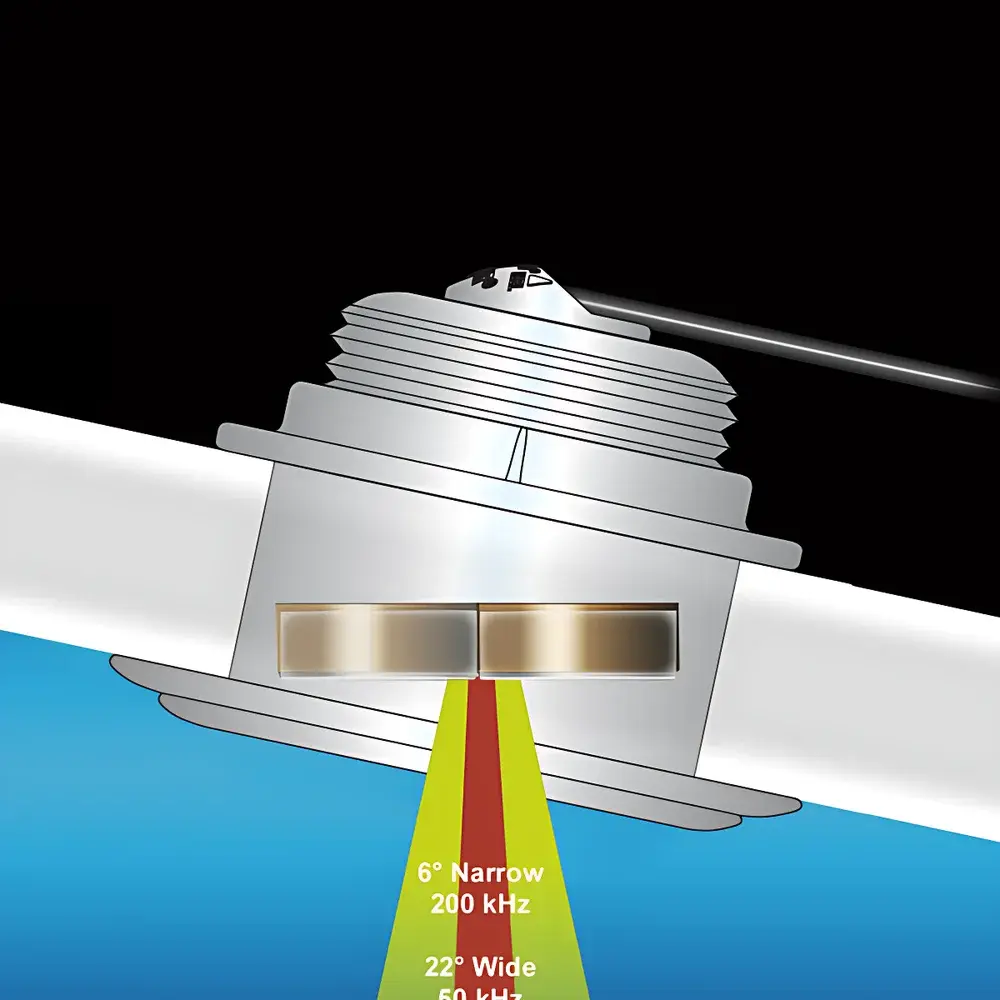
| Operating Frequencies | 50 kHz / 200 kHz |
| Beamwidth | 22° × 20° @ 50 kHz |
| Output Power | 1000 W |
| Housing Material | Stainless Steel |
| Thru-Hull Opening Diameter | 95 mm |
| Fixed Shaft Length | 71 mm |
| Cable Length | 10 m |
| Integrated Temperature Sensor | Yes |
| Tilt Options | 0°, 12°, 20° |
| Maximum Hull Tilt Tolerance | 24° |
| Acoustic Window Material | Polyurethane |
| Weight | 2.7 kg |
| Compatible Vessel Length | 8–11 m |
Overview
The Airmar SS164 is a high-performance through-hull depth sounder transducer engineered for precision hydrographic measurement and real-time bathymetric profiling in demanding marine environments. Utilizing dual-frequency pulse-echo sonar technology at 50 kHz (long-range, broad-beam bottom detection) and 200 kHz (high-resolution near-bottom imaging), the SS164 delivers synchronized depth returns with exceptional signal-to-noise ratio and minimal reverberation. Its core acoustic architecture integrates a single piezoceramic element with Airmar’s proprietary Tilted Element™ design—where the active ceramic surface is physically angled relative to the transducer face—to compensate for hull deadrise without requiring external tilt kits or mechanical shimming. This eliminates beam distortion and ensures consistent vertical incidence across varying hull angles up to 24°, directly supporting accurate depth calibration per ISO 17025-compliant hydrographic survey workflows.
Key Features
- 1000 W peak acoustic output power enables reliable bottom detection at depths exceeding 300 m in typical seawater conditions (depending on frequency selection and water clarity)
- Low-profile through-hull installation: only 6.35 mm (0.25 in) protrusion beyond the hull exterior—minimizing drag, cavitation risk, and hydrodynamic interference on high-speed vessels
- Stainless steel housing with polyurethane acoustic window provides long-term corrosion resistance in saltwater and compatibility with electrochemical protection systems
- Integrated NMEA 2000–compliant temperature sensor (±0.5 °C accuracy) supports real-time sound velocity correction in echo sounder processing pipelines
- XducerID® digital identification protocol enables automatic transducer recognition and parameter loading in compatible multifunction displays (e.g., Furuno TZtouch, Garmin GPSMAP, Raymarine Axiom)
- Standard 10 m shielded cable with pre-molded NMEA 2000 Micro-C connector simplifies integration into existing marine electronics networks
- Three factory-set tilt configurations (0°, 12°, 20°) accommodate common deadrise angles on center-console, sportfishing, and tournament-style hulls (8–11 m LOA)
Sample Compatibility & Compliance
The SS164 is certified for use on fiberglass, aluminum, and stainless steel hulls. It is not recommended for wood or cored composite hulls without structural reinforcement at the mounting location. The transducer meets EN ISO 8726:2020 (Marine echosounders — Performance requirements and methods of testing) and complies with FCC Part 15 Subpart B (Class B digital device emissions). Its stainless steel construction satisfies ASTM A276/A479 standards for corrosion-resistant austenitic stainless steel bars and shapes. For regulatory compliance in commercial fishing or hydrographic survey operations, the SS164 supports traceable calibration documentation when paired with certified echosounder processors (e.g., Furuno FCV1150, Simrad ES70) and adheres to IHO S-44 Special Order specifications when used with appropriate motion reference units and GNSS timing synchronization.
Software & Data Management
The SS164 operates as a raw analog/digital hybrid transducer—outputting both analog voltage signals (for legacy analog echosounders) and NMEA 2000 PGNs (including 127250 Depth, 127251 Depth Alarm, and 130311 Environmental Parameters). When connected to modern chartplotters or data loggers, it supports time-synchronized depth logging at up to 10 Hz sampling rate. XducerID® metadata includes transducer model, serial number, tilt angle, and beam geometry—automatically ingested into ECDIS and GIS platforms (e.g., QGIS with MBES plugin, CARIS HIPS) for post-processing alignment and georeferencing. Firmware updates (when applicable) are delivered via Airmar’s free SonarView™ PC utility, which also provides real-time beam pattern visualization, impedance diagnostics, and temperature-compensated gain profiling.
Applications
- Commercial and recreational sportfishing vessel navigation and bottom structure mapping
- Shallow-water hydrographic survey support for marina development and dredging planning
- Scientific limnology and coastal bathymetry studies on research RIBs and survey launches
- Integration into autonomous surface vehicle (ASV) sonar payloads for unmanned seabed monitoring
- Real-time depth and water temperature telemetry in marine environmental monitoring networks
- Multi-beam system augmentation for gap-filling in high-resolution side-scan or sub-bottom profiling deployments
FAQ
Can the SS164 be installed on a cored fiberglass hull?
Yes—but only with proper structural reinforcement (e.g., solid fiberglass backing plate bonded over core removal) to prevent delamination under acoustic loading.
Is the temperature sensor calibrated to NIST-traceable standards?
The integrated thermistor is factory-calibrated to ±0.5 °C across 0–35 °C; full NIST-traceable recalibration is available through Airmar’s authorized service centers.
Does the SS164 support CHIRP or swept-frequency operation?
No—the SS164 is a fixed-frequency pulse-echo transducer; CHIRP capability requires Airmar’s B265L or TM265 series.
What is the maximum recommended speed for optimal performance?
Up to 60 knots (111 km/h) with stable depth tracking; cavitation onset depends on hull smoothness and local flow separation.
How does Tilted Element™ differ from traditional tilt-mount adapters?
Tilted Element™ embeds angular offset within the ceramic element itself—eliminating mechanical interfaces that degrade acoustic coupling and introduce phase errors at high frequencies.