
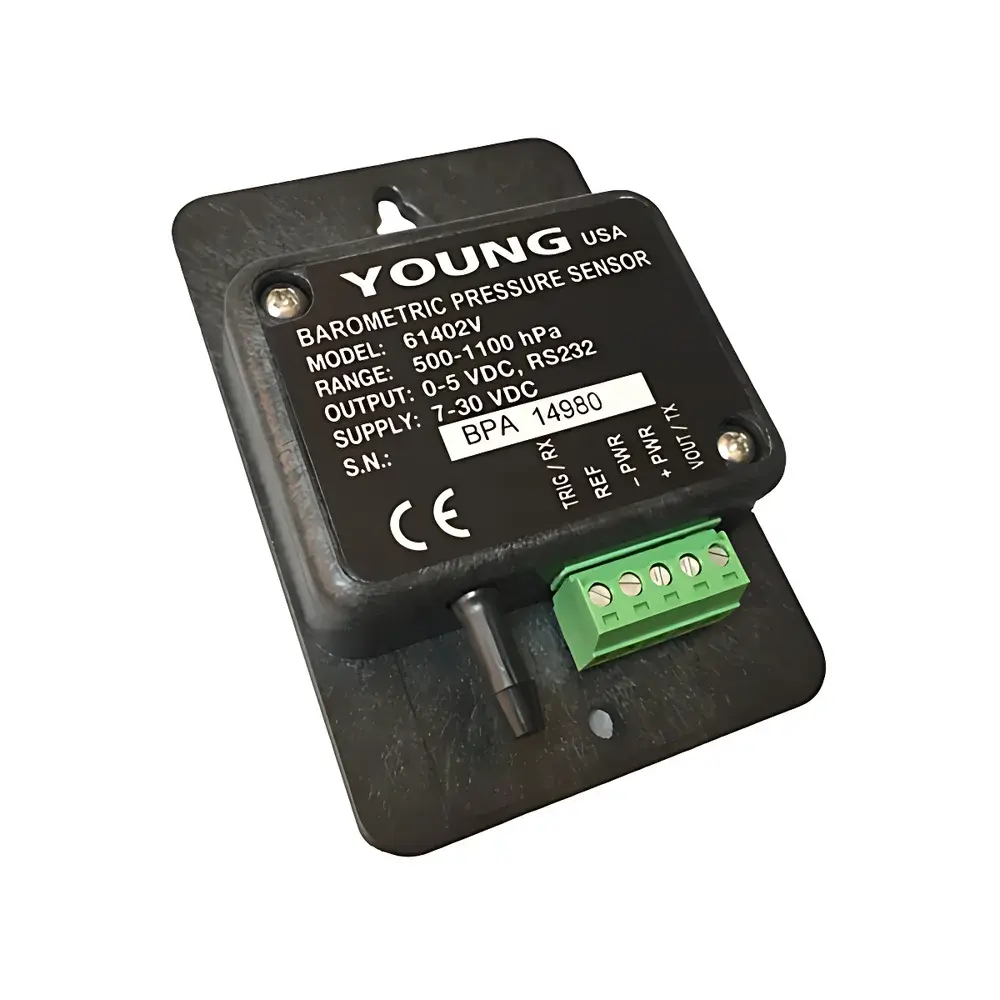
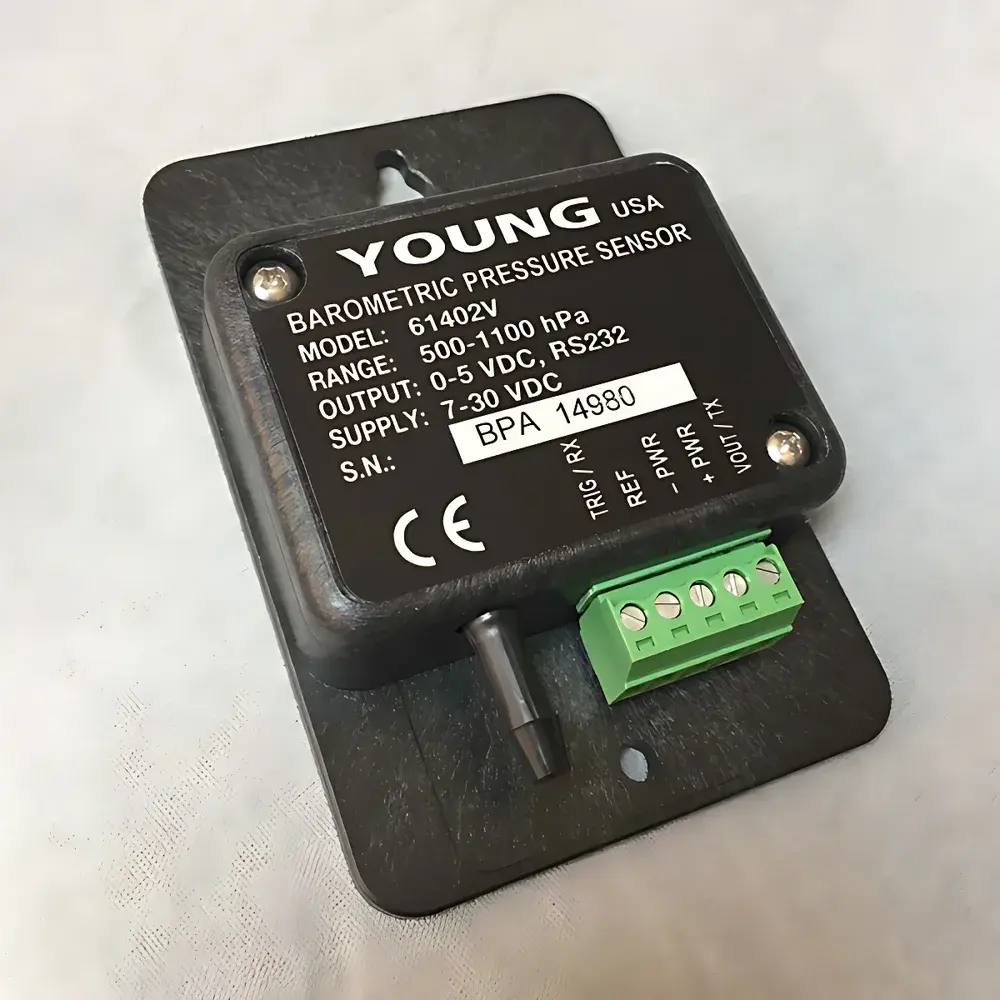
R.M. Young 61402 Precision Barometric Pressure Sensor
| Brand | R.M. Young |
|---|---|
| Origin | USA |
| Model | 61402 |
| Output Options | 0–5 VDC (61402V), 4–20 mA (61402L), SDI-12, RS-232, RS-485 (61402L only) |
| Measurement Range | 500–1100 hPa |
| Digital Accuracy | ±0.2 hPa @ 25°C, ±0.3 hPa @ −50 to +60°C |
| Analog Accuracy | ±0.05% of full scale |
| Temperature Coefficient | 0.0017% FS/°C |
| Long-Term Stability | 0.08% FS/year |
| Resolution | 0.01 hPa (digital), 0.025% FS (analog) |
| Update Rate | up to 1.8 Hz |
| Power Supply | 7–30 VDC |
| Current Consumption | <4 mA (active), 2.7 µA (sleep mode) |
| Dimensions | 90 × 60 × 20 mm |
| Weight | 44 g |
Overview
The R.M. Young 61402 Precision Barometric Pressure Sensor is an engineered solution for long-term, high-stability atmospheric pressure monitoring in environmental, meteorological, and industrial applications. Based on a silicon piezoresistive sensing element with temperature-compensated signal conditioning, the 61402 delivers traceable, NIST-traceable calibration across its operational range of 500–1100 hPa. Its low-power architecture supports deployment in remote, battery-powered stations—especially where extended autonomy and minimal thermal drift are critical. The sensor operates over an extended ambient temperature range (−50°C to +60°C), with digital accuracy maintained at ±0.2 hPa at 25°C and ±0.3 hPa across the full operating envelope. Designed for integration into automated weather stations (AWS), air quality monitoring networks, and calibration laboratories, the 61402 meets functional requirements aligned with WMO Guide to Instruments and Methods of Observation (CIMO Guide) Chapter 12 for barometric sensors.
Key Features
- High-resolution digital output: 0.01 hPa resolution via serial interface (RS-232, SDI-12, or RS-485)
- Low-power operation: <4 mA typical active current; ultra-low 2.7 µA sleep mode for energy-constrained deployments
- Multiple analog output variants: 61402V provides calibrated 0–5 VDC (or 0–2.5 VDC); 61402L supports industry-standard 4–20 mA current loop output
- Configurable serial communication: Full-duplex RS-232 standard on all models; RS-485 and SDI-12 available on 61402L variant
- Robust mechanical design: Compact 90 × 60 × 20 mm footprint enables integration into instrument enclosures without spatial compromise
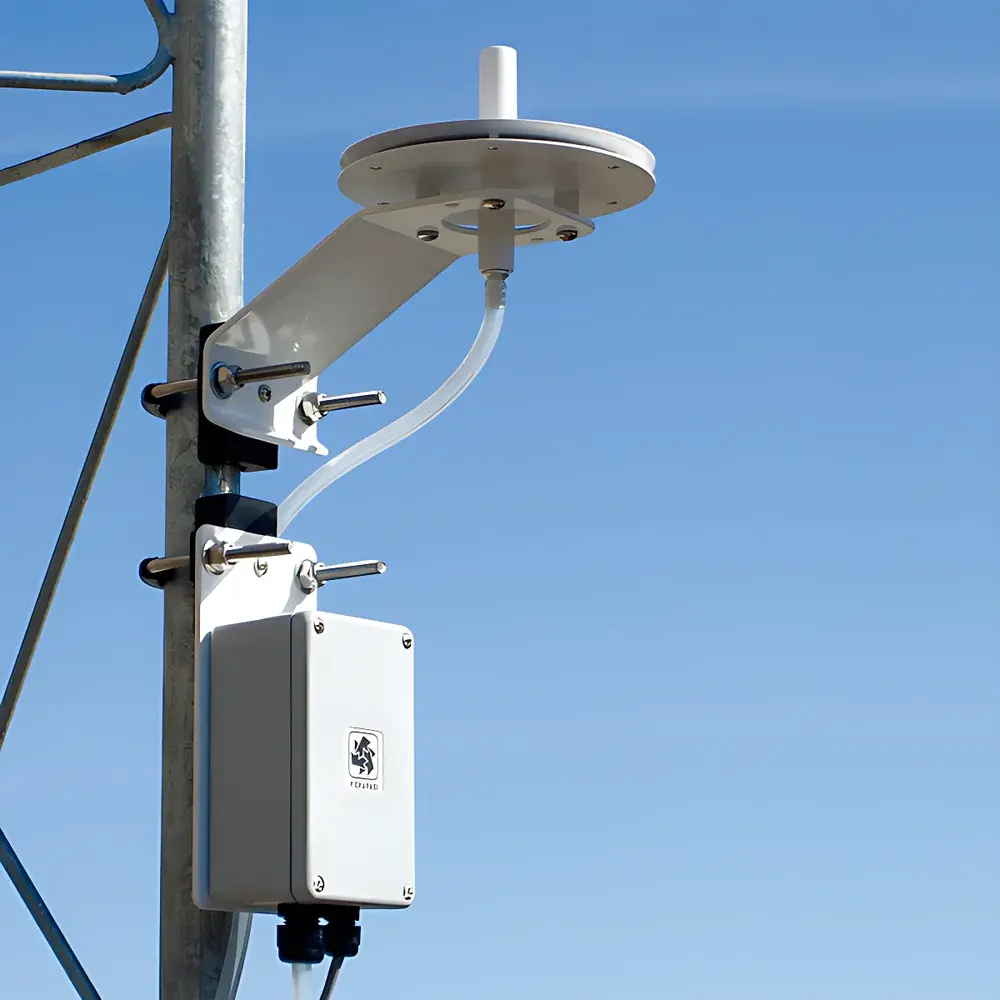
- Environmental resilience: Optional rain shield (Model 61360) and pressure buffer port (Model 61002) minimize wind-induced dynamic pressure errors and moisture ingress
- Long-term stability: 0.08% full-scale drift per year ensures minimal recalibration frequency in field-deployed systems
Sample Compatibility & Compliance
The 61402 is designed for direct atmospheric sampling and is compatible with standard vented enclosure mounting configurations. Its pressure port geometry and optional 61002 buffer port reduce turbulence-induced measurement artifacts—critical for compliance with ISO 2533:2020 (Standard Atmosphere) and WMO-recommended siting practices. While not certified for intrinsic safety or ATEX/IECEx zones, the sensor complies with FCC Part 15 Class B and CE EMC Directive 2014/30/EU for electromagnetic compatibility. Its analog outputs meet IEC 60381-1 (current signals) and IEC 60381-2 (voltage signals) standards. For regulated environments requiring auditability, raw serial data output supports time-stamped ASCII/NMEA-formatted records suitable for GLP-compliant logging systems.
Software & Data Management
The 61402 supports both polled and continuous data transmission modes over serial interfaces. In polled mode, host controllers issue standardized ASCII commands (e.g., “READ” or “STATUS”) to retrieve pressure, temperature, and diagnostic values. Continuous mode streams ASCII strings at user-configurable intervals (up to 1.8 Hz), enabling real-time ingestion into SCADA platforms, CR1000/CR6 dataloggers (Campbell Scientific), or custom Python-based acquisition frameworks. All serial outputs include checksums and carriage-return/line-feed delimiters for parsing robustness. No proprietary drivers or closed firmware are required—communication adheres strictly to open protocol conventions. Firmware updates (if applicable) are performed via RS-232 using documented command sets, ensuring compatibility with legacy and modern control architectures alike.
Applications
- Automated Weather Stations (AWS) requiring high temporal resolution and long-term baseline stability
- Atmospheric research campaigns measuring pressure gradients, sea-level pressure anomalies, and tropospheric lapse rates
- Calibration transfer standards in metrology labs supporting secondary barometer verification against primary manometers
- Industrial process monitoring where barometric compensation is needed for mass flow controllers or vacuum system diagnostics
- Unmanned aerial systems (UAS) and balloon-borne payloads leveraging low mass (44 g) and ultra-low power consumption
- Environmental monitoring networks compliant with EPA Reference Method PS-11 or EU Air Quality Directive 2008/50/EC Annex IX
FAQ
What is the recommended calibration interval for the 61402?
Annual calibration is recommended under typical field conditions; however, users operating in stable thermal environments may extend intervals based on documented stability performance per ISO/IEC 17025 Clause 7.7.
Can the 61402 be used for absolute pressure measurements in vacuum applications?
No—the 61402 is designed exclusively for atmospheric (barometric) pressure measurement within 500–1100 hPa and is vented to ambient. It is not rated for sealed or vacuum reference use.
Is the RS-485 interface electrically isolated?
The RS-485 interface on the 61402L is non-isolated; external galvanic isolation is recommended when interfacing with ground-referenced or noisy industrial bus systems.
Does the sensor support Modbus RTU or other industrial protocols?
No—native protocol support is limited to ASCII/NMEA over RS-232, SDI-12, and RS-485. Protocol translation requires external gateway hardware or software-layer mapping.
How does the pressure buffer port (Model 61002) improve measurement fidelity?
The 61002 diffuser reduces transient pressure fluctuations caused by wind shear and turbulent flow at the sensor inlet, lowering RMS error in unsheltered outdoor installations per WMO siting guidelines.







