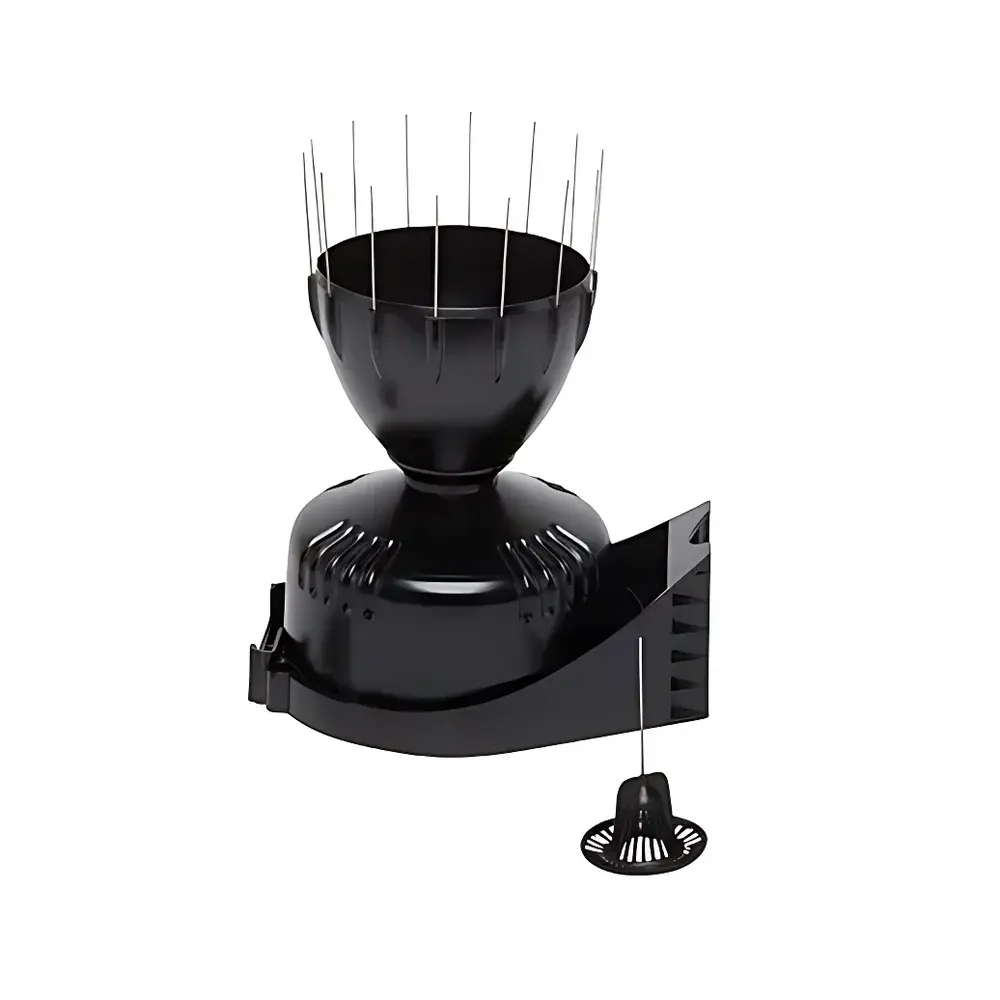
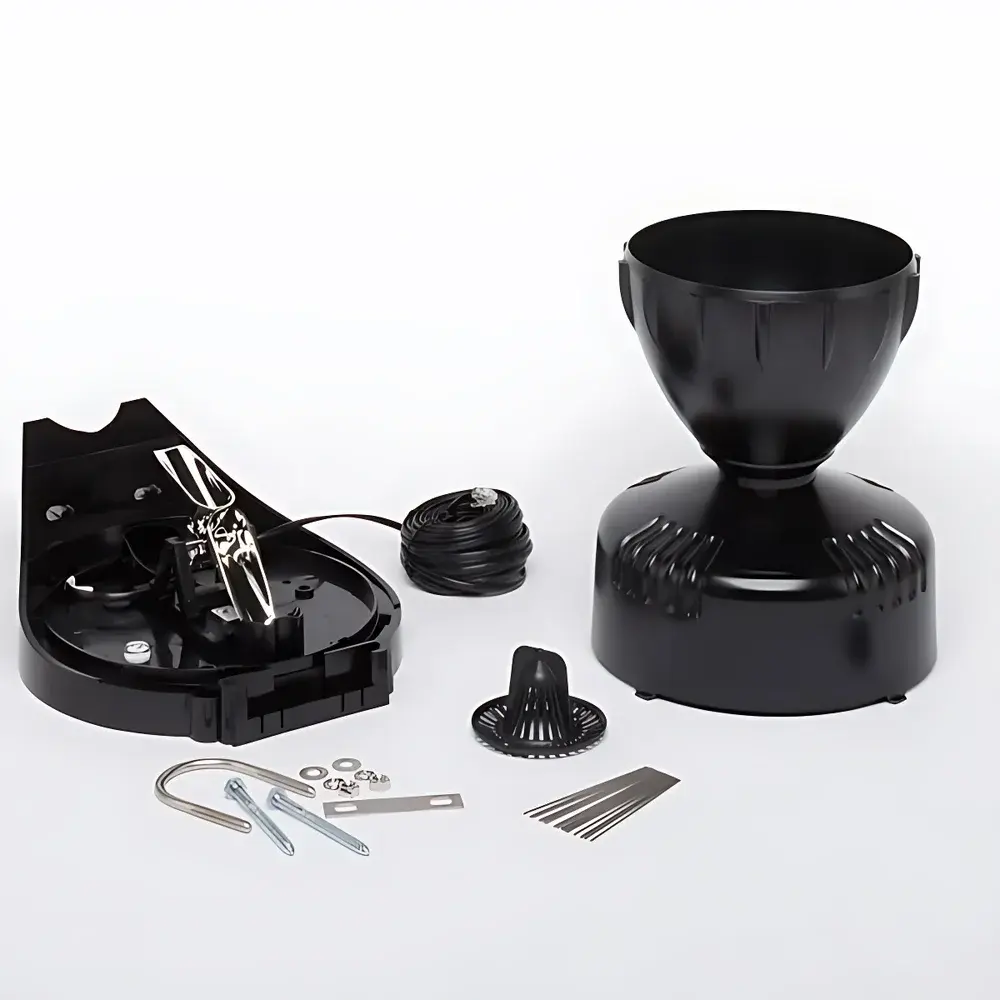
Davis 6466 Tipping Bucket Rain Gauge
| Brand | Davis |
|---|---|
| Origin | USA |
| Model | 6466 |
| Sensor Type | Tipping Bucket |
| Resolution | 0.2 mm per Tip |
| Accuracy | ±4% of Total Rainfall or ±1 Tip (0.2 mm), whichever is greater |
| Cable Length | 12 m (standard), up to 270 m max |
| Cable Specification | 4-conductor, 26 AWG, modular RJ-11 connector |
| Housing Material | UV-stabilized ABS plastic |
| Collection Area | 214 cm² |
| Dimensions (rain gauge only) | Ø16.5 cm × H24 cm (excl. bird spike) |
| Weight | 1.8 kg |
| Mounting | Pole- or mast-mounted via integrated base |
Overview
The Davis 6466 Tipping Bucket Rain Gauge is a precision meteorological sensor engineered for long-term, high-reliability precipitation measurement in environmental monitoring, hydrological research, agricultural weather stations, and automated climate networks. It operates on the well-established tipping bucket principle: rainfall is directed through a conical collector and debris screen into a balanced dual-chamber bucket assembly. Each chamber has a calibrated volume capacity corresponding to 0.2 mm of rainfall over the instrument’s standardized collection area of 214 cm². When one chamber fills to its threshold, gravity causes the bucket to tip, actuating a reed switch that generates a discrete digital pulse. The opposing chamber then assumes the collection role—ensuring continuous, uninterrupted measurement. This mechanical-electrical transduction design eliminates drift, requires no external power for basic operation, and delivers intrinsic traceability to physical rain volume.
Key Features
- Aerodynamically optimized collector geometry minimizes wind-induced undercatch—validated against WMO Guidance on Precipitation Measurement (WMO-No. 8, 2022) for improved accuracy in exposed installations.
- UV-stabilized ABS housing ensures structural integrity and dimensional stability across -40°C to +65°C operating temperatures, with no degradation in calibration over extended outdoor exposure.
- Integrated mounting base enables secure, level installation on poles, masts, or towers; compatible with standard 1.5–2.5 inch OD vertical supports.
- Modular RJ-11 connector simplifies field deployment and cable replacement; supports daisy-chaining in multi-sensor networks when used with compatible data loggers.
- Factory-calibrated resolution of 0.2 mm per tip provides consistent quantization for both short-duration convective events and cumulative seasonal totals.
- No internal electronics or batteries required—purely electromechanical signal generation enhances mean time between failures (MTBF) and reduces maintenance overhead.
Sample Compatibility & Compliance
The 6466 is designed for natural rainfall measurement under ambient atmospheric conditions and is not intended for artificial or pressurized water delivery systems. Its performance complies with fundamental requirements outlined in ISO 9035:2011 (Rain gauges — Specifications and testing methods) and aligns with WMO observational standards for non-recording and telemetry-integrated rain gauges. While not certified to IEC 61326-1 (EMC) or UL 61010-1 (safety) as a standalone device, it meets electromagnetic compatibility thresholds typical for Class B industrial environments when paired with appropriately rated data acquisition hardware. No hazardous substances are used in construction; RoHS 2011/65/EU compliance is maintained across all polymer and metallic components.
Software & Data Management
The 6466 outputs open-collector dry-contact pulses (normally open reed switch) referenced to ground—compatible with any data logger supporting digital input counting (e.g., Campbell Scientific CR1000X, Onset HOBO U30, Delta-T DL2e). Pulse interpretation is handled at the logger level: each closure represents 0.2 mm of accumulated precipitation. Time-stamped event logging enables calculation of intensity (mm/h), accumulation rates, and temporal distribution analysis. When integrated into cloud-based platforms (e.g., WeatherLink Live, Meteobridge, or custom MQTT/HTTP APIs), raw tip counts are translated into standardized units and subjected to quality control flags—including freeze-thaw validation, self-test diagnostics, and outlier filtering based on concurrent wind speed and temperature metadata. Audit trails for calibration history and firmware updates (where applicable to host logger) support GLP-aligned operational documentation.
Applications
- Real-time hydrometeorological monitoring for flood forecasting and watershed modeling.
- Calibration reference for radar-derived quantitative precipitation estimates (QPE).
- Long-term climate station networks requiring NIST-traceable, low-maintenance precipitation sensors.
- Irrigation scheduling and evapotranspiration (ETo) modeling in precision agriculture deployments.
- Educational meteorology labs where mechanical transparency and reproducible physics principles are pedagogically essential.
- Urban stormwater management systems integrating IoT-enabled infrastructure reporting.
FAQ
What is the effective collection area of the Davis 6466?
The calibrated collection orifice area is 214 cm², which defines the geometric basis for converting tip count to depth-equivalent rainfall (0.2 mm per tip).
Can the 6466 be used in freezing conditions?
Yes—it operates mechanically down to -40°C; however, ice accumulation on the collector rim may impair accuracy. Heated versions (e.g., 6466-HEAT) are available for sustained sub-zero applications.
Is the 6466 compatible with third-party data loggers?
Yes—any logger supporting TTL or dry-contact digital input counting can interface directly; no proprietary protocol or driver is required.
How often does the unit require recalibration?
Davis specifies factory calibration validity for 5 years under normal use; field verification using standardized catchment tests (per ASTM D3242) is recommended annually in critical applications.
Does the 6466 include a bird deterrent?
The standard 6466 includes a stainless-steel bird spike mounted centrally above the collector to prevent perching and nesting interference.