
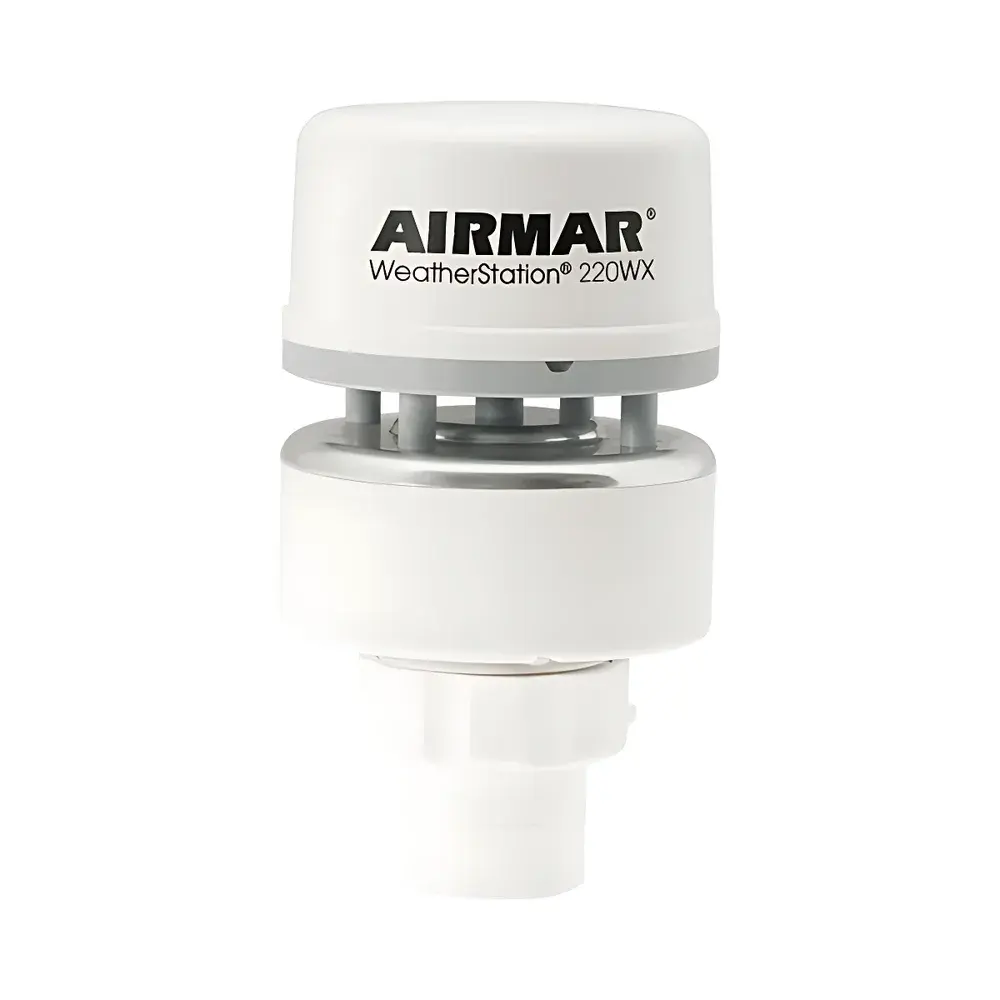
Airmar 220WX Ultrasonic Weather Station
| Brand | Airmar |
|---|---|
| Origin | USA |
| Model | 220WX |
| Instrument Type | Portable Weather Station |
| Output Interfaces | RS232 / RS422 / CAN Bus |
| Communication Protocols | NMEA 0183 & NMEA 2000 |
| IP Rating | IPX6 |
| Power Supply | 9–40 VDC |
| Integrated Sensors | Ultrasonic Wind (Speed & Direction), Solid-State Compass, 10 Hz GPS, 3-Axis Accelerometer, 3-Axis Gyroscope, Barometric Pressure, Relative Humidity (Field-Replaceable), Air Temperature, Wind Chill |
| Optional | Heater Module |
| Mounting | 1"-14 UNS or ½" NPT |
Overview
The Airmar 220WX Ultrasonic Weather Station is a discontinued but historically significant marine and mobile environmental sensing platform engineered for high-fidelity, real-time meteorological data acquisition in dynamic environments. Unlike traditional cup-and-vane anemometers, the 220WX employs time-of-flight ultrasonic wind measurement—based on precise acoustic transit time differentials across orthogonal transducer pairs—to deliver wind speed and direction with no moving parts, eliminating mechanical wear and inertia-related lag. Its integrated 10 Hz GPS receiver, solid-state compass, and triaxial inertial measurement unit (IMU) enable simultaneous computation of both apparent (relative) and true wind vectors—a critical capability for vessel navigation, autonomous maritime platforms, and buoy-based oceanographic monitoring. Designed for deployment on vessels, land vehicles, and offshore buoys, the unit operates reliably under harsh conditions, meeting IPX6-rated protection against powerful water jets and sustaining stable performance across wide ambient temperature and humidity ranges.
Key Features
- Ultrasonic wind sensing with zero-maintenance operation and immunity to icing or bearing degradation
- Simultaneous output of apparent wind (vessel-relative) and true wind (Earth-referenced) using integrated GPS velocity, heading, and pitch/roll compensation
- 10 Hz high-update-rate GPS module supporting accurate motion vector resolution for dynamic platform correction
- Field-replaceable humidity sensor—designed for long-term calibration stability and simplified maintenance without factory return
- Triple-sensor fusion architecture: 3-axis accelerometer + 3-axis gyroscope + solid-state compass enables robust attitude estimation and motion compensation
- Wide-input DC power range (9–40 VDC) compatible with marine battery systems and solar-charged auxiliary power supplies
- Dual NMEA protocol support: NMEA 0183 (ASCII) and NMEA 2000 (CAN-based) for seamless integration into legacy and modern marine electronics networks
- Multiple digital interface options: RS232 (point-to-point), RS422 (differential, noise-immune, multi-drop capable), and CAN Bus (for NMEA 2000 or custom control layer integration)
- IPX6-rated enclosure suitable for permanent mounting on wave-exposed buoys and deck-mounted marine applications
- 50% reduction in standby power consumption versus predecessor models—optimized for extended unattended operation on battery- or energy-harvesting systems
Sample Compatibility & Compliance
The 220WX was designed and tested per IEC 60945 (Maritime Navigation and Radiocommunication Equipment), EN 60945:2015, and relevant sections of MIL-STD-810G for shock, vibration, and salt fog exposure. Its pressure, temperature, and humidity sensors were calibrated traceably to NIST standards, with documentation provided via included calibration certificate. While not certified for regulatory compliance under ISO/IEC 17025 laboratory accreditation, its measurement methodology aligns with WMO Guide to Instruments and Methods of Observation (CIMO Guide, Chapter 12) for ultrasonic wind sensors. The device supports GLP/GMP-aligned data integrity practices when used with WeatherCaster software’s timestamped, non-editable binary logging mode.
Software & Data Management
WeatherCaster—a Windows-based configuration and visualization utility—provides real-time telemetry display, sensor diagnostics, firmware updates, and customizable NMEA sentence filtering. It logs raw sensor outputs (including uncorrected ultrasonic transit times, IMU quaternions, and GPS RMC/GGA frames) in UTC-synchronized CSV or binary formats, enabling post-processing for research-grade wind vector analysis. The software enforces write-once data handling and supports user-defined metadata tagging (e.g., platform ID, deployment location, operator). Though not FDA 21 CFR Part 11 compliant out-of-the-box, audit trail functionality—including user login timestamps, parameter change history, and export logs—can be enabled for internal QA/QC workflows.
Applications
- Marine navigation and autopilot input for commercial and recreational vessels
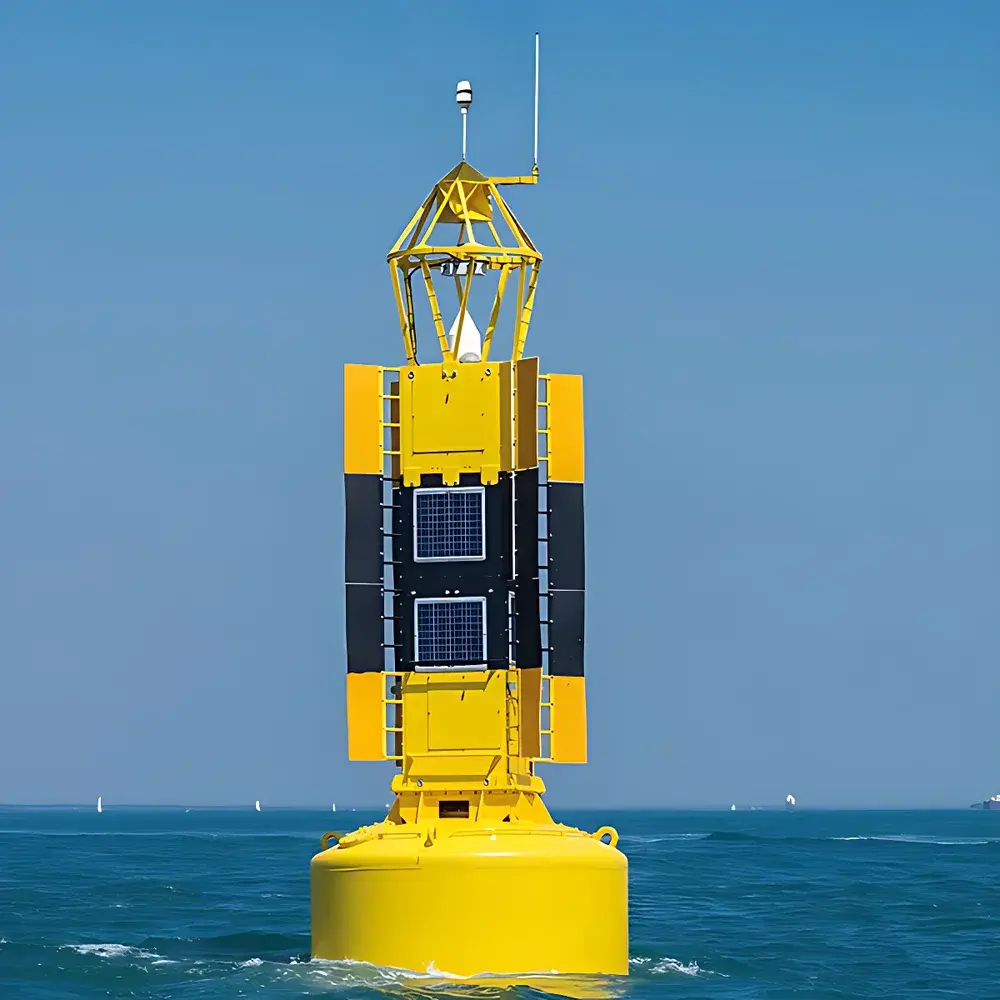
- Oceanographic buoy networks requiring true-wind-derived heat flux and momentum transfer estimates
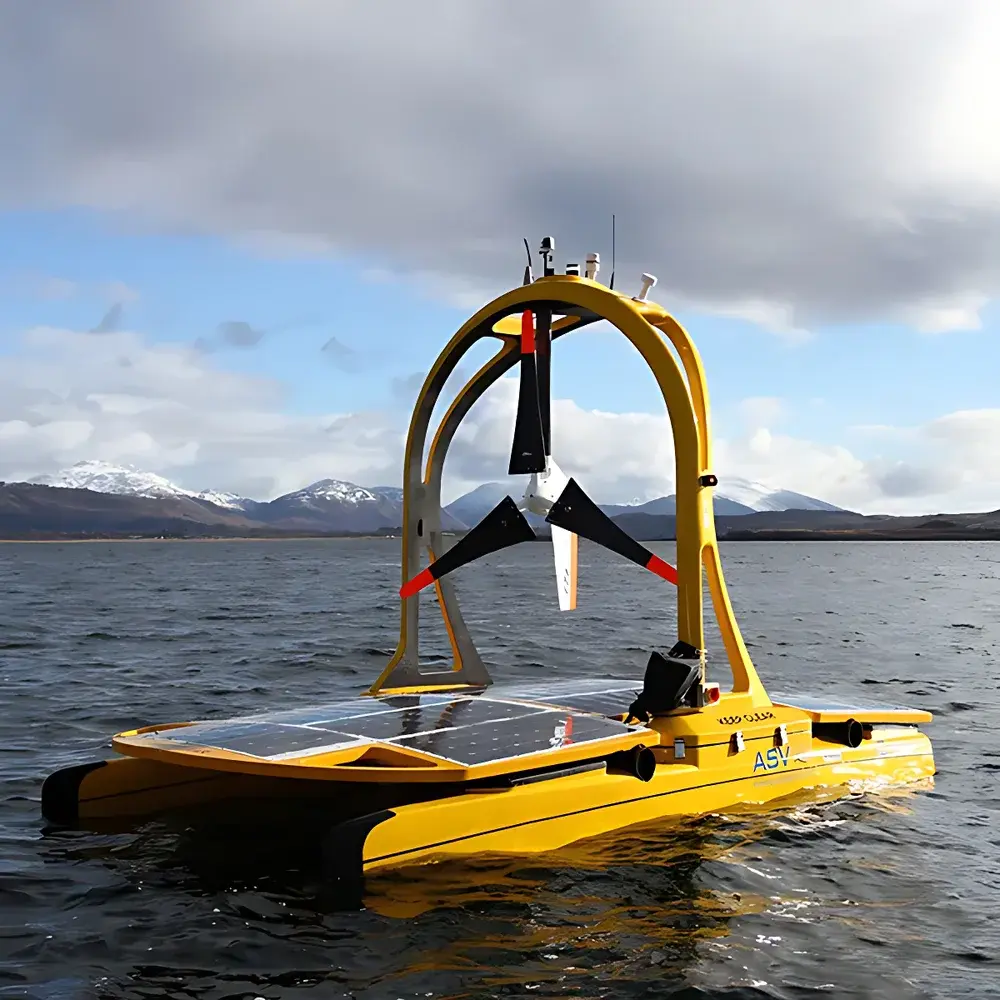
- Autonomous surface vehicle (ASV) environmental awareness and path planning
- Coastal atmospheric boundary layer studies where platform motion must be decoupled from ambient wind fields
- Mobile air quality monitoring platforms integrating meteorological context for dispersion modeling
- Defense and security applications involving tactical weather situational awareness on moving assets
FAQ
Is the 220WX still in production?
No—the 220WX has been officially discontinued by Airmar. The 200WX is its designated successor model, offering comparable functionality with updated firmware architecture and enhanced low-power operation.
Can the 220WX operate without GPS signal?
Yes—it continues measuring apparent wind, temperature, humidity, pressure, and attitude independently; however, true wind calculation requires valid GPS-derived ground speed and course-over-ground data.
What is the purpose of the field-replaceable humidity sensor?
It allows users to maintain long-term measurement accuracy without returning the entire unit for recalibration; replacement can be performed onsite using standard tools and a validated sensor cartridge.
Does the unit support time-synchronized data logging across multiple sensors?
Yes—internal hardware timestamping at 10 Hz ensures sub-millisecond alignment between wind, IMU, GPS, and environmental channels when logged via WeatherCaster or third-party NMEA parsers.
Is the heater option certified for ice mitigation?
The optional heater module is rated for continuous operation up to −20 °C and reduces frost accumulation on transducer faces; it is not certified to IEC 60079 for hazardous locations.







