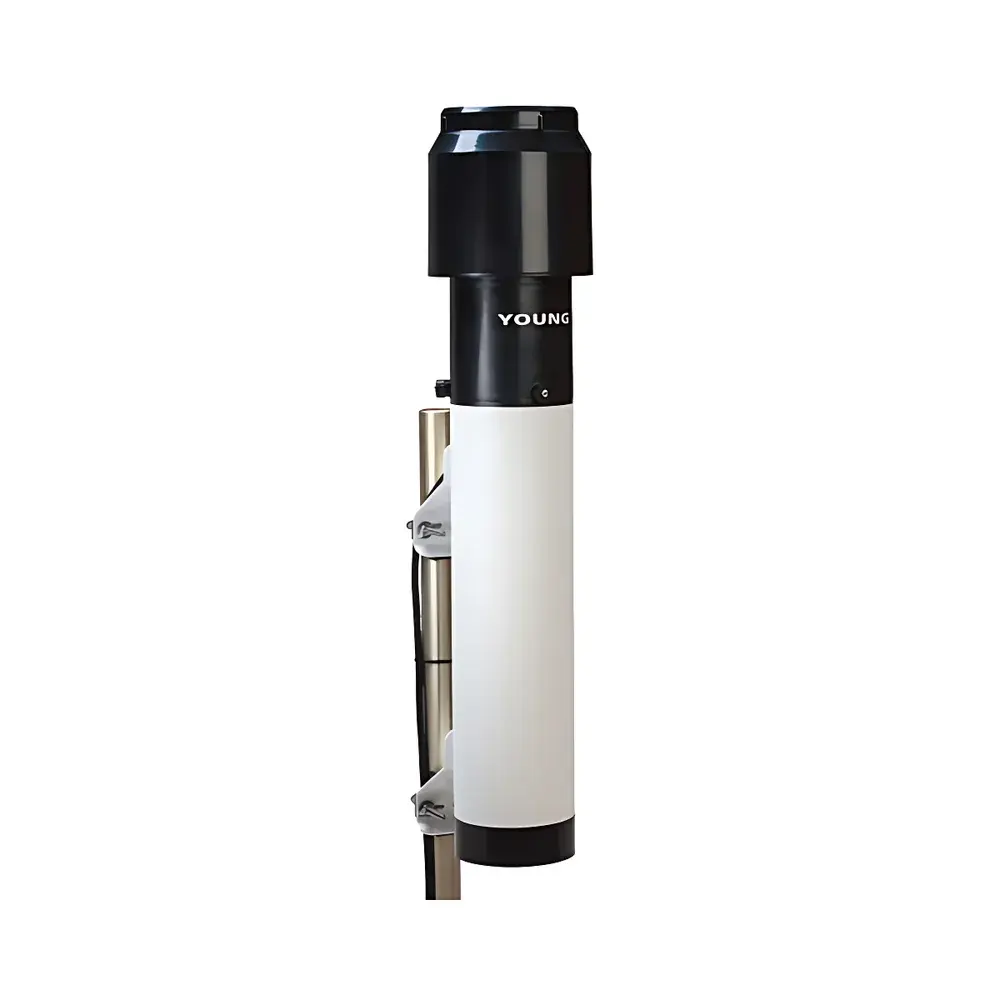
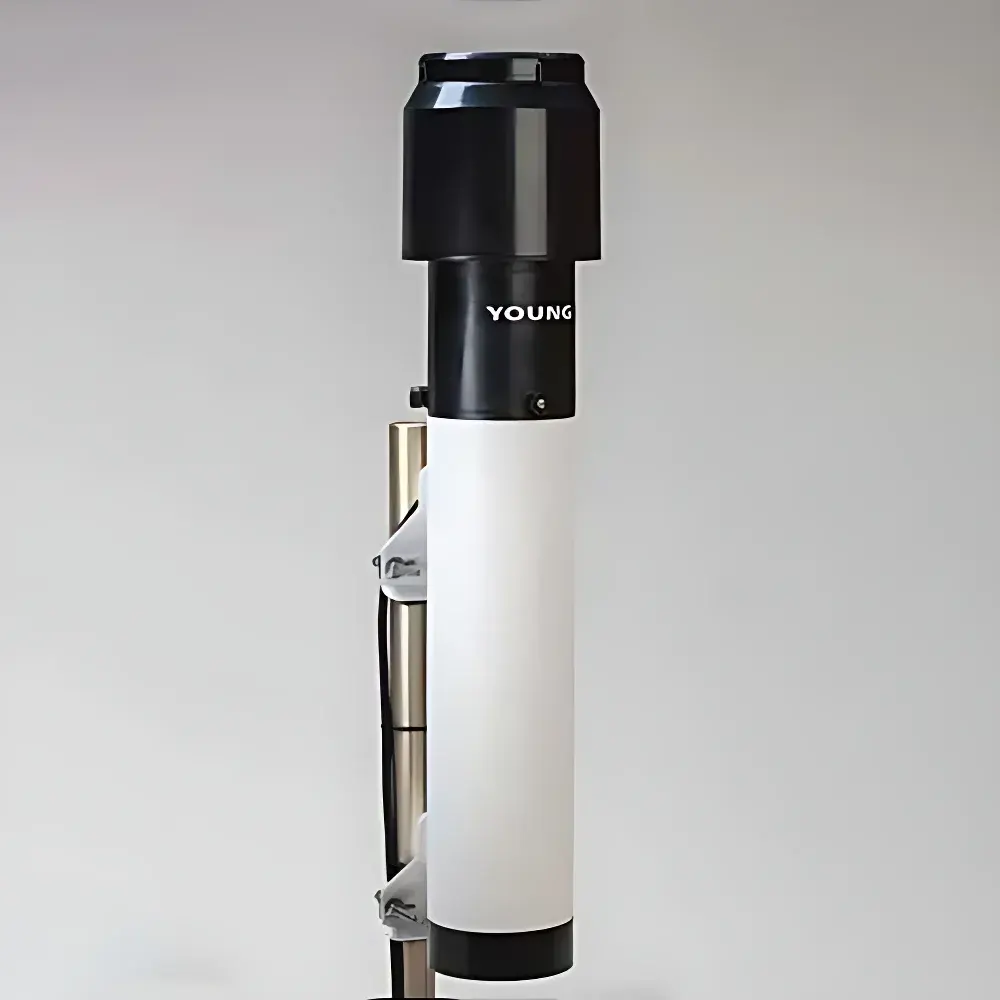
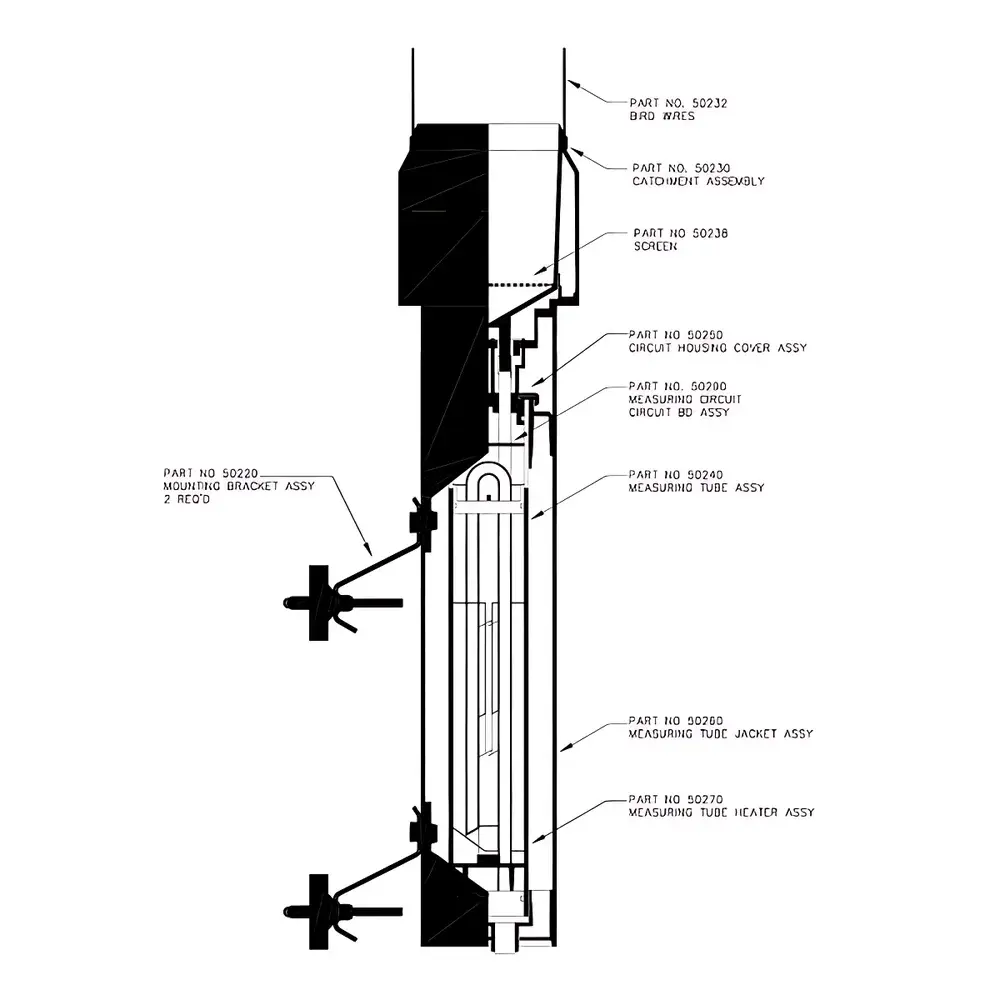
R.M. Young 50202 Siphon Rain Gauge
| Brand | R.M. Young |
|---|---|
| Origin | USA |
| Model | 50202 |
| Threshold | 1 mm |
| Accuracy | ±1 mm |
| Output Signal | 0–5.00 VDC (linear, 0–50 mm rainfall) |
| Siphon Cycle Time | ~30 s |
| Power Supply | 8–30 VDC (sensor), 48 W @ 28 VAC (heater) |
| Operating Temperature | −20 to +50 °C (with heater enabled) |
| Dimensions (w/o mounting housing) | 14 cm dia × 65 cm H |
| Collection Area | 100 cm² |
| Collector Diameter | 113 mm |
| Weight (instrument) | 2.5 kg |
| Mounting | U-bracket for mast diameter 25–50 mm |
| Features | Capacitive level sensing, thermostatically controlled heater, frost-resistant insulated housing, no moving mechanical parts |
Overview
The R.M. Young 50202 Siphon Rain Gauge is a precision meteorological instrument engineered for long-term, unattended measurement of liquid and solid precipitation—including rain, snowmelt, and mixed-phase events—in demanding environmental conditions. Unlike tipping-bucket or weighing gauges, the 50202 employs a siphon-based hydrostatic amplification principle: collected precipitation flows into a calibrated measuring column where a 1:5 mechanical amplification ratio converts 1 mm of accumulated rainfall into a 5 mm vertical displacement of the water column. This amplified displacement is detected by a centrally mounted capacitive sensor—immune to vibration, tilt, and platform motion—ensuring stable operation on buoys, offshore platforms, and mobile research vessels. The absence of rotating shafts, gears, or magnetic reed switches eliminates wear-related drift and maintenance cycles, contributing to multi-year calibration stability under field conditions.
Key Features
- Capacitive level detection system with central probe geometry—minimizes sensitivity to lateral acceleration, wind-induced oscillation, and installation tilt.
- Integrated thermostatically controlled heating element (48 W @ 28 VAC) enables continuous operation down to −20 °C; prevents freezing in the siphon tube and collector funnel during sub-zero precipitation events.
- Corrosion-resistant thermoplastic housing with thermal insulation—designed for coastal, marine, and industrial environments where salt fog or chemical exposure is present.
- Siphon mechanism resets automatically at 250 mm column height (equivalent to 50 mm accumulated precipitation), with full drainage completed in approximately 30 seconds—verified per ASTM D2471-22 Annex A1 for siphon repeatability.
- Linear analog output (0–5.00 VDC) directly proportional to accumulated precipitation depth (0–50 mm), compatible with standard data loggers supporting 12-bit or higher resolution ADC inputs.
- Modular mounting via stainless-steel U-bracket accommodates masts of 25–50 mm diameter; integrated leveling feet ensure consistent orientation independent of mast alignment.
Sample Compatibility & Compliance
The 50202 is validated for measurement of natural precipitation across phase states—liquid rain, wet snow, and refrozen meltwater—provided snow is fully melted prior to entry into the measuring column. Its 100 cm² orifice area complies with WMO Guide to Instruments and Methods of Observation (CIMO Guide, Chapter 6) recommendations for standard rain gauge siting and exposure. The instrument meets IEC 60529 IP65 ingress protection requirements for outdoor electronics enclosures. When deployed in regulated environmental monitoring networks (e.g., EPA SLAMS, NOAA COOP, EEA Eionet), its analog output and passive siphon architecture support audit-ready traceability under ISO/IEC 17025:2017 clause 7.7 (sampling and measurement uncertainty). Heater control logic includes overtemperature cutoff and thermal hysteresis management to prevent ice bridging while maintaining power efficiency.
Software & Data Management
The 50202 operates as a self-contained transducer requiring no embedded firmware or onboard processing. Raw voltage output is digitized externally using calibrated data acquisition systems such as Campbell Scientific CR6, Onset HOBO RX3000, or Delta-T DL2e loggers. Signal conditioning best practices—shielded twisted-pair cabling, remote ground referencing, and low-pass filtering at ≤1 Hz—are recommended to preserve resolution and suppress EMI in high-noise coastal or industrial settings. When integrated into GLP-compliant environmental monitoring workflows, the linear transfer function (V = 0.1 × mm) permits direct unit conversion without interpolation. Optional third-party software packages—including LoggerNet (Campbell), HOBOware Pro (Onset), and custom Python-based ingestion pipelines—support automated QA/QC flagging for siphon reset anomalies, heater status logging, and diurnal thermal drift correction using auxiliary temperature sensor inputs.
Applications
- Long-term climate monitoring stations where low-maintenance, high-reliability precipitation records are required over multi-decade intervals.
- Offshore meteorological buoys and autonomous surface vehicles (ASVs) where motion tolerance and corrosion resistance are critical design constraints.
- Hydrological modeling inputs for watershed-scale runoff forecasting, particularly in cold-region catchments subject to snowmelt-dominated regimes.
- Regulatory air quality and deposition networks measuring wet scavenging of particulates and soluble gases (e.g., SO₂, NOₓ, NH₃).
- Calibration reference for optical disdrometers and radar quantitative precipitation estimation (QPE) algorithms in validation campaigns.
FAQ
Does the 50202 require periodic recalibration?
No scheduled recalibration is mandated under normal operating conditions; however, annual verification against a NIST-traceable graduated cylinder (per ISO 9060:2018 Annex B) is recommended for regulatory deployments.
Can the 50202 measure snowfall directly?
It measures liquid-equivalent precipitation only. Snow must be captured and allowed to melt within the collector before entering the siphon chamber; optional heated funnels (e.g., Young 50202H variant) accelerate melt kinetics in sub-zero ambient conditions.
What is the maximum measurable rainfall intensity?
The siphon cycle time (~30 s) imposes an upper limit of ~100 mm/h; intensities exceeding this threshold may cause overflow and undercatch—consistent with WMO-defined “intensity error” for siphon gauges.
Is the analog output compatible with SCADA systems?
Yes—0–5 VDC output meets standard industrial voltage input specifications; isolation amplifiers are advised when interfacing with PLCs in electrically noisy substations or pumping stations.
How does the capacitive sensor maintain accuracy during rapid temperature fluctuations?
The sensor’s differential capacitance architecture and thermally compensated oscillator circuit reduce thermal coefficient error to <±0.02 %/°C over the full operating range, as verified per IEC 61290-1-3.