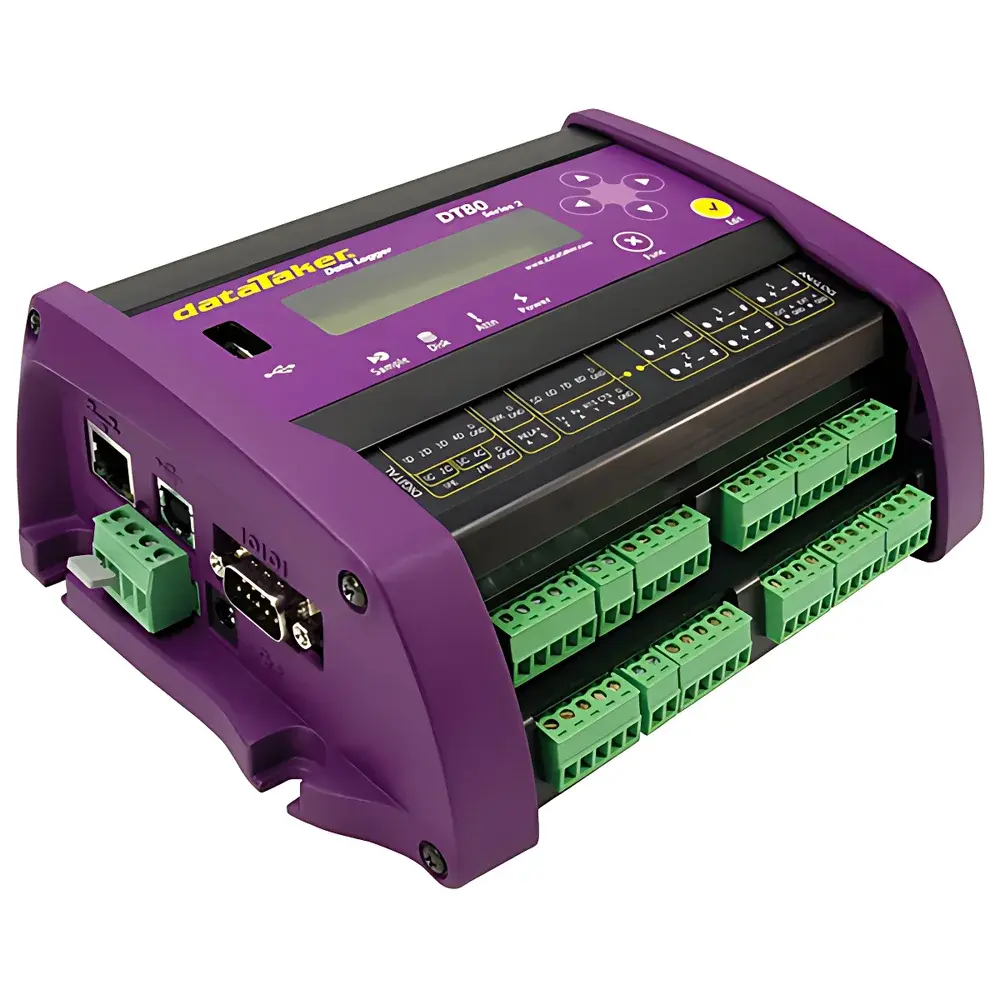
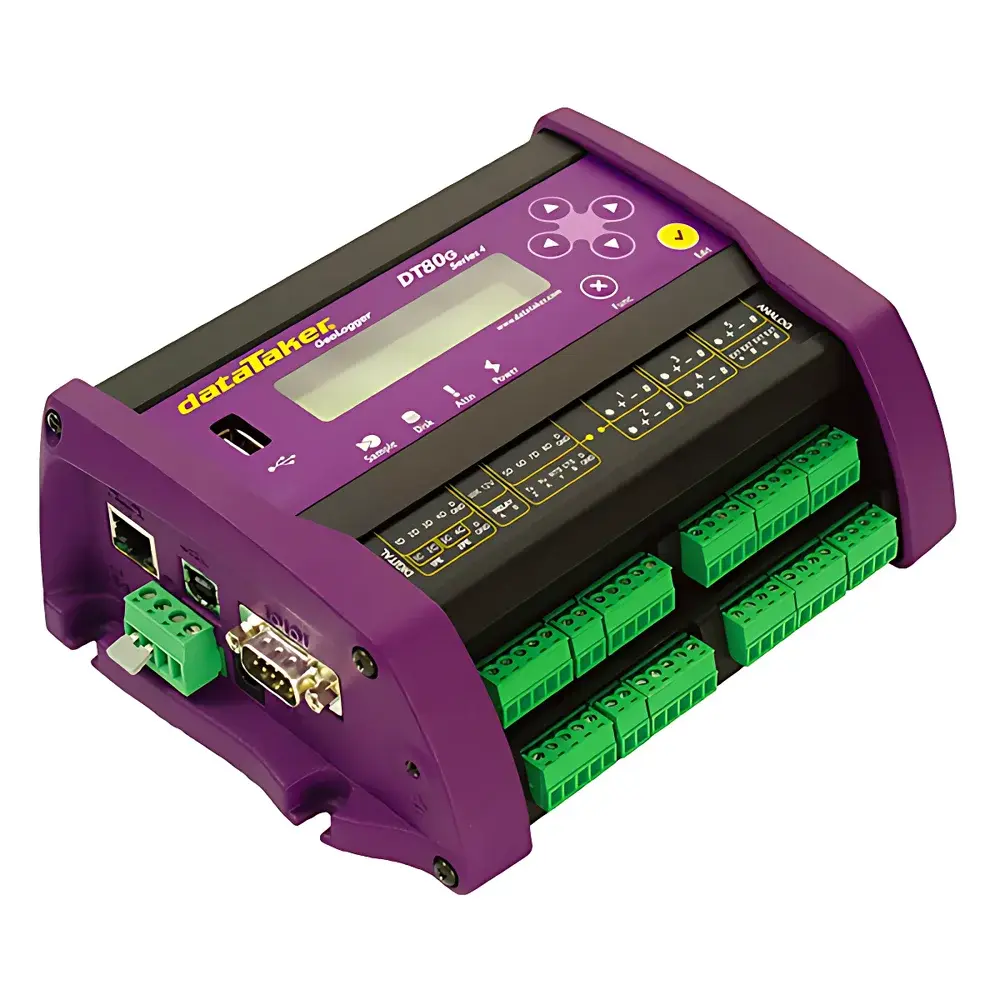
DataTaker DT80 Intelligent Data Acquisition Unit
| Brand | DataTaker |
|---|---|
| Origin | Imported |
| Model | DT80 |
| Analog Inputs | 15 single-ended / 10 differential / 5 three- or four-wire |
| Resolution | 8-bit |
| Max Sampling Rate | 40 Hz |
| Excitation Outputs | 5 V / 12 V selectable, up to 150 mA |
| Digital I/O & Counter | 32-bit, up to 100 kHz |
| Communication Ports | RJ45 Ethernet, USB, RS232 (host), RS232/RS485/RS422 (configurable) |
| Protocols | MODBUS RTU (master/slave), MODBUS TCP/IP, SDI-12, ASCII |
| Network Support | HTTP, FTP, SMTP |
| Power Supply | 10–30 VDC |
| RTC Accuracy | ±1 min/year (0–40 °C), ±4 min/year (−40–70 °C) |
| Operating Temperature | −40 to +70 °C, 85% RH non-condensing |
| Enclosure Rating | IP54 |
| Dimensions | 180 × 137 × 65 mm |
| Weight | 1.5 kg |
| Internal Storage | 128 MB CompactFlash (upgradable to 4 GB), optional 8 GB USB storage |
| Internal Battery | 6 V @ 1.2 Ah |
Overview
The DataTaker DT80 Intelligent Data Acquisition Unit is a field-deployable, industrial-grade data logger engineered for long-term, unattended monitoring in demanding environmental and infrastructure applications. Based on a deterministic real-time architecture, the DT80 acquires synchronized measurements from heterogeneous sensor types—including thermocouples, RTDs, strain gauges, 4–20 mA loops, voltage/current transducers, frequency sources, digital pulses, and serial-output sensors—using configurable analog input isolation, programmable excitation, and high-fidelity signal conditioning. Its modular design supports scalable channel expansion via CEM20 channel extension modules, enabling up to 300 single-ended inputs in a single system. The unit operates autonomously with onboard timekeeping (±1 min/year accuracy over 0–40 °C), non-volatile storage, and configurable power management—making it suitable for battery- or solar-powered remote deployments where connectivity may be intermittent or constrained.
Key Features
- Universal Sensor Integration: Supports voltage (±200 mV to ±50 V), current (0–20 mA, 4–20 mA), resistance (2-wire to 4-wire), thermocouple (J, K, T, E, R, S, B, N), RTD (Pt100, Pt1000), thermistor, bridge, strain gauge, frequency (0.1 Hz–100 kHz), and serial sensors (SDI-12, ASCII protocols) — all configurable per channel with user-defined engineering units and statistical post-processing.
- Robust Industrial Architecture: Housed in an IP54-rated aluminum enclosure with operating temperature range of −40 °C to +70 °C, conformal-coated PCBs, and galvanically isolated analog inputs to mitigate ground loops and EMI in electrically noisy environments.
- Flexible I/O & Control Capabilities: Includes 16-bit programmable analog outputs (0–10 V / 0–20 mA), latching relay outputs (30 VDC / 1 A), high-speed 32-bit counters, quadrature encoder inputs, and programmable digital I/O for local feedback control, alarm triggering, and actuator interfacing.
- Multi-Protocol Connectivity: Native support for MODBUS RTU/TCP, SDI-12, and ASCII over RS232/RS485/RS422, plus Ethernet (RJ45), USB, and optional integrated wireless (Wi-Fi, 3G modem, or vibrating wire module) — enabling seamless integration into SCADA, cloud telemetry, and legacy industrial networks.
- Autonomous Data Management: Onboard 128 MB CompactFlash memory (expandable to 4 GB), optional 8 GB USB storage, scheduled data logging, email/FTP auto-transmission (DT80M), and event-triggered transfers ensure data integrity and traceability without continuous supervision.
Sample Compatibility & Compliance
The DT80 accommodates sensors compliant with international measurement standards including IEC 60584 (thermocouples), IEC 60751 (RTDs), ASTM E230 (temperature sensor calibration), and ISO 10012 (measurement management systems). Its isolated analog inputs meet IEC 61000-4-5 surge immunity (2 kV line-to-earth) and IEC 61000-4-4 electrical fast transient (EFT) requirements. Firmware and dEX configuration software support audit-trail logging and user-access controls aligned with GLP and GMP principles. While not FDA 21 CFR Part 11 certified out-of-the-box, the DT80’s deterministic timestamping, immutable storage, and exportable CSV/Excel-compatible data formats facilitate validation in regulated environments when deployed with documented SOPs.
Software & Data Management
dEX software provides a Windows-based interface for intuitive setup, real-time visualization, and historical data retrieval. It enables channel-by-channel scaling, linearization, statistical aggregation (min/max/mean/std dev), alarm condition definition (with hysteresis and delay), and script-based automation (e.g., conditional logging, relay activation, or external device polling). All configuration changes are timestamped and stored in non-volatile memory. Raw data is logged in binary format for efficiency and exported as ASCII/CSV with metadata headers, supporting interoperability with MATLAB, Python (Pandas), LabVIEW, and commercial analytics platforms. Remote firmware updates and configuration synchronization are supported via HTTP/FTP.
Applications
- Environmental Monitoring: Long-term logging of groundwater level (pressure transducers), water quality (pH, conductivity, dissolved oxygen), meteorological parameters (wind speed/direction, solar irradiance, precipitation), and air pollutant concentrations (NO₂, PM₂.₅) across distributed sensor networks.
- Geotechnical & Structural Health Monitoring: Strain, tilt, settlement, pore pressure, and crack-width measurement in dams, tunnels, bridges, retaining walls, and landslide-prone slopes—particularly when extended with the DT80G vibrating wire interface for geotechnical piezometers and extensometers.
- Industrial Process Validation: Thermal profiling during sterilization cycles (ISO 13485), HVAC performance verification, material curing (concrete, composites), and equipment vibration analysis using synchronized analog and frequency inputs.
- Energy Infrastructure: Substation temperature monitoring, solar farm IV curve tracing, wind turbine nacelle vibration logging, and battery bank state-of-charge trending in off-grid microgrids.
FAQ
What is the maximum number of analog input channels supported by the DT80 base unit?
The DT80 supports up to 15 single-ended, 10 differential, or 5 three-/four-wire analog inputs natively. With up to five CEM20 expansion modules (each adding 20 universal channels), total capacity reaches 300 single-ended, 200 differential, or 100 three-/four-wire inputs.
Does the DT80 support Modbus TCP communication for integration with SCADA systems?
Yes—the DT80 includes native MODBUS TCP/IP server functionality over its Ethernet port, allowing direct register mapping and real-time polling by supervisory systems without protocol conversion hardware.
Can the DT80 operate independently without external power for extended periods?
Yes—it accepts 10–30 VDC input and includes an internal 6 V / 1.2 Ah rechargeable battery for backup operation. With low-duty-cycle logging and sleep-mode optimization, typical field deployments achieve months of autonomy on battery alone.
Is dEX software compatible with modern Windows OS versions?
dEX v4.1 and later fully support Windows 10 and Windows 11 (64-bit), including secure boot and UAC-compliant installation. Legacy XP/Vista support is discontinued.
How is data security handled in Wi-Fi or 3G-connected variants (DT80W/DT80M)?
DT80W supports WPA2-PSK encryption and operates in client or access-point mode; DT80M uses standard GSM/UMTS authentication via SIM card. Neither stores credentials in plaintext—authentication tokens are held in protected memory and never exposed in logs or configuration exports.