
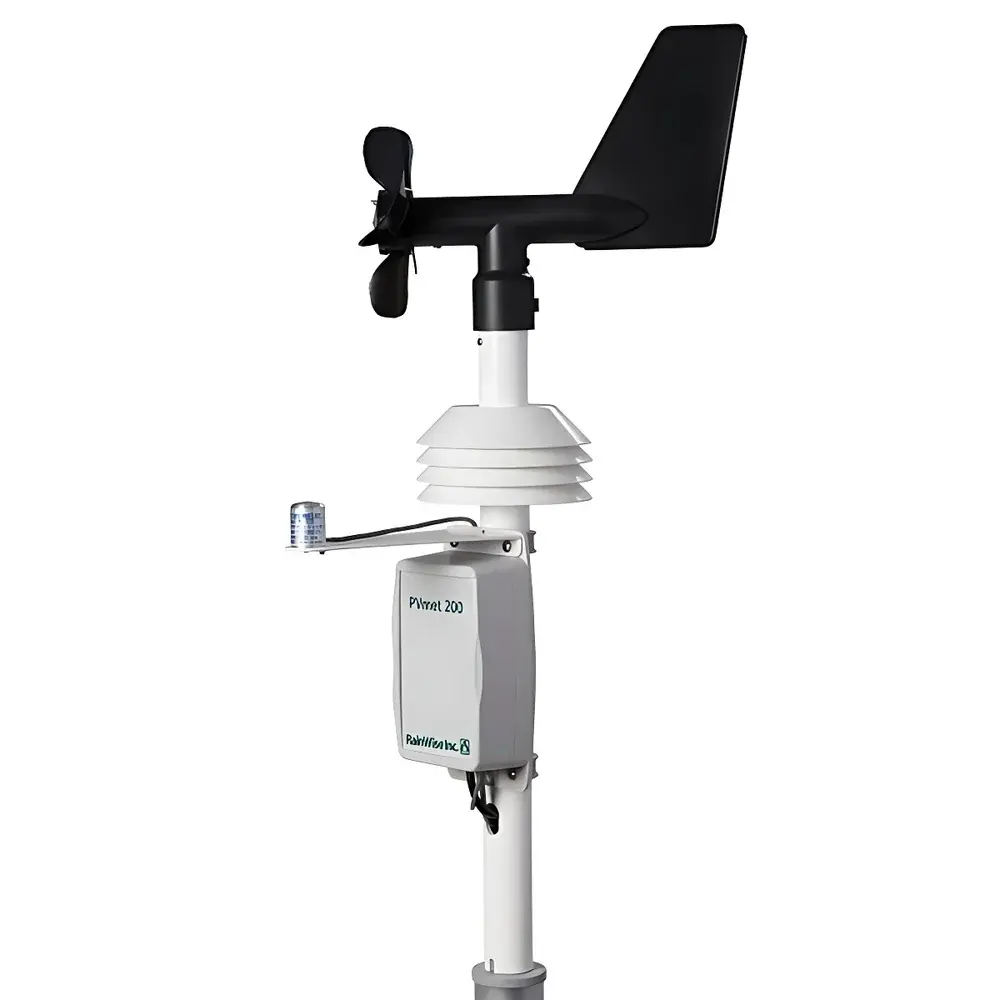
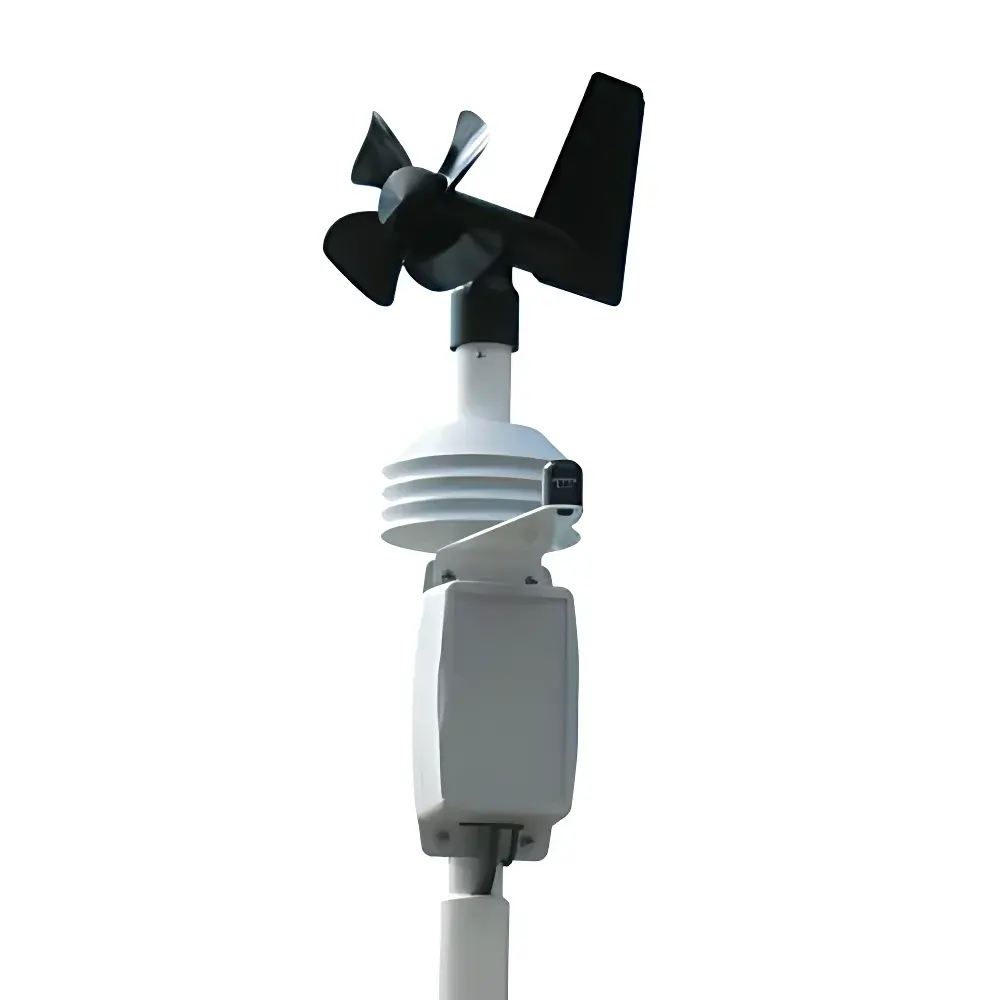
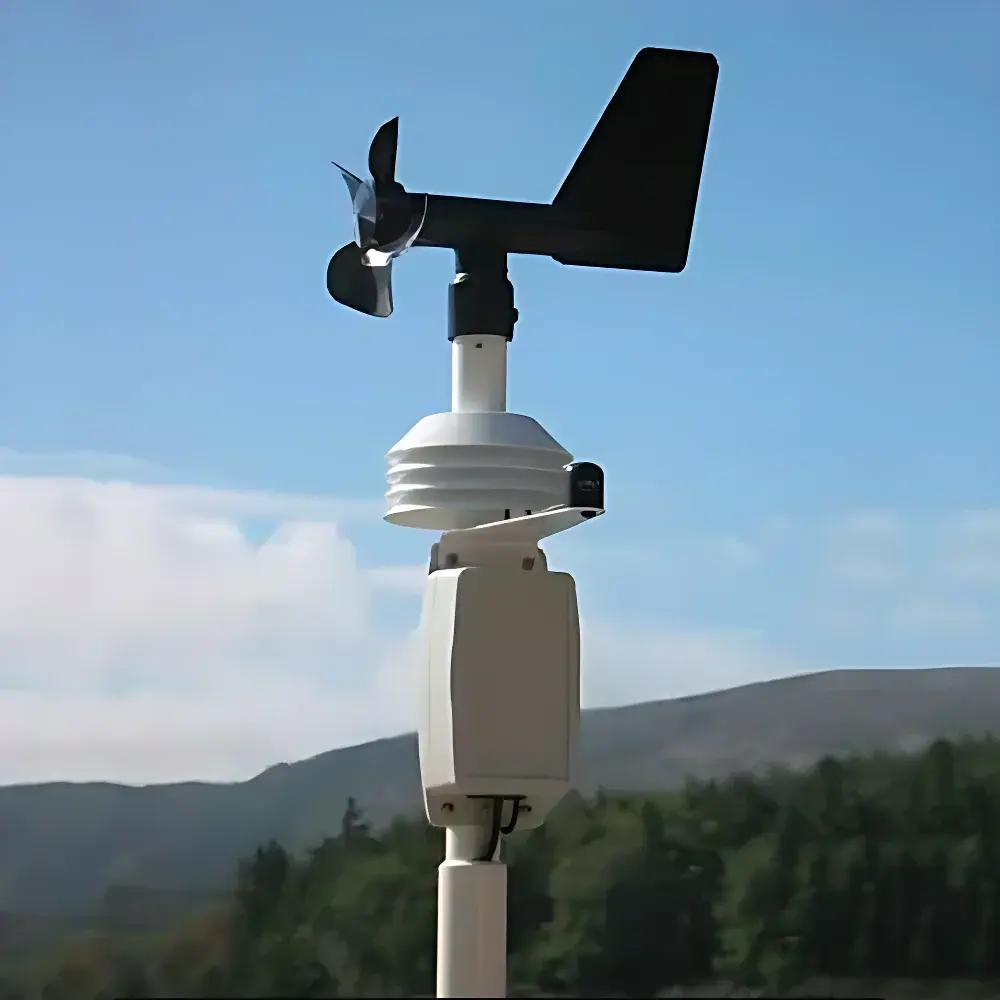
RainWise PVmet 200 Photovoltaic Weather Station
| Brand | RainWise |
|---|---|
| Origin | USA |
| Model | PVmet 200 |
| Communication Interface | RS-485 Modbus RTU (standard), optional Modbus TCP via Ethernet |
| Certified | SunSpec Compliant |
| Solar Irradiance Range | 0–1750 W/m², Accuracy: ±5% |
| Air Temperature Range | −40 to +80 °C, Accuracy: ±0.3 °C |
| Backsheet Temperature Range | −40 to +80 °C, Accuracy: ±0.3 °C |
| Wind Speed Range | 0–67 m/s, Accuracy: ±0.45 m/s or ±5% |
| Wind Direction Range | 0–360°, Accuracy: ±11.25° |
| Operating Temperature | −40 to +60 °C |
| Power Supply | 10–30 VDC, 50 mA |
| Enclosure Materials | PVC, ABS, Anodized Aluminum, Stainless Steel, LEXAN®, Makrolon® 2658 |
| Cable Length | 7.62 m |
Overview
The RainWise PVmet 200 Photovoltaic Weather Station is a purpose-built environmental monitoring system engineered for performance validation, energy yield modeling, and operational efficiency analysis in utility-scale and commercial photovoltaic (PV) power plants. Unlike general-purpose meteorological stations, the PVmet 200 integrates sensor configurations aligned with IEC 61724-1:2021 (Photovoltaic system performance monitoring — Guidelines for measurement, data exchange and analysis) and ASTM E2848-22 (Standard Test Method for Reporting Photovoltaic Non-Concentrator System Performance). Its architecture centers on synchronized, time-stamped measurements of plane-of-array (POA) irradiance, module backsheet temperature, ambient conditions, and wind dynamics—parameters critical for calculating performance ratio (PR), temperature-corrected efficiency, and soiling loss indices. The station employs industrial-grade transducers calibrated traceably to NIST standards, with thermal mass and spectral response optimized for silicon-based PV technologies under real-world spectral and angular incidence conditions.
Key Features
- Integrated global horizontal irradiance (GHI) and plane-of-array (POA) irradiance sensors—both thermopile-based, ISO 9060:2018 Class C compliant, with cosine error <±1% at 45° and <±5% at 75° incidence
- Dual-channel backsheet temperature measurement capability (standard: one PT1000 sensor; expandable to two via field-configurable terminal block)
- High-stability air temperature sensor housed in a naturally ventilated, double-louvered radiation shield meeting WMO guidelines
- Ultrasonic wind speed and direction sensor with no moving parts, eliminating mechanical wear and enabling reliable operation across desert, coastal, and high-dust environments
- RS-485 Modbus RTU interface as standard (2-wire, half-duplex, 9600 baud, 120 Ω termination); optional integrated Ethernet module supporting Modbus TCP for SCADA-level integration
- SunSpec certified—ensuring interoperability with inverters, SCADA platforms, and cloud-based O&M software (e.g., SolarLog, PowerTrack, Aurora Forecast)
- RoHS-compliant construction using UV-stabilized LEXAN® polycarbonate, anodized aluminum mounting hardware, and stainless-steel fasteners for long-term corrosion resistance
Sample Compatibility & Compliance
The PVmet 200 is designed for deployment on fixed-tilt, single-axis, and dual-axis PV tracker arrays. Its compact footprint (6 × 20.3 × 20.3 cm) and low-mass mounting bracket minimize shading interference and structural loading. All sensors meet IP65 ingress protection rating and operate continuously within −40 °C to +60 °C ambient temperatures and 0–100% RH non-condensing humidity. Data acquisition firmware supports configurable sampling intervals (1–300 seconds) and on-device averaging (1–60 minute rolling means), ensuring alignment with IEC 61724-1 data logging requirements. The device complies with FCC Part 15 Subpart B (Class A), CE EMC Directive 2014/30/EU, and RoHS 2011/65/EU. Calibration certificates are provided per sensor type, including traceability statements to NIST or equivalent national metrology institutes.
Software & Data Management
Data output follows standardized Modbus register maps defined by SunSpec Model ID 160 (Irradiance), 161 (Temperature), and 162 (Wind), enabling plug-and-play integration with industry-standard SCADA systems (e.g., Ignition, Siemens Desigo, Schneider EcoStruxure). Optional RainWise CloudLink gateway provides secure TLS 1.2 encrypted transmission to MQTT- or REST-based cloud platforms. Local data buffering (up to 30 days at 1-minute resolution) ensures continuity during network outages. Firmware updates are performed remotely via Modbus or local USB-C interface, with full version control and rollback capability. Audit logs record all configuration changes, timestamped to UTC and signed with device-specific cryptographic keys—supporting GLP/GMP-aligned data integrity workflows where required.
Applications
- Performance ratio (PR) calculation and degradation trending per IEC 61724-1 Annex C
- Soiling rate quantification via normalized POA/GHI ratio analysis
- Backsheet temperature correlation with module voltage derating and hot-spot risk assessment
- Wind-induced cooling effect modeling for thermal loss correction in energy yield simulations
- Validation of satellite-derived irradiance datasets (e.g., NSRDB, Solargis) at plant level
- Input source for automated cleaning scheduling algorithms based on accumulated dust index
- Regulatory reporting for PPA compliance, especially where weather-adjusted availability metrics are contractually mandated
FAQ
Does the PVmet 200 support dual backsheet temperature inputs out of the box?
No—the standard configuration includes one PT1000 backsheet sensor. A second channel is supported electrically and firmware-enabled, but requires user-installed cabling and terminal block configuration prior to deployment.
Is NIST-traceable calibration included with shipment?
Yes—each sensor type (irradiance, air temperature, backsheet temperature, wind) ships with an individual calibration certificate referencing NIST-traceable standards and stating uncertainty budgets per ISO/IEC 17025 principles.
Can the station operate independently without a central data logger?
The PVmet 200 is a sensor hub only—it does not include onboard data logging memory or display. It requires connection to a compatible Modbus master (e.g., PLC, RTU, or edge gateway) for data acquisition and storage.
What is the recommended mounting height above the PV array plane?
Per IEC 61724-1, irradiance sensors should be mounted at least 1 m above the highest module surface and outside the shading envelope of adjacent rows; wind sensors require ≥2 m clearance and unobstructed 360° exposure.
How is firmware updated, and is version history retained?
Firmware updates are applied via Modbus register write commands or USB-C interface using RainWise’s authenticated update utility. Device firmware revision, build date, and SHA-256 hash are permanently stored in non-volatile memory and accessible via Modbus read.







